Why Finding Talent Feels Impossible

A Singapore SME had something many businesses take for granted: an accountant who managed the finances of the company. She knew which suppliers needed a reminder before the invoice was overdue. She knew why a particular expense looked unusual months ago and what it turned out to be. Then she decided to retire and the company had to start looking for her replacement.
This situation is not unusual. Across Singapore’s SME landscape, different versions of this story are playing out quietly, where a finance function built around one person’s institutional knowledge, suddenly exposed by a talent market that can no longer reliably replace them.
The accounting talent shortage isn’t simply about the number of qualified accountants available. It is about a growing mismatch between the work companies need done and the work the next generation wants to do. That makes the shortage structural. The answer isn’t to train more accountants and hire more people. It is about how we can rethink the role itself so it attracts and retains the kind of talent that is needed.
Fewer Candidates, Higher Expectations
Singapore’s accounting talent shortage has been building for years. Fewer graduates are choosing accounting. The ones who do tend to be absorbed by larger firms, with employers that have structured training programmes and higher salaries that SMEs cannot match. What remains for smaller businesses is a thinner, more expensive pool of candidates who are being asked to do more demanding work than the same role required a decade ago.
Here’s the other side of the problem. The role itself has changed and regulatory complexity has increased. The expectation that an accountant brings technology literacy, which means fluency with cloud platforms, automated workflows, and integrated systems, has risen sharply.
The repetitive, transactional work that once filled much of a junior accountant’s day such as data entry, invoice processing, bank reconciliations, is increasingly automatable. The candidates who are available know this. They are not interested in spending their careers doing work that software can handle. They want to do the higher-value work like interpreting financial information and supporting business decisions.
The problem is that most SMEs still need someone to do the transactional work and they are trying to hire one person to do both, at a salary that reflects neither. That is not a recruitment failure. It is a structural mismatch, which cannot be solved by posting the same job description again and again.
What the Function Is Being Asked to Do
Before thinking about who should fill the role, it is worth being clear about what the role actually contains. Not all accounting work is the same, and treating it as though it is has created some of these problems SMEs are trying to solve.
Firstly, there are routine and highly structured work which follows a predictable pattern: capturing invoices, categorising transactions, matching payments to purchase orders, attaching receipts. It is repetitive and often automatable. Then there are exception-based work involving anomalies and reconciliations. It requires pattern recognition and for someone to notice when something doesn’t look right. For example, a payment that doesn’t match an invoice or there is a duplicate transaction. This work is less about processing and more about investigation.
Lastly, there is work requiring professional judgement, interpretation and business context. Should the company hire another salesperson given its current cash runway? Can it afford to enter a new market this quarter? Should available cash be conserved or invested? This work requires a human being who understands the business, and can translate financial data into actionable insights.
Most SMEs hire and expect one person to do all three. The routine work arrives constantly while judgement-based work tends to feel less urgent until it suddenly isn’t, the person filling the role ends up spending most of their time on the first type of work at the expense of the third. So while the filings get made, the financial intelligence that could improve how the business is run, like knowing which product lines are generating cash and which are quietly draining it, which customers are worth keeping and which are costing more, doesn’t get produced. This is the opportunity cost of a finance function that is so busy processing the past that it has little capacity to help shape the future.
This is why the answer is not simply to find more accountants and founders should be reflecting on what does my accounting function actually need to produce? This question helps to shift the focus. Rather than thinking about who is doing the work, it’s looking at what the work requires. The businesses adapting early are not replacing their accountants with software. They are redirecting their accountants toward the work that actually requires them while letting technology absorb the rest. The lack of affordable transactional accounting talent can be a push toward a better version of the function.
What Technology Can Help With
The tools are increasingly available but what’s challenging is for an SME founder to put it all together. Cloud accounting platforms, expense management software, automated categorisation, bank feed integrations, all the various technology that can reduce the bulk of an accountant’s work is widely available, increasingly affordable, and more capable than it was years ago.
Done properly, the payoff can be significant. These tools can enable what is known as a continuous close. Instead of waiting for month-end to chase receipts, investigate transactions and reconstruct the books, transactions are captured and reconciled as they happen. Financial records stay current throughout the month. The close becomes a confirmation rather than reconstruction, a check that everything is in order, rather than a sprint to establish what happened.
For Singapore SMEs, that has implications beyond convenience. Accurate, current, well-maintained financial records make it significantly easier to meet Inland Revenue Authority of Singapore (IRAS) and Accounting and Corporate Regulatory Authority (ACRA) compliance obligations, and to respond quickly and confidently when questions are raised. A finance function running on a continuous close is inherently better aligned with those obligations than one reconstructing the month from memory every thirty days.
The more useful frame is to treat it less as a software implementation and more as a redesign of the finance function. The goal is not to add technology for its own sake. It’s to build a system where technology handles the work it’s reliably good at so that the people in the function can focus on the work that still requires judgement.
That distinction is becoming sharper as the technology itself evolves. The first wave of AI tools in accounting was assistive. Asking the tool to explain a discrepancy, to classify a transaction or to draft a reconciliation summary. Useful, but still dependent on a human initiating every step.
The more recent shift is toward autonomous AI agents. Rather than responding to prompts, an agent can execute an entire workflow independently. For example, in a reconciliation, an agent pulls transactions from multiple systems, matches them against invoices and bank records, investigates discrepancies using predefined logic, and surfaces only the exceptions that require human judgment. The human accountant’s role shifts from doing the work to setting the parameters, reviewing outputs, and handling cases the system flags up. This is a structural shift in what the finance function requires from the people inside it.
Redesigning the SME Finance Function
Most founders hear “continuous close” and assume it means a complex overhaul. Realisitcally, it means building in stages, starting with what matters most and adding from there.
Start by connecting the core accounting ledger to live bank feeds, eliminating manual entry and ensuring transactions flow in automatically. Add digital expense and invoice capture so costs are recorded when they occur. Once the data is flowing, automate the predictable work and route exceptions to a person for review. Over time, month-end stops being a reconstruction exercise and becomes a review of what has already been handled.
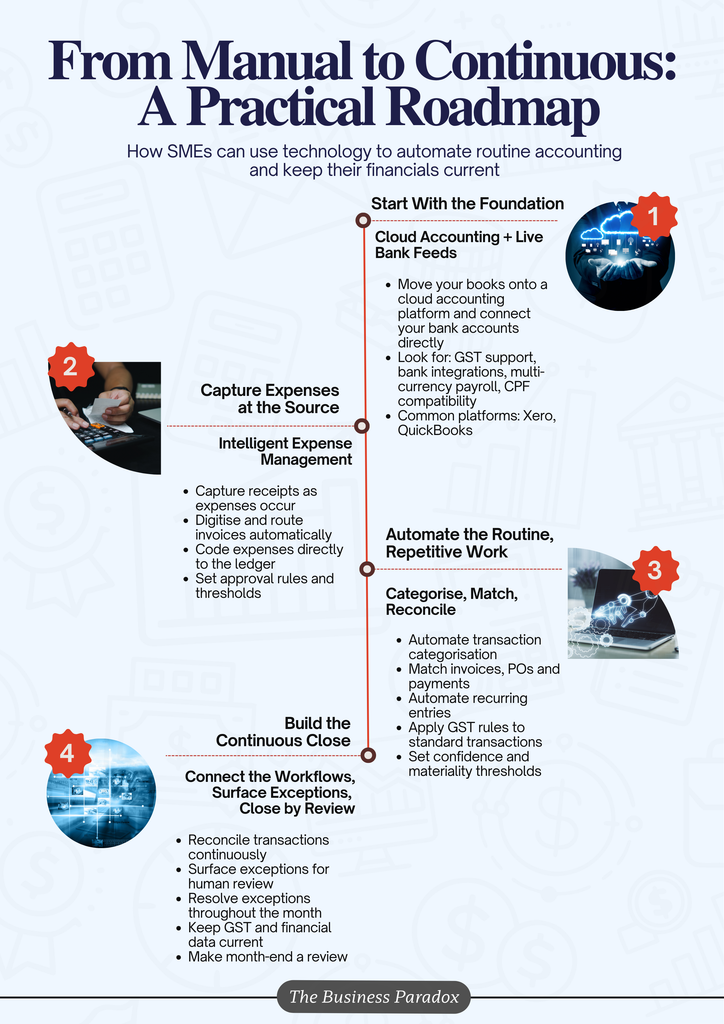
One important note is that the technology alone does not create a continuous close. Getting from a manual or partially manual system to a continuous close setup takes an upfront investment of time and usually some professional guidance to do properly. The tools work when they are configured around clear processes, defined ownership, and agreed review thresholds. A founder that skips this step tends to end up with several apps generating inconsistent data and nobody responsible for resolving the gaps.
What Most SME Founders Miss
The same data infrastructure that keeps a business compliant also produces the real-time financial intelligence that most founders currently make decisions without.
Modern cloud accounting systems can connect directly to real-time dashboards that bring together cash balances, receivables, payables, margins, expenses and cash runway. For a small business owner, this turns accounting from a compliance exercise into an operating tool. Instead of waiting until month-end to discover that costs have crept up or cash is tightening, the owner can see those signals as they emerge.
When the accounting function is running on a continuous close, that data exists and it’s current. The business owner who knows their cash position this morning makes different decisions than the one working from last month’s statements. The founder who can see in real time which product lines are generating cash and which are consuming it manages inventory, pricing, and marketing spend differently.
Traditional accounting tells you what happened but a connected finance function helps you understand what is happening now and what may happen next.
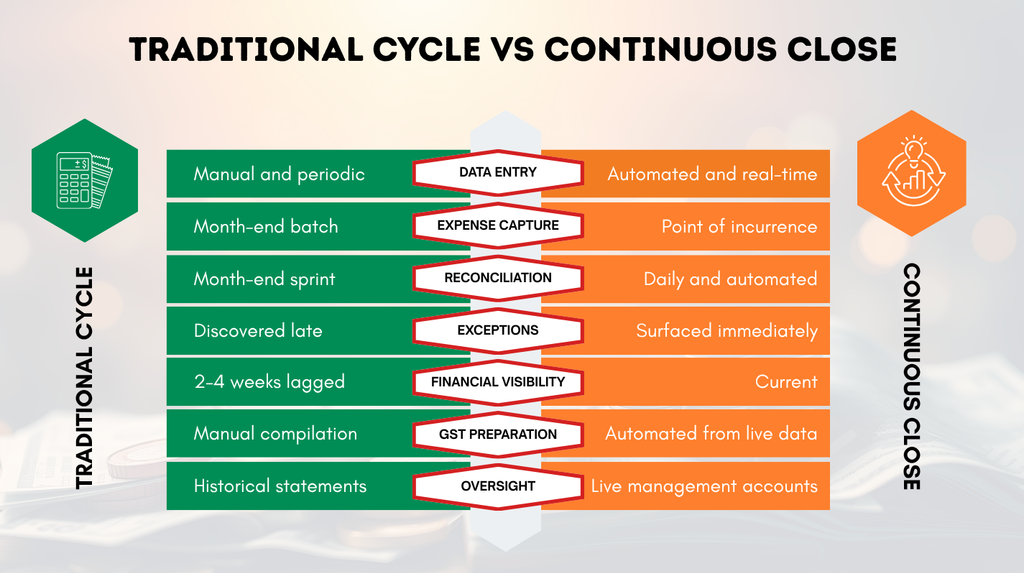
For an SME owner, the value is seeing the signals early enough to act. The role of finance changes fundamentally. For SMEs that cannot afford a full internal team, this is achievable with a reliable outsourced accounting partner and the right technology in place. An outsourced partner working from a continuous close setup adds significantly more value than one spending most of their engagement reconstructing what happened last month.
Furthermore, most SMEs think of accounting as an obligation where the output is designed for someone outside the business like a tax authority, auditor or investor. This framing misses the value of accounting. The same financial data can also tell the owner how the business is performing and what decisions need to be made next. A better reframe is to treat accounting as a source of business intelligence. External stakeholders simply receive a version of the information the business should already be using itself.
Conclusion: Future‑Proofing Finance
The accounting talent shortage is real and it is not going to be resolved by finding more people willing to do work that machines can increasingly handle. The more useful response is to ask what you need your finance function to be doing. What is the function producing today and what do you want it to be producing? Is the financial information being produced helping the business make better decisions or is it only being prepared for someone outside the business?
These questions shift the conversation from “How do we fill our accounting role?” to “How can we redesign our accounting function?” As routine work becomes increasingly automated, the value of the finance function will depend less on its ability to process transactions and more on how effectively technology, processes and human judgement work together.
A leaner finance function can keep the books current, automate routine work and give founders better information for the decisions that matter. The talent shortage may have forced a rethink of accounting. The opportunity we have now is to use that pressure to design a finance function that is leaner, smarter, and far more valuable to the business.
Stay ahead with exclusive insights! Sign up for our mailing list and never miss an article. Be the first to discover inspiring stories, valuable insights and expert tips – straight to your inbox!