The Compliance Ripple

When most SME founders hear the words “sustainability reporting” or “climate disclosure,” they tend to gloss over it and assume it doesn’t apply to them. After all, it sounds like problems for listed companies with Environmental, Social, and Governance (ESG) teams. Most SMEs are not required to provide such data, so why should a small business owner spend time and resources tracking emissions, energy use or other environmental data?
Sustainability reporting may be mandated for large corporations, but the underlying data does not sit exclusively with them. To account for emissions across their value chains, companies must gather information from suppliers, contractors, and business partners. That demand for information ripples outward, reaching SMEs that may have no formal reporting obligation of their own. This means SMEs are increasingly expected to provide reliable environmental information because larger companies cannot meet their own disclosure standards without it. The key misconception is assuming that “not required” means “not relevant.”
For SMEs, this means anticipating questions before they arrive because they will be asked for sustainability information before regulators start knocking.
Singapore Sustainability Disclosure Standards (Singapore SDS)
Sustainability is becoming central to how businesses are judged and how value is created. Singapore’s sustainability disclosure framework is built on the International Sustainability Standards Board (ISSB)’s International Financial Reporting Standards (IFRS) S1 and S2 standards, covering general sustainability-related financial disclosures and climate-related disclosures respectively. Singapore’s SFRS S1 and SFRS S2, mirror these international benchmarks with adjustments for Singapore’s context.
To better understand how sustainability reporting works, it helps to first understand how emissions are categorised:
- Scope 1 covers emissions a company produces directly from sources it owns or controls e.g., petrol burned in company-owned vehicles
- Scope 2 covers the emissions from energy the company purchases and uses e.g., purchased electricity used to power an office or factory
- Scope 3 covers everything else that occurs across the company’s value chain e.g., emissions associated with transporting purchased goods by third-party suppliers
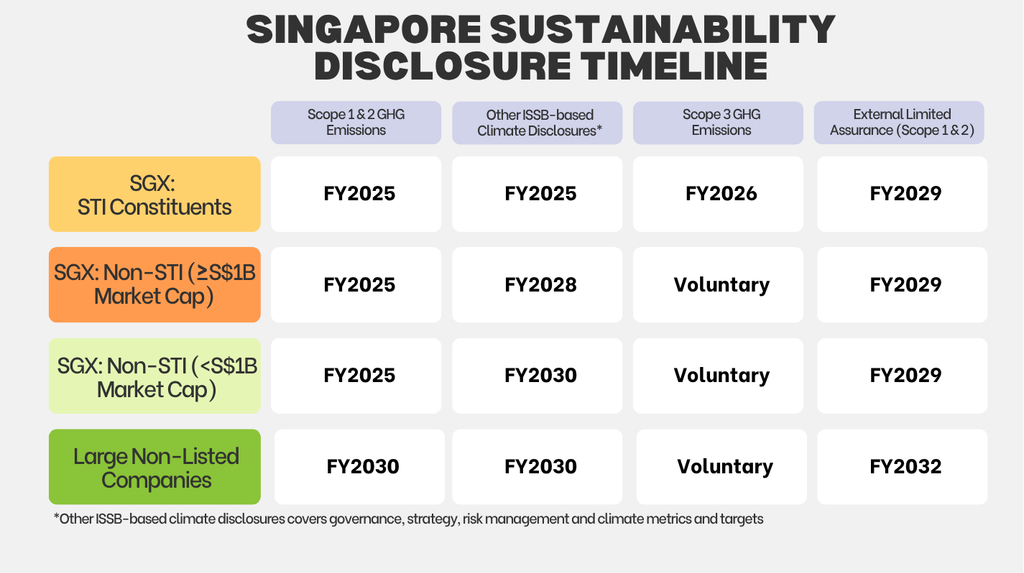
For most large companies, Scope 3 is the largest and most complex emissions category and one that sits most directly inside the operations of other businesses. The framework is being implemented in phases, and all listed companies on the Singapore Exchange have been required to report Scope 1 and Scope 2 greenhouse gas emissions from financial years commencing on or after 1 January 2025. Straits Times Index (STI) constituents are additionally required to report Scope 3 emissions from FY2026, and to provide ISSB-based climate-related disclosures from FY2025. For other non-STI listed companies, Scope 3 reporting remains voluntary. Though this may defer mandatory Scope 3 disclosures for many, it is crucial for companies to continue building Scope 3 capabilities.
Earlier on 27 July 2026, Accounting and Corporate Regulatory Authority (ACRA)’s Interim Sustainability Standards Committee (Interim SSC) released drafts of the Singapore Sustainability Disclosure Standards (Singapore SDS) and launched a public consultation that remain open until 25 October 2026. The draft standards are not yet law and ACRA is concurrently preparing the necessary legislation. Under the proposed structure, draft SFRS S2 will be a mandatory standard covering climate-related disclosures, while draft SFRS S1 will be issued as a voluntary standard.
The Singapore SDS is expected to apply to listed companies from financial years commencing on or after 1 January 2028, and to large non-listed companies from financial years commencing on or after 1 January 2030. The timelines were adjusted in August 2025 to give companies more time to build capabilities for climate reporting. The majority of Singapore SMEs fall outside of these thresholds and they are not currently subject to any mandatory sustainability disclosure requirement.
What is Green Accounting?
Sustainability reporting is the visible output, it is the report, disclosures and metrics a company publishes. Green accounting is part of what happens behind the scenes. It provides the information infrastructure that helps a business understand and account for its environmental impact alongside its financial performance. It expands on traditional financial accounting to measure and record ecological impacts alongside monetary transactions.
Just as financial accounting helps a business keep track of where its money comes from and where it goes, green accounting helps it understand where its resources come from and where they go. This includes the energy it consumes, materials it purchases, waste it generates and emissions associated with its operations. It connects these environmental realities to the financial decisions the business makes every day.
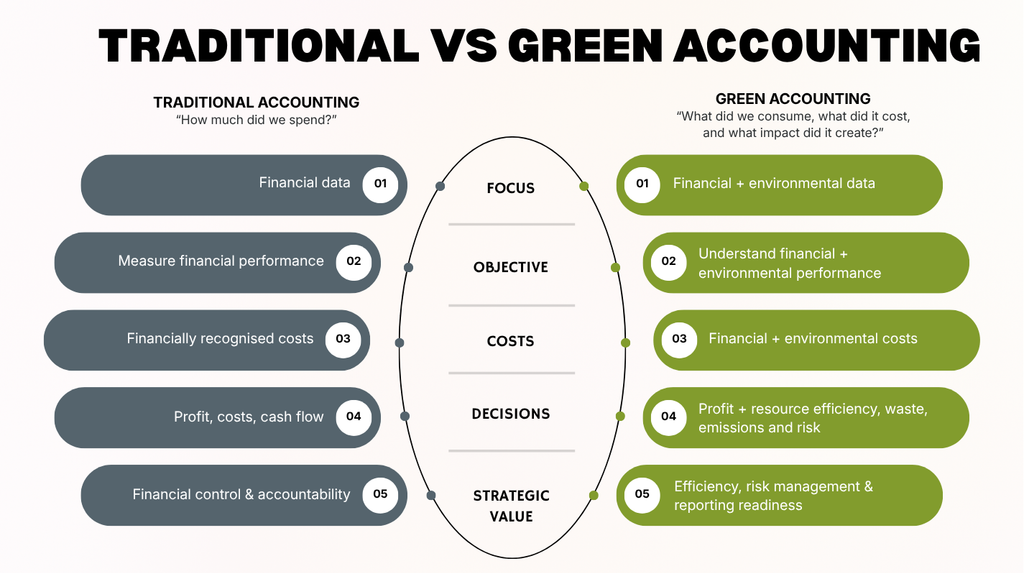
At its core, green accounting is about making environmental costs and impacts visible. Once they are measured and organised, they become easier to understand: Where are we using the most energy? Where are we wasting resources? What is costing us more than it should? Where could we operate more efficiently?
Green accounting does not begin with a published report. It begins with paying attention, to what the business consumes, what it wastes and what those patterns are telling you. Measurement makes those patterns visible, and that visibility gives decision-makers something they can act on.
Every Business is Part of the Disclosure Equation
For SMEs, sustainability reporting may not be a regulatory requirement today, but that doesn’t mean they can ignore it. Large companies with mandatory Scope 3 reporting obligations need supplier data to fulfil their own requirements. An SME may still receive questions from a larger customer about its energy use, materials, waste or emissions.
Manufacturing suppliers to listed industrial and consumer goods companies face the most immediate pressure. Logistics and freight companies are similarly exposed, as transportation emissions are among the most commonly reported Scope 3 categories. For a manufacturer, that could mean providing information about the materials and components it supplies. For a logistics provider, it could mean providing data related to transportation activities.
Suppliers who can provide organised, credible environmental data remove a compliance friction point. An SME that already has a consistent record of its electricity and fuel use, materials, waste and other relevant environmental information is in a very different position from one trying to reconstruct a year’s worth of data after a customer asks for it. While SMEs who primarily supply other SMEs are less immediately affected, supply chains are often interconnected, and the pressure that arrives at tier-one suppliers today typically flows to tier-two suppliers over time.
Preparing Before You’re Forced To
The strategic move for SMEs is to build a green ledger before they are asked to. When a major customer suddenly needs sustainability data, the problem is often not the data itself. It is knowing where to find it, whether it is reliable and who is responsible for it. Building the system early gives the business time to establish a baseline, understand how it uses resources and improve the way it captures information.
Useful data also takes time to build. Rather than reconstructing months or years of energy use, materials, waste or emissions after a request arrives, SMEs can gradually make this information part of their normal business processes. When the question eventually comes, they are not starting from scratch.
It also matters for a reason that goes beyond compliance because of the simple fact that you cannot manage what you do not measure. Once a business starts tracking where its energy goes, it can see where costs are building up and where efficiency can improve. Tracking waste can reveal materials that are being lost, discarded or underused. Understanding emissions can highlight operational risks and help the business respond to customer and procurement requirements.
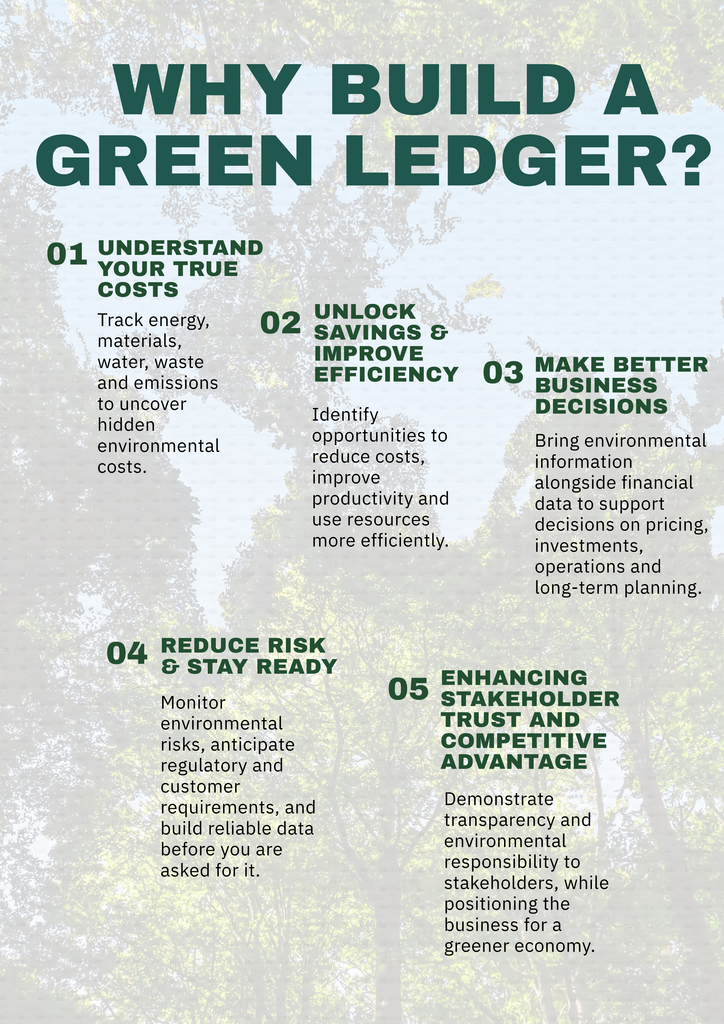
Sustainability information may increasingly form part of how companies assess their operations, risks, suppliers and business relationships. The green ledger, in that sense, is not about doing more reporting for the sake of it. It is about making sure the business knows what it is doing, both environmentally as well as financially, before someone else asks it to prove it. With a green ledger, SMEs can shift from being reactive to proactive.
Conclusion: Start Building Your Green Ledger
This transition towards sustainability is giving businesses an opportunity to gain a clearer view of how they use resources, where costs arise and where opportunities to improve may be hiding. For SMEs, building that visibility now means being better prepared when customers, partners, lenders or regulators eventually ask for sustainability information, without having to start from scratch or scramble for it.
Knowing why a green ledger matters is only the beginning, the next question is what should actually go into one, and how can an SME build it without creating another burdensome reporting exercise? In the second part of this series, we move to the how, looking at the key environmental information a green ledger should capture and how to turn it into something useful for everyday business decisions.
Stay ahead with exclusive insights! Sign up for our mailing list and never miss an article. Be the first to discover inspiring stories, valuable insights and expert tips – straight to your inbox!