For founders, the Start‑Up Tax Exemption (SUTE) is one of Singapore’s biggest advantages, offering relief that can make the difference between surviving and scaling. It’s one of the most generous tax incentives in the region, designed to give new businesses breathing room to grow. In those early years, every dollar counts and SUTE cushions your startup by freeing up capital. From early hires to product iterations and market expansion, the scheme helps to channel savings into areas that accelerate growth.
In Part 1 of this series, we broke down how SUTE works and why timing matters. A single decision of Financial Year End (FYE) that founders choose at incorporation can make or break the value of the exemption window. The clock begins with your first Year of Assessment (YA), not when your profits kick in. As we showed with our scenarios, the choice of FYE can mean enjoying three full productive years of relief, or losing one or two years to a pre‑revenue phase.
In Part 2, we will dive deeper to uncover the pitfalls founders often stumble into, and share a practical checklist to help avoid them. The goal is to ensure your exemption years protect the phase when your business is scaling.
Are You Eligible for SUTE?
SUTE is not a one-time approval granted at incorporation, it is assessed year by year. Each YA stands on its own, which means a company that qualified previously may later fall outside the scheme if its ownership or investor structure changes over time.
This reflects the broader intent behind SUTE. The exemption was introduced to support genuine early-stage businesses during their formative years. As such, the framework is designed to favour companies with active business operations, identifiable beneficial ownership, and relatively straightforward shareholding structures.
To qualify for SUTE, a company must satisfy the following conditions:
1. Incorporated in Singapore
Foreign-registered companies and Singapore branches of overseas entities do not qualify, even if they operate primarily in Singapore. Founders expanding from an overseas parent should pay close attention to whether they are incorporating a local subsidiary or registering a branch.
2. Tax Resident in Singapore for the relevant YA
Tax residency is determined by where control and management are exercised i.e., where strategic decisions are made and where board meetings are held. Startups with overseas founders, regional management teams, or cross-border operations should not assume residency is automatic.
3. No more than 20 shareholders
SUTE is designed for relatively closely held startups, which is why the scheme imposes shareholder limits. Founders should monitor the shareholder count and ownership thresholds as new investors come in. At least one individual shareholder must hold a minimum of 10% of the issued ordinary shares.
As SUTE exists to support active enterprise in its formative years, it is not for those parking capital or speculating on property. Thus, an additional point founders should be mindful of is that SUTE does not apply to investment holding companies or certain property development companies.
As companies grow, structures change, and holding companies get introduced for fundraising, regional expansion, or investor requirements. Over time, if a company’s activities become predominantly passive, its eligibility can shift. Thus, founders should periodically review whether the company’s actual operations continue to align with the underlying intent of SUTE.
Common Mistakes Founders Make With SUTE Planning
Many startups lose valuable SUTE benefits through a series of small but avoidable decisions. Individually, none of these decisions are catastrophic, but together, they quietly reduce the amount of relief available during the company’s early years. Since the SUTE exemption window only happens once in your company’s lifetime, these missed opportunities are impossible to recover later.
These are some of the traps that founders overlook and the cost of each misstep:
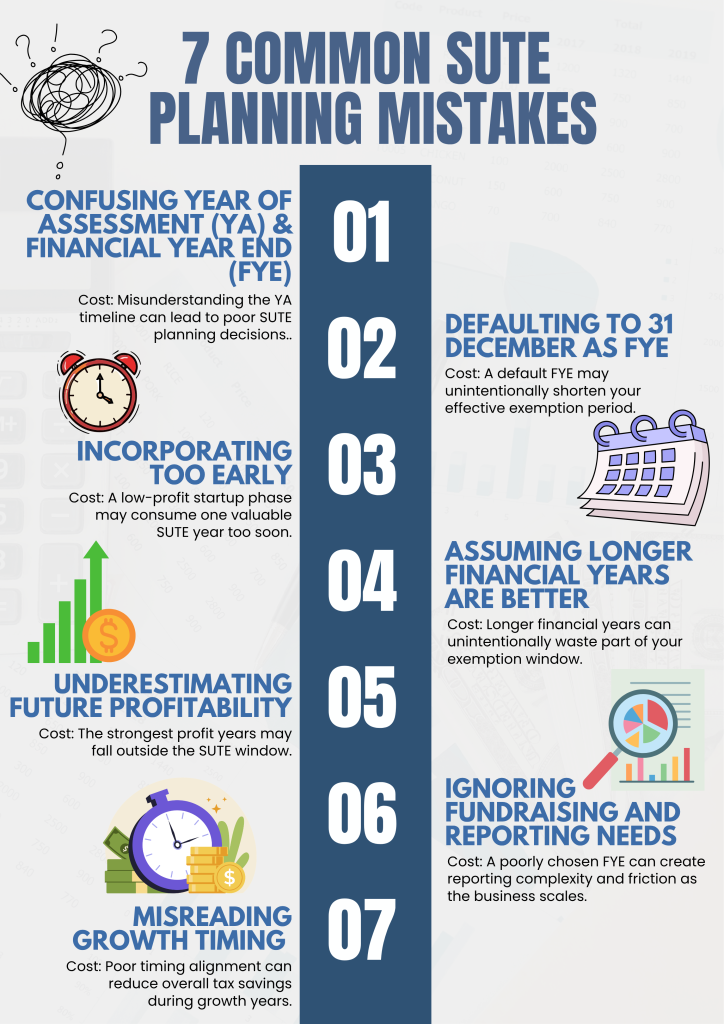
A few of these pitfalls surface repeatedly in practice because they sit at the intersection of fundraising, operations, and long-term planning. What appears to be a routine business decision early on can later affect SUTE eligibility, timing, or overall value.
For example, founders often rush to incorporate because it signals momentum and commitment. But incorporating too early may start the SUTE clock long before the business generates meaningful chargeable income, causing valuable exemption periods to be wasted on losses or minimal profits.
Similarly, companies are often structured around immediate operational or tax considerations without fully accounting for future fundraising and reporting needs. Investor requirements, audits, holding structures, or changes to shareholder composition may affect SUTE eligibility later on or create friction with the original FYE chosen at incorporation. Founders should therefore build with alignment in mind from the start.
In reality, the mistakes that cost founders the most are the quiet defaults set at incorporation. Founders often overlook setup decisions that feel minor in the early stage. But because the SUTE clock starts immediately, those choices matter. By the time founders realise their mistake, one or more of their three precious SUTE years have been spent shielding losses or negligible profits. It’s often the overlooked administrative choices made when the company is just getting started that erode value.
A Simple Checklist To Consider
Before finalising your company structure, take a step back and think beyond incorporation paperwork. The goal is not just to start a company quickly but to structure your first three YAs in a way that gives your business the greatest long-term advantage.
Founders should approach SUTE planning as part of the broader process of designing the business itself. A small amount of planning upfront can help preserve valuable tax relief later. Here are a few practical questions and steps worth considering early:
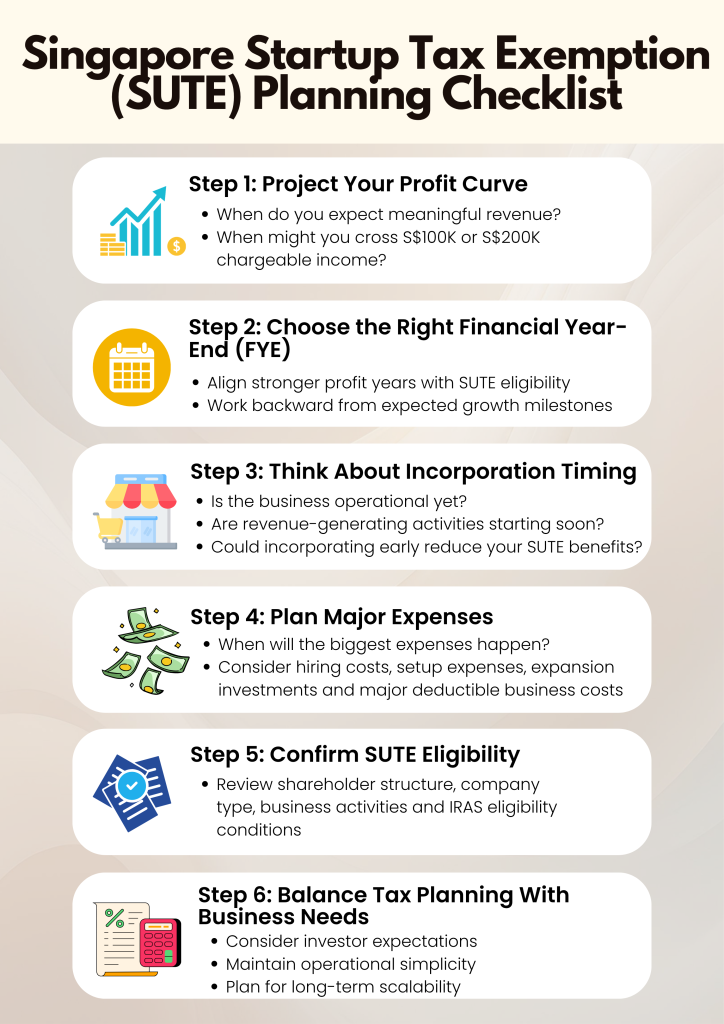
Project your growth conservatively and focus on when the business is expected to generate meaningful chargeable income. If meaningful operations or revenue are still some distance away, consider whether incorporating later may better align the SUTE period with the company’s actual growth phase.
Before incorporating, confirm that the company satisfies the eligibility conditions, and seek professional advice where issues such as tax residency or shareholder arrangements are unclear. Importantly, it might help to stress-test your assumptions. Since growth rarely follows a perfect timeline, profitability may take longer than expected. A structure that works only under optimistic projections may fail to deliver the intended benefit in practice.
Key Takeaways for Founders
Good tax planning goes beyond knowing the rules. It’s about understanding the rhythm of your business, and requires aligning with how your business operates and grows. Every company has a natural cadence: the slow burn of setup, the initial sparks of traction, the acceleration of growth. Cash flow rises and falls, contracts land at different times, and profitability rarely follows a neat calendar.
The real value of SUTE comes when your tax strategy is aligned with your growth curve. In this manner, tax planning becomes more about ensuring the timing of your exemptions matches the flow of your company’s journey. There are a few important lessons here:
1. Early decisions have long-term consequences
Most founders think tax planning begins after the business is generating revenue. SUTE shows that the most consequential tax decisions happen before incorporation. The choices at the start can determine how much value your company extracts from SUTE.
2. Qualifying once does not guarantee qualifying later
Qualifying for SUTE in Year 1 does not guarantee eligibility in Year 2 or Year 3. Changes in shareholder composition, management location, fundraising structure, or business activity may affect whether the company continues to satisfy the conditions for each YA.
3. Align FYE with your profit timeline
The effectiveness of any SUTE strategy depends on having a realistic view of when the business is expected to generate chargeable income. Founders who understand their profit curve are better positioned to align their FYE and structure their first three YAs more intentionally.
4. Small administrative gaps can become costly
Inconsistent records, unclear shareholder tracking, or undocumented structural changes often surface only during tax filing or due diligence, at which point they can create uncertainty around SUTE eligibility and lead to avoidable tax or compliance issues.
5. Tax planning is part of business planning
SUTE eligibility is shaped by how a business is built, funded, and scaled. When tax planning, fundraising strategy, and business design are aligned early, founders are better positioned to preserve SUTE benefits while retaining flexibility to grow. This alignment protects cash flow and helps founders avoid costly structural mistakes later.
Conclusion: Early Decisions, Lasting Impact

At the end of the day, deliberate and well-timed decisions can preserve and even maximise the benefits available under SUTE. This is why SUTE should sit within the way a company is designed. When tax considerations are embedded into business decisions early, founders are better positioned to protect value, rather than lose it through unintended structural or timing issues.
The lesson here is to plan early and protect your runway. Thoughtful structuring and early planning ensure that available incentives can do what they are meant to do, support the journey of growth when capital is most constrained.
While this series aims to help founders understand how SUTE works and provide a practical approach to planning, it is not a substitute for tailored advice. Engaging a Singapore tax advisor early can help ensure your decisions align with your specific structure and obligations. The cost of advice upfront is often small compared to the cost of fixing structural issues later, and it helps safeguard the relief that supports your growth.
Stay ahead with exclusive insights! Sign up for our mailing list and never miss an article. Be the first to discover inspiring stories, valuable insights and expert tips – straight to your inbox!