Singapore has always been serious about corporate governance. That is largely why it works as a business hub. Its reputation rests not just on low tax rates and excellent infrastructure, but on the credibility of its institutions and the reasonable expectation that companies operating here are accountable and properly governed. For founders and directors, incorporating in Singapore means accepting a high bar of accountability.
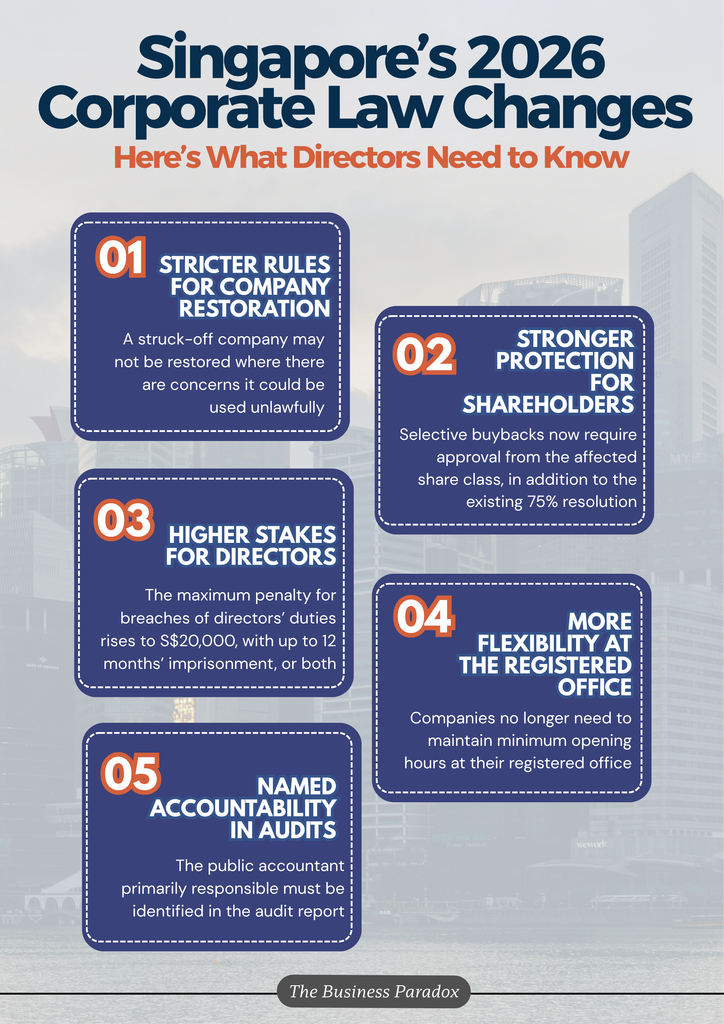
The Corporate and Accounting Laws (Amendment) Act 2025 with its first provisions effective from 6 May 2026, is not a departure from that tradition. This includes heavier penalties for breaches of directors’ duties, stronger safeguards against misuse of companies, and enhanced shareholder protections.
Taken individually, these are manageable regulatory changes. Taken together, they point to a broader shift in how Singapore expects companies to be governed. Singapore is drawing a clearer line between companies that are genuinely governed and companies that are merely incorporated.
What is changing is the expectation around how companies are governed and who is accountable when things go wrong. This shift matters for founders managing Singapore entities from overseas. Delegating finance, corporate secretarial work, or compliance does not remove responsibility. Directors must still understand what is happening inside their companies.
Accounting is now a governance tool and a strategic asset. For the companies that treat it that way, it can also be a growth enabler. As Singapore raises the bar, financial records and governance processes are the foundation of responsible decision‑making. It builds trust with investors, partners, and stakeholders, turning governance into a source of confidence rather than a constraint.
Why Directors Can No Longer Afford to Look Away
For years, it has been easy to mistake being a director for being a name on a document. However, the days of the “director in name only” are becoming harder to sustain. This is particularly relevant for companies with overseas founders, where a local nominee director may be appointed primarily to meet residency requirements. The risk is that the appointment becomes procedural, while oversight remains with management elsewhere. The recent amendments make that distinction increasingly difficult to ignore.
A director may not run the business every day, but they are still accountable for how it is governed. The role of a director is shifting from being primarily a legal appointment to being an active governance responsibility. A director is expected to understand the business, exercise judgment and oversee what is happening under their watch. The fact that someone else handles the accounting, corporate secretarial work or daily management does not make the director a bystander.
Under Section 157 of Singapore’s Companies Act, directors are expected to act honestly and use reasonable diligence in the discharge of their duties. The 2026 amendments increase the maximum fine for breaches of directors’ duties under Section 157 of the Companies Act from $5,000 to $20,000. That changes the conversation around accounting and bookkeeping.
The important point is not the fine, it is the logic behind it. It’s about who assumes responsibility. A director cannot transfer accountability by appointing someone else to manage the day-to-day. The obligation is personal. What this means in practice is that directors need more than a general sense that things are in order. Directors need to understand the company’s financial position, rather than relying on someone else to tell them whether everything is in order.
Simply looking at the changes through the lens of fines is not sufficient. That is because the moment something goes wrong, the question of what the director knew and when they knew it becomes the central question. Consider what that may look like. An investor begins due diligence and asks for financial records that are incomplete or inconsistently maintained. A bank wants to understand a transaction and the supporting documentation cannot be found. Shareholders disagree about how a decision was made and the board minutes do not reflect what actually happened. A regulator asks questions about the register of controllers and the company cannot produce an accurate answer.
The strongest business leaders know exactly what is happening inside the company. They understand their role and obligations. They can explain movements in their financial position. They know who is making decisions and why those decisions were made. This is why accounting is the infrastructure that determines a director’s ability to govern and to defend that governance when it is questioned.
What the Amendments Actually Changed
Accounting as a Governance Tool
The recent amendments raise the stakes for directors, but accountability is only meaningful when directors have timely information on which to act. That information comes from one place: the accounting function. This is where accounting stops being an administrative function and becomes a governance tool.
Recording transactions after the fact is not enough. A growing business, especially one where the directors are not involved in daily operations, needs timely management accounts and financial reporting that surfaces what is happening now. The distinction between recording the past and illuminating the present is the difference between an accounting function that protects directors and one that leaves them exposed.
Consider the overseas founder overseeing a Singapore subsidiary from London or New York. They cannot personally review every transaction. They cannot spot every anomaly. What they need is an accounting infrastructure that does that work for them and flags irregularities early, that maintains the registers accurately and produces financial information the director can actually use to exercise judgment.
This is what accounting as a governance tool looks like. It is not simply the corporate secretary’s filing reminders. It is a live picture of the company’s financial position that gives directors the confidence to govern and the evidence to demonstrate that they have. The legislation has raised the cost of not having this.
The Case for Getting Your House in Order
There is a practical reason to act on all of this that goes beyond avoiding penalties and it is more compelling for growth-minded founders. The same financial discipline and corporate records that meet Singapore’s governance obligations are the same ones that demonstrate grant readiness. This is a deliberate feature of how Singapore’s business support ecosystem is designed.
Under Budget 2026, Inland Revenue of Singapore (IRAS) has enhanced the Corporate Income Tax (CIT) Rebate from the originally announced 40% to 50% of corporate tax payable, with a maximum total benefit of S$40,000. Eligible active companies that employed at least one local employee in calendar year 2025 automatically receive a S$2,000 CIT Rebate Cash Grant. There is no separate application or form to complete. The grant is automatically disbursed once the company’s income tax return has been filed.
These are not competitive grants requiring a business case. They are triggered by compliance: timely filing, accurate payroll records, CPF contributions made correctly and on time. A company with messy or delayed filings does not just risk penalties. It risks forfeiting cash it was already entitled to.
For companies looking beyond automatic rebates to more substantial growth support, the Enterprise Development Grant, the Market Readiness Assistance Grant, and other Enterprise Singapore schemes, the eligibility requirement that matters most for foreign-founded entities is the 30% local shareholding threshold. At least 30% of equity must be held directly or indirectly by Singapore Citizens or Permanent Residents, traced to ultimate beneficial owners.
The companies best positioned to meet that threshold and demonstrate it when applying are the ones that have maintained accurate records of their shareholding from the very beginning. Clean books and well-maintained corporate records are the infrastructure that allows a company to access the opportunities Singapore is actively creating for businesses that are ready to grow.
The Foreign Founder Playbook
For founders who built their Singapore entity from overseas, the regulatory tightening lands with an additional layer of complexity. The rules are not different for foreign founders. But the administrative infrastructure such as a corporate secretary who knows the filing requirements and an accountant who understands local standards, is less likely to have been set up carefully from day one when the founder was not physically present.
The Accounting and Corporate Regulatory Authority (ACRA) register requirements are the clearest expression of what Singapore formally expects. Companies with nominee arrangements, whcih are common in foreign-founded entities, must maintain a formally filed register of nominee directors and shareholders. Any changes must be updated within two business days and annual verification of controller particulars is mandatory.
ACRA is essentially asking: do you know who owns and controls this company, and can you prove it?
For regional venture capital firms and institutional investors conducting due diligence, the same question applies. A Singapore company with clear, verifiable beneficial ownership is easier to finance and easier to back. The transparency that satisfies ACRA is the same transparency that satisfies an investor. It is the same discipline applied in two directions.
Conclusion: The Standard Singapore is Enforcing
Singapore has not become a harder place to do business. It has become a place where the gap between well-governed companies and poorly-governed ones is more visible and consequential than it has ever been.
The founders who come out ahead in this environment are the ones building good habits early, while the business is still small enough to do so deliberately. Over time, those habits become credibility. When the time comes to raise capital, bring in a strategic partner or expand overseas, that credibility can speak for the business before the founder does.
Good governance means knowing where the money is, who is accountable for decisions, and whether the company can stand behind the information it presents. That standard has always existed in Singapore. What the recent amendments have done is raise the cost of ignoring it.
Corporate governance has always mattered. What is different now is that Singapore has made neglecting it impossible to overlook.
*This article is for general informational purposes and does not constitute legal or accounting advice. Please refer to ACRA or IRAS websites for latest updates.
Stay ahead with exclusive insights! Sign up for our mailing list and never miss an article. Be the first to discover inspiring stories, valuable insights and expert tips – straight to your inbox!