When Carbon Becomes a Line Item
In our previous article, we looked at how sustainability reporting requirements for larger companies can create demand for environmental data further down the supply chain. The reporting obligation may sit with the larger company, but the data may sit with its suppliers. For SMEs, that can mean a customer asking for information on energy use, emissions, materials or waste, even when the SME itself is not required to publish a sustainability report. The question is no longer simply why should SMEs care, it is where do you start?
Instead of treating sustainability as something that sits alongside the business, environmental data becomes part of understanding the business itself. The green ledger gives SMEs a practical way to start connecting environmental impact with the financial and operational decisions they already make.
Business owners do not need to measure every operational detail or get their carbon data perfect overnight. They just need a baseline. By prioritising the high-impact areas where the business consumes the most energy and fuel, it can turn a daunting task into a manageable workflow.
So what does it actually take to build a green ledger? More importantly, how can SMEs build environmental metrics into the financial information they already track, without creating another layer of complexity?
Understanding the Rules of the Game
Before deciding what to track, it helps to understand the rules that increasingly sit behind the numbers.
Enterprise customers, investors and regulators may not all ask for the exact same information, but the Greenhouse Gas Protocol (GHG Protocol) is the most widely used framework for measuring and reporting greenhouse gas emissions. It is the methodology that gives environmental data credibility when a procurement process asks how the figures were calculated.
It provides the basis for measuring Scope 1, Scope 2 and Scope 3 emissions, and its Scope 3 Standard provides a common approach for measuring emissions across the value chain. For instance, if a customer asks where your emissions numbers came from, they want to know how the number was calculated, what was included and where the underlying data came from.
For an SME starting out, it means paying attention to these 3 things:
1. Know Your Boundaries: Decide which parts of the business are included in your emissions inventory. Be clear about what is included and what is not.
2. Choose What Matters Most: Start with the basics of Scope 1 and Scope 2, then add relevant Scope 3 categories over time, particularly those commonly requested by customers.
3. Use Recognised Emission Factors: An emission factor is simply the conversion factor that turns activity data into an estimate of greenhouse gas emissions e.g., for electricity in Singapore, the Energy Market Authority (EMA) publishes the national grid emission factor.
The goal is to produce a number that can be explained. Hence, it is crucial to maintain a record of the factors used, the source, the period they apply to and how the result was calculated. A well‑documented assessment that explains its methodology and limitations is far more credible to customers asking for it than a highly precise-looking figure that nobody can trace back to its source.
How to Trace Your Footprint?
Scope 1 and Scope 2 are the categories that Singapore’s listed companies are currently required to report, which means they are the categories their suppliers are most likely to be asked about first. Scope 1 covers the emissions your business produces directly from sources it owns or controls, while Scope 2 covers emissions from the energy your business purchases and uses, primarily electricity.
Tracing your footprint begins with familiar data. Simply start with the numbers you already know: last month’s electricity, fuel, and waste bills. In most SMEs, the majority of the data needed to build a basic green ledger already exists, but it may not be labelled as environmental data. The first job is simply to bring them together. Then add the physical quantity behind each cost. This provides a basic understanding of:
- What did we buy?
- How much did we use?
- What did it cost?
- What was the environmental impact?
A basic spreadsheet is enough to begin, taking this first step does not require any specialised carbon-accounting software or a complicated dashboard. At this stage, the discipline of capturing the data matters more than the sophistication of the spreadsheet. Once you have consistent data, you can apply recognised emission factors and calculate the associated emissions. Over time, you can also slowly expand the ledger to include water, materials, transport and relevant Scope 3 categories.
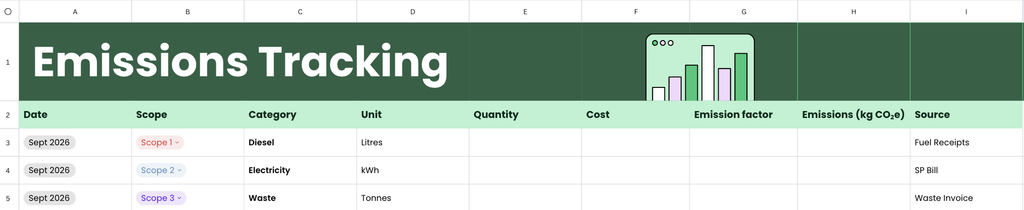
The point is to trace the footprint before trying to perfect it. Start with the transactions the business already understands, follow the numbers, then slowly build up from there.
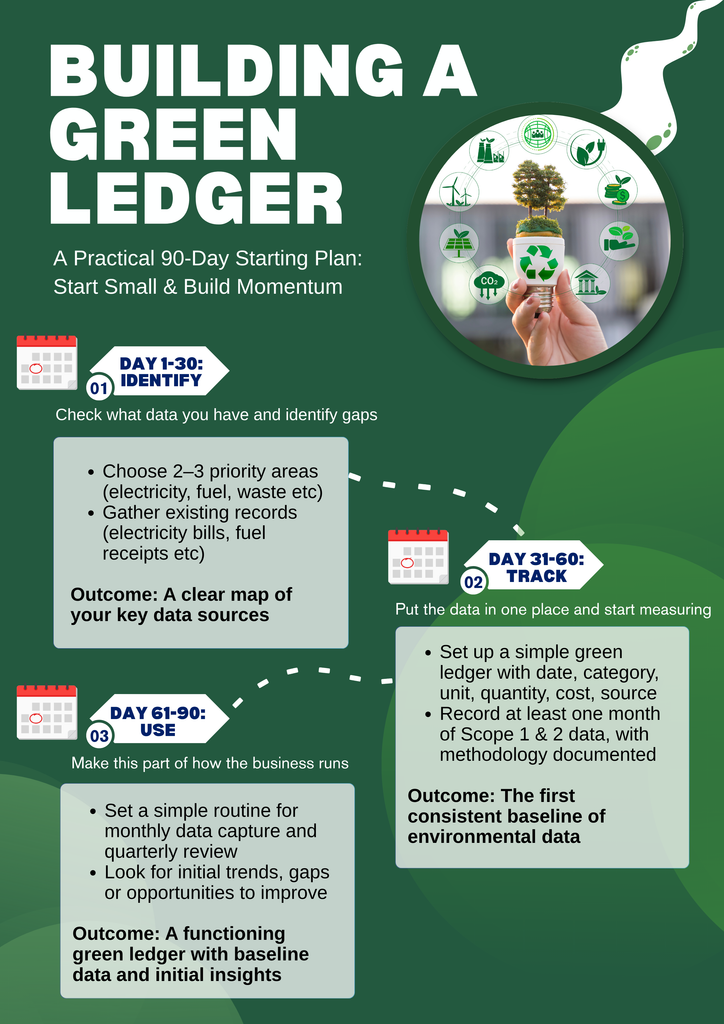
Where to Start? A 90-Day Roadmap
MONTH 1: IDENTIFY (Observe how the business operates)
Before collecting data or running calculations, spend the first month observing how your business functions in environmental terms. Where is energy consumed most heavily? Which materials are purchased in significant quantities? How much is spent on fuel, transport, and disposal? The goal is building awareness, to identify what matters most and where the numbers already live. A manufacturer with high electricity use but minimal water should focus on energy, while a logistics‑heavy SME should start with fuel and freight.
MONTH 2: TRACK (Put the numbers in one place)
Once you know what matters, begin capturing it consistently. Assign one person responsibility for maintaining the records and set a monthly cadence for data entry. Consolidate bills, invoices, and operational data into a single ledger. Then choose two or three performance indicators that make sense for your business e.g., energy intensity, waste per unit, or fuel consumption. By day sixty, you will have one full month of quantified environmental data, ready to be repeated and compared over time.
MONTH 3: USE (Turn data into decisions)
Patterns begin to emerge by the third month. Are materials being purchased in volumes that exceed what ends up in the finished product? Are waste costs rising faster than output? These insights allow leaders to act, by reducing packaging, tightening inventory management, or cutting idle energy use. This is the moment the green ledger stops being a data‑collection exercise and becomes a management tool that improves efficiency and strengthens credibility.
The green ledger is a living document, maintained periodically and updated as the emissions profile evolves. This is what enables a business to respond to vendor questionnaires in days instead of weeks. It gives environmental data credibility in tender submissions, and help businesses transition smoothly into formal sustainability reporting.
Leveraging The System
The good news is that SMEs have support available from the government. Singapore has a range of support for digitalisation, sustainability capability-building, and green financing. The key is to start with the business problem, not the grant. What capability are you missing? Better carbon data or a sustainability strategy? Once you know what needs improvement, then you can explore which programme can help pay for the solution.
From 30 September 2026, Enterprise Development Grant (EDG), Market Readiness Assistance (MRA), and Productivity Solutions Grant (PSG) will be consolidated into the new EDGE Grant, which provides support across areas including financial management, digitalisation, sustainability and productivity. SMEs can receive up to 70% support, subject to the specific activity and grant conditions.
There are also more targeted resources. Enterprise Singapore’s Sustainability Reporting Programme can support eligible SMEs developing their first sustainability report, while its sustainability playbook and the SME Sustainability Hub provide practical guidance for businesses that want to get started without immediately engaging a consultant. Likewise, the Singapore Business Federation offers similar sustainability guidance for SMEs. The principle is to use government support to build a capability that makes your business stronger, rather than simply to produce another report.
The same thinking applies when you move from tracking sustainability data to financing. Green and sustainability-linked loans may require independent assessment or verification of the loan framework, sustainability performance or targets. The Monetary Authority of Singapore (MAS) offers Sustainable Loan Grant Scheme (SLGS) to help defray some of the costs associated with engaging independent sustainability assessment and advisory service providers. The SLGS lowers the barrier to entry by covering up to S$125,000 of those external review costs.
This is where a green ledger becomes particularly valuable. If your business has started to build a reliable record of its energy use, emissions and other environmental data, you will have the data foundation that can support the next conversation, with a customer, an investor or a bank. The real value of government support is helping SMEs build the capabilities to grow, access financing, and meet rising sustainability expectations.
Conclusion: Building for What Comes Next
For SMEs, the key takeaway is that you do not need a ESG team or elaborate systems to begin. A well-maintained green ledger is enough to lay the foundation. Start small, record consistently, and align your data with recognised standards. Over time, that record becomes a living source of truth that grows with the business.
In the short term, it helps you respond to vendor questionnaires, reduce friction in compliance processes, and meet customer requirements. Over time, it becomes the data backbone for sustainability disclosure, financing applications, and growing investor expectations.
In supply chains where environmental performance increasingly matters, credibility is currency and the green ledger is how SMEs build it. The green economy is being built now, one supply chain at a time. The businesses that start building their green ledger today will be better prepared to meet sustainability demands with confidence.
Stay ahead with exclusive insights! Sign up for our mailing list and never miss an article. Be the first to discover inspiring stories, valuable insights and expert tips – straight to your inbox!