Are You Thinking About Your First Hire?

Many businesses often start as a side hustle, a passion project, or a way to earn a little extra income. In the beginning, there is usually no team, no department, and no dedicated support. There is only the founder. They start by doing the work themselves. Baking cakes from home, managing an online store after office hours, creating content, designing websites, or fulfilling customer orders on evenings and weekends. Handling everything alone is manageable and wearing multiple hats was part of the deal. You were the salesperson, the packer, the customer service team, the bookkeeper, and the delivery driver.
Then things started to pick up. Orders came in faster, customer messages started stacking up faster than you could reply to them. The work you actually enjoyed, making the product, serving the client, building the thing, got buried under a pile of admin that seemed to grow faster than the business itself. You found yourself packing orders past midnight and replying to enquiries during lunch, and somewhere in the middle of all of that, you started considering your first hire.
This is the turning point where the business reaches a stage where one person can no longer do everything alone, but hiring an employee is only one of several ways to access the help a growing business needs. Depending on your workload, budget, and business model, a freelancer, outsourcing partner, or even better systems and processes may be a more suitable first step. Before you start hiring, it helps to understand the different options available.
Not Every Problem Requires a Full-Time Employee
Before thinking about who, think about what.
The most common hiring mistake is bringing someone in before the work is properly defined. If you do not know exactly what you need done, how often it needs doing, and what a good outcome looks like, whoever you bring in will spend more time asking questions than getting things done. It will be useful to prepare a workflow or set of standard operating procedures before you even add anyone into your team.
Before you even consider building a team, work through these questions:
- What specific tasks need to be done? E.g., “write two Instagram captions per week, schedule them, and reply to comments.”
- How often does it need to happen? Daily, weekly, monthly?
- What outcomes do you hope to achieve?
- What tools or software does the person need?
- Which decisions can they make independently and which ones need to come back to you?
This is the groundwork that determines whether adding someone actually moves the business forward or creates a new management burden.
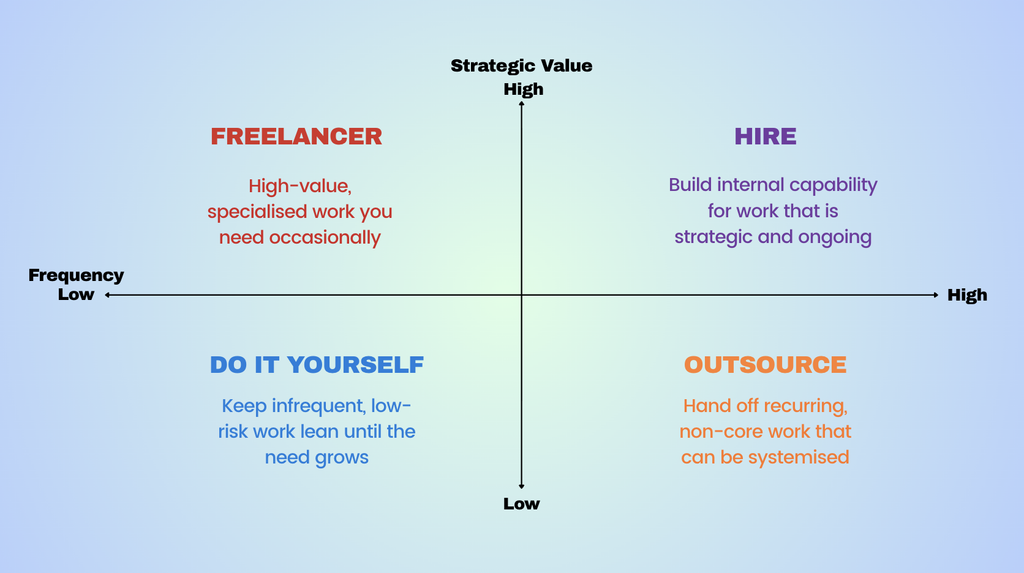
Not every problem requires a full-time employee. In fact, for most early-stage Singapore businesses, a full-time hire is often the most expensive and least flexible option available. The right choice depends on two things: how important the work is, and how often the business needs it done.
A Practical Decision Framework
A simple decision matrix can help guide that assessment. As a general rule of thumb, build capabilities that are core to your business, bring in specialists when expertise is needed on demand, outsource support functions, and keep infrequent tasks in-house until the need grows.
Option 1: Do It Yourself (For Now)
Some tasks don’t yet justify delegation. If the task is manageable and occasional, your own time may still be the simplest solution. These include basic invoicing, simple administrative filing, occasional social media updates.
Option 2: Engage a Freelancer
Freelancers provide specialist expertise on a project or short-term basis. This is particularly useful when you need a specific outcome rather than ongoing support. These include website design, graphic design, content writing, video production. For these tasks, hiring a full-time employee rarely makes sense because the workload is often project-based rather than continuous. Freelancers allow entrepreneurs to access skills without making long-term commitments.
Option 3: Work with an Outsourcing Partner
Some functions are essential but not core to what makes your business distinctive. These are often areas where outsourcing makes sense, such as accounting and bookkeeping, payroll processing, corporate secretarial services, IT support. This works for tasks when you need the work done consistently, but you do not necessarily need to own the capability.
Option 4: Hire an Employee
Hiring becomes more attractive when the work is both strategically important and consistently required. These are often roles that directly affect revenue generation, customer experience, or service delivery such as operations executives or sales representatives. An employee becomes part of the organisation in a way a freelancer or outsourcing partner cannot. They accumulate knowledge, build relationships with customers, and contribute to the culture you are trying to create.
How do we differentiate between an employee or freelancer? In Singapore, the classification is not determined by what the contract says, rather, it’s determined by the substance of the working relationship.
The relationship looks like employment when: The person works regular, fixed hours for the business. They work primarily or exclusively for you. You control how and when the work gets done. They use your equipment and tools. They are paid by the hour or by the day rather than by the deliverable.
The relationship looks like freelancing when: The person is engaged for a specific project or deliverable. They work for multiple clients. They control their own schedule and methods. They provide their own tools. They invoice you rather than receiving a payslip.
How the Decision Changes as the Business Grows
These four options are not fixed or permanent. Businesses progress through different talent models as their needs evolve.
For example, a founder might start by handling their own social media. When content becomes time-consuming and increasingly important, they bring in a freelance content creator. When content becomes a primary acquisition channel that needs strategy, consistency, and cross-functional coordination, they hire someone internally to own it. The function is the same, but the model changes because the business changed.
The same pattern plays out across different roles like finance, operations, and human resources. What starts as a DIY spreadsheet becomes an outsourced bookkeeper becomes an internal finance manager as the volume and complexity grow.
The challenge is rarely recognising that you need help. The harder question is understanding what kind of help the business actually needs. The decision tree below is designed to guide founders through that process, helping them identify the most suitable solution based on the nature, frequency, and importance of the work.
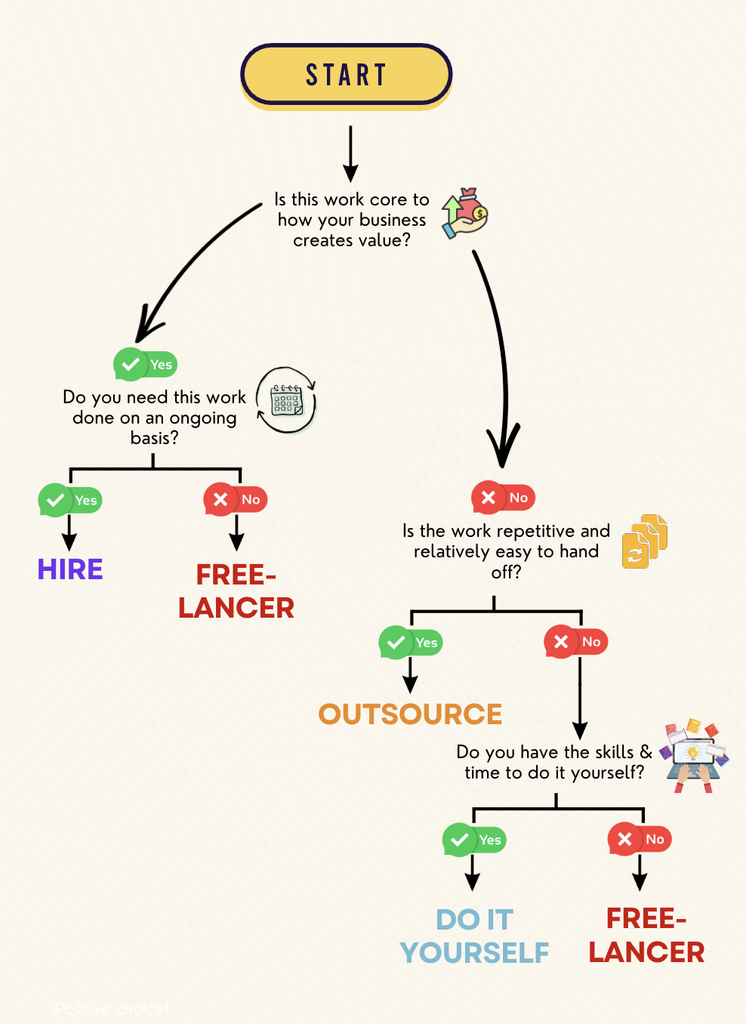
The mistake is treating the initial decision as permanent. It is important to revisit these decisions as the business evolves.
Beyond the Salary: CPF, Leave and Benefits
When founders do decide to hire, whether full-time or part-time, the salary figure is only the starting point. A role that appears affordable on paper can cost significantly more once the full employment package and compliance requirements are taken into account. Depending on the employee and circumstances, you may also need to consider:
1. Employer Central Provident Fund (CPF) contributions
For Singapore Citizens and Permanent Residents, employers are required to contribute to CPF on top of the salary paid. For employees below 55, the employer contribution rate is 17% of ordinary wages. This is an additional cost the business bears. A hire at $2,500 per month doesn’t cost $2,500. First-time employers who budget only the salary figure consistently discover this on their first payroll cycle.
2. Statutory leave entitlements
Employees covered by the Employment Act, which includes most employees in Singapore, are entitled to paid annual leave, sick leave, and public holidays from the start of employment. Annual leave begins at seven days in the first year of service and sick leave entitlement begins after three months of service. These are all legal minimums and the employment contract cannot offer less.
3. Skills Development Levy (SDL)
A small but often overlooked obligation, the SDL is a mandatory levy payable on all employee wages, currently at 0.25% of gross monthly wages, subject to a minimum of $2 per employee per month.
4. Less visible costs
Beyond the statutory obligations, there are also less visible costs such as onboarding time, training, equipment, software licences, and the founder’s own time spent recruiting and managing a new team member.
Before making a hiring decision, entrepreneurs should therefore evaluate the total cost of employing someone rather than focusing solely on the salary figure. In some cases, a freelancer or outsourcing partner may provide the support the business needs while offering greater flexibility and lower fixed costs, particularly during early stages of growth.
Conclusion: The Right People at the Right Time
As a business grows, it is natural to start thinking about hiring and building up a team. After all, more orders, more clients, and more responsibilities often mean that one person cannot realistically do everything alone. Yet growth does not necessarily mean hiring a large team. It means being deliberate about which capabilities you build, which expertise you bring in, and which work you can confidently hand to someone else.
It is equally important to take the time to understand the tasks itself. Is it a short-term need or a long-term requirement? Does it directly contribute to your company’s core work or is it a support function that can be systematised? Sometimes, a freelancer or outsourcing partner can solve the problem just as effectively.
There is no single right path to building a team. Some capabilities are worth developing in-house because they define the customer experience, others are better accessed through specialists who can provide expertise without a permanent commitment, and some tasks simply do not justify delegation yet.
What matters is making the decision intentionally based on what the work requires, what it costs, and what the business actually needs right now. The first hire is a milestone, but it doesn’t have to be the first thing you look at when you need help with your business.
Stay ahead with exclusive insights! Sign up for our mailing list and never miss an article. Be the first to discover inspiring stories, valuable insights and expert tips – straight to your inbox!