When Your Best Seller Isn’t Actually Profitable
You are reviewing your monthly numbers and one product immediately stands out. It drives the most orders, earns the most repeat purchases, and accounts for a significant chunk of revenue. Every instinct tells you this is your strongest product, the one to double down on and the one to build around. Then your accountant asks a simple question: after fulfilment, payment processing fees, platform commissions, and packaging, what does each unit actually leave behind?
Turns out that each unit is contributing far less than you assumed. The product isn’t losing money. But it isn’t really making any either. Every sale is doing just enough to sustain itself and not nearly enough to support the business around it. The volume was real. The contribution wasn’t. This is one of the most common discoveries in early-stage business. Everything appeared to be going “right”: revenue was growing and customers were coming back.
In the previous article, we explored how inventory costing methods shape how profit is measured and reported. But even when inventory is valued correctly, a deeper question remains: after all the costs that move with each sale, what is each product actually contributing to the business?
What is Contribution Margin?
This is where the concept of contribution margin comes in. In its simplest form:
Contribution Margin = Selling Price − Variable Costs
Contribution margin is the money left over from a sale after you have paid all the direct, per-unit costs associated with making and delivering that specific product. These include things like raw materials, packaging, and any other expenses directly tied to producing or delivering that specific product or service. They rise when you produce more and fall when you produce less. Fixed costs such as rent, salaries, software subscriptions, insurance, are a different category entirely. They stay constant whether you sell one unit or a thousand. They are excluded from the contribution margin calculation because they don’t change with each sale.
What contribution margin is asking is a more focused question: before we think about overheads, what does each unit actually leave behind? That leftover amount is what each sale contributes toward covering your fixed costs. Once those fixed costs are fully covered, every additional unit of contribution margin becomes profit.
These three terms are worth keeping clear:
- Revenue is the total income generated from selling your product or service
- Variable costs are the expenses that move directly with each unit sold e.g., raw materials, packaging, fulfilment fees, sales commissions
- Contribution margin is what remains after variable costs are subtracted from revenue.
Unlike revenue, which shows how much comes in, contribution margin shows how much is actually left after variable costs are paid. A business can report healthy margins yet still lose money on each additional sale once those costs are fully accounted for. Contribution margin reveals what each unit truly contributes toward covering fixed costs and generating profit, separating costs that scale with activity from those that remain fixed. This makes it clear which products genuinely support the business and which only add revenue without improving profitability.
What Does Contribution Margin Actually Measure?
Let’s say you are running a small handmade earring business and each pair of earrings sells for $25. The materials, packaging, and delivery fees cost you $10 per pair. Your contribution margin per pair is $15. That $15 doesn’t go straight to profit. It first goes toward covering your fixed costs like your monthly website fees, studio workspace rent, and equipment upkeep that stays the same whether you sell one pair or one hundred. But once those fixed costs are covered, every additional $15 of contribution margin becomes profit.
Contribution margin gives you a clear view of three signals inside your business: 1) Cash Impact, 2) Product Worth and 3) Layered Profitability.
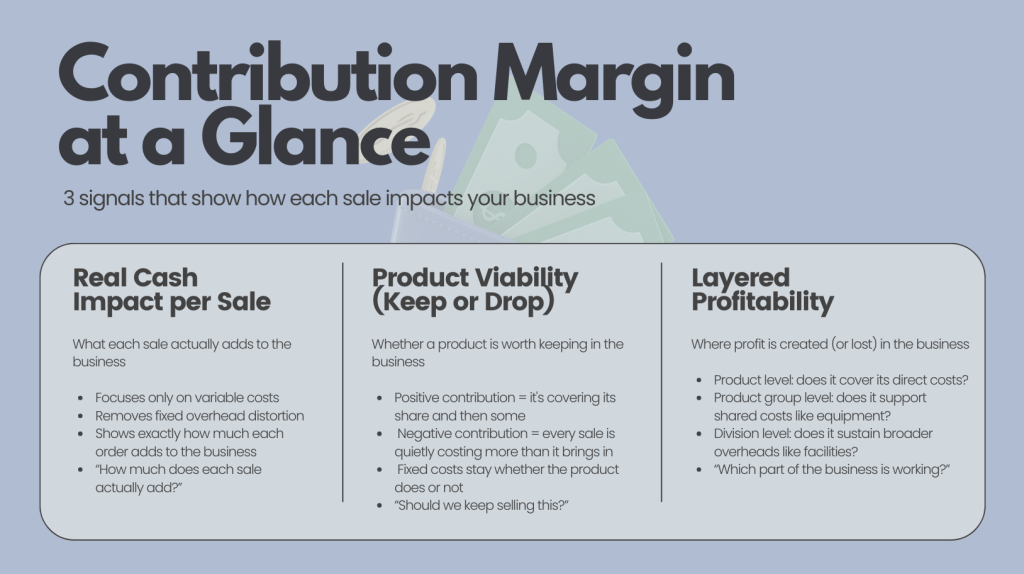
As such, contribution margin becomes a practical decision tool, helping you decide which products to focus on, and how much you can safely sell at different price points before the business becomes profitable.
At its core, the principle is straightforward: if the price of a product exceeds its variable costs, that product is making a positive contribution. If it doesn’t, then every sale is making the business worse. No amount of volume changes that reality. It only amplifies it.
What Gross Margin Leaves Out
Gross margin tells you how much money is left after covering the direct costs of making or selling a product, like materials or per‑unit labor. That’s useful, but it’s only part of the story. It does not include fixed costs like rent, salaries, software, or overheads that remain the same regardless of sales volume. As a result, a product can appear healthy on a gross margin basis while still failing to generate enough to support the wider business. True profitability is not determined at the product level alone, but when total contribution from all products exceeds total fixed costs.
Gross margin also has another limitation since the way cost of goods sold is calculated often includes a mix of direct inputs and allocated overheads that may not reflect the true economic cost of producing a unit. And because these costs are only recognised when inventory is sold, not when cash is actually spent, gross margin can also blur the timing between operations and cash flow. In short, it explains what remains after making the product, but not whether the business as a whole is truly profitable or cash-generative.
Take an e-commerce brand selling a product for $50. The manufacturing cost is $20, so the gross margin appears to be $30 per unit. But that figure only reflects the cost of making the product. Once the sale happens, additional costs appear:
- $4 in payment processing fees
- $6 in fulfilment and shipping
- $5 in platform commissions
- $3 in returns and customer support
Gross margin: $30
Contribution margin: $12
The difference of $18 per unit was the cost of completing the sale. Gross margin captures what it costs to make a product on paper. Contribution margin captures what it actually costs to make, sell, and deliver it in real life. For e-commerce and product-based businesses, where fulfilment, platform fees, and logistics scale with every order, that gap determines whether growth builds profitability or simply increases activity.
Leaders must look beyond gross margin to how products contribute after all variable costs, and ultimately how that contribution supports fixed costs and profit.
When Sales Don’t Reflect Profitability
The most dangerous assumption a founder can make is that rising sales volume naturally leads to a healthier business. Sales alone rarely tell you whether a business is actually profitable. Two products can generate the same revenue while producing very different economic outcomes once variable costs are taken into account.
Take two products, each selling for $80. Product A has variable costs of $30, leaving a contribution margin of $50 per unit. Product B has higher variable costs of $65, leaving just $15 per unit. Now assume both products sell 500 units per month. Product A generates $25,000 in contribution, while Product B generates only $7,500. If the business has $20,000 in fixed costs, Product A not only covers them but contributes $5,000 toward profit. Product B, despite matching it in revenue, falls short.
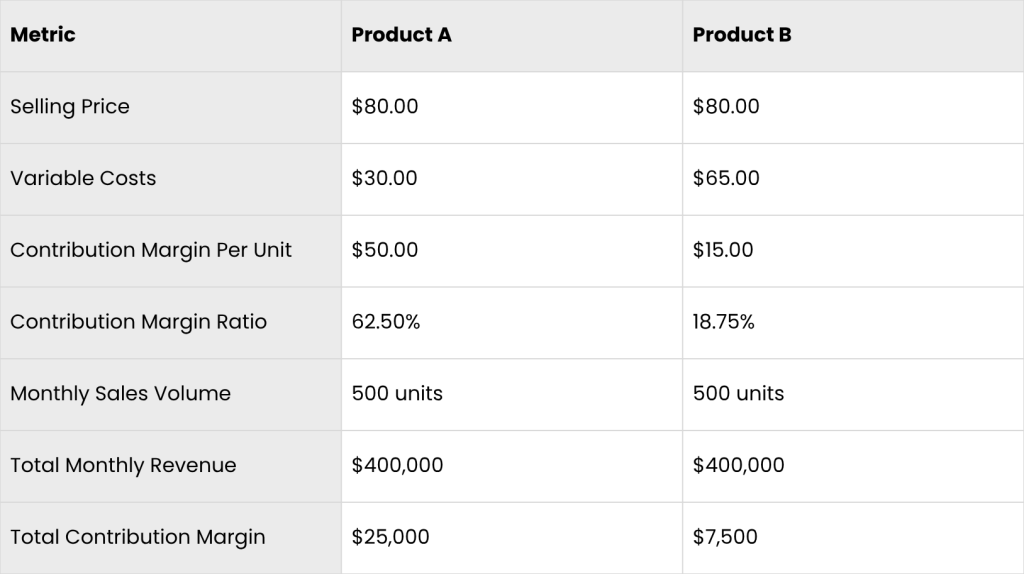
The scaling implication is even more revealing. To cover the same $20,000 in fixed costs, Product B would need to sell over 1,300 units for the same financial outcome as Product A. This is how contribution margin tells you what is actually building a profitable business.
Scaling the Wrong Product
When a product is selling well, the natural response is to back it. Order more stock. Bring in more people. Build the infrastructure to keep up with demand. In the moment, it feels like exactly the right call since revenue is climbing, orders are coming in, and every signal points to a business gaining momentum.
But revenue is not the same as contribution. And when the contribution margin is thin, scaling doesn’t solve the problem. It deepens it.
Here’s how the trap works. At low volumes, a weak margin is easy to absorb and even easier to ignore. The shortfall per unit is small. Existing capacity handles the early growth without obvious strain. The model appears to be working because on the surface, it is. Sales are up. The product looks viable. There’s no obvious reason to intervene. Then the commitments begin.
To keep growing, the business has to invest in the capacity to grow: more warehouse space, more headcount, more logistics infrastructure. Each of these investments raises the fixed cost base. But the contribution margin per unit hasn’t changed. It was insufficient before the scale-up. It remains insufficient after it. The business is now carrying a heavier cost structure, supported by a product that was never generating enough per unit to carry it.
What makes this particularly difficult to catch is that low-margin products rarely trigger alarm as they still generate revenue. They still look acceptable on the surface-level. So the decision to keep or cut gets postponed, leaders wait for scale to improve the economics, for efficiency gains to close the gap, for something to shift.
And the reason this catches so many founders off guard is simple: revenue growth feels like proof that the strategy is working. That is the most seductive form of false confidence in early-stage business. Momentum feels like direction. Activity feels like progress. By the time the numbers tell a different story, the commitments are already locked in: the lease is signed, the team is hired, the inventory is sitting in a warehouse that costs more than last year. The business is larger but it is no more profitable than it was before it scaled.
Not all growth is good growth. When expansion is driven by products that don’t contribute enough, it ends up building a bigger version of a fragile one.
Conclusion: What Contribution Margin Reveals
Revenue is a measure of activity. Contribution margin is a measure of value. The two can look identical on the surface and tell completely different stories underneath.
When viewed through the contribution margin lens, products are judged by how much they support the business that sells them. Some products quietly carry the organisation, funding fixed costs, enabling investment, and creating the conditions for sustainable growth. Others generate activity without building anything. They add to the top line while contributing little to the foundation beneath it.
It moves the conversation away from revenue and gross margin, and asks: “What is each sale actually contributing once every cost that moves with it is accounted for?” This question, asked consistently and at the product level, changes how leaders make decisions. It changes which products get backed and which get reconsidered. It changes how pricing conversations start.
Stay ahead with exclusive insights! Sign up for our mailing list and never miss an article. Be the first to discover inspiring stories, valuable insights and expert tips – straight to your inbox!