The Leadership Bottleneck

Take a moment to think about your team. Do you often hear, “Can I get your approval on this?” Do employees ask questions they should already know how to answer, or hesitate to act because they are unsure who has the authority to make a decision? Do managers routinely seek your sign-off on decisions they should be able to make themselves?
If so, the problem may not be that your team lacks initiative. You may have become the bottleneck.
For many leaders, these scenarios are a familiar part of running a growing business. As teams expand and responsibilities multiply, it can seem natural for more decisions to flow upwards. After all, leaders have a reputation to protect, standards to maintain, and outcomes to answer for. When the stakes are high, stepping in can feel like the safest way to ensure things are done properly.
But when decisions and approvals consistently flow through one person, the organisation’s ability to move forward becomes dependent on that person’s time and availability. Projects slow down and capable employees become accustomed to waiting for direction. The organisation may continue to grow in size, but not in autonomy.
Herein lies the paradox: the more leaders hold on to control, the fewer opportunities their teams have to develop the capability and confidence to operate independently. When employees learn that their decisions will routinely be reviewed or overridden, seeking approval can feel safer than taking initiative. Leaders may then interpret this dependence as a lack of motivation or capability, reinforcing their belief that they need to remain closely involved.
Breaking this cycle requires a shift in how leaders think about delegation. It is not simply about handing over tasks, but about building the trust and decision-making capability that allow others to take ownership while upholding the standards. This article explores why leaders struggle to delegate and how effective delegation can help create an organisation that performs well without depending on a single individual for every answer.
Why Letting Go Feels So Hard
Most leaders didn’t get to where they are by stepping back. They got there by paying close attention, solving problems fast, and caring deeply about the quality of every output. The problem is that the instincts that made a founder effective when their team had five people becomes a constraint when their team has fourty.
For many founders, there’s also something deeper at play. The business isn’t just a business. It’s the thing they built, the thing that reflects their standards and their judgment. Stepping back from day-to-day decisions can feel less like growing as a leader and more like becoming a stranger to the thing they created.
But underneath all of it, there are three patterns that quietly make delegation harder than it needs to be.
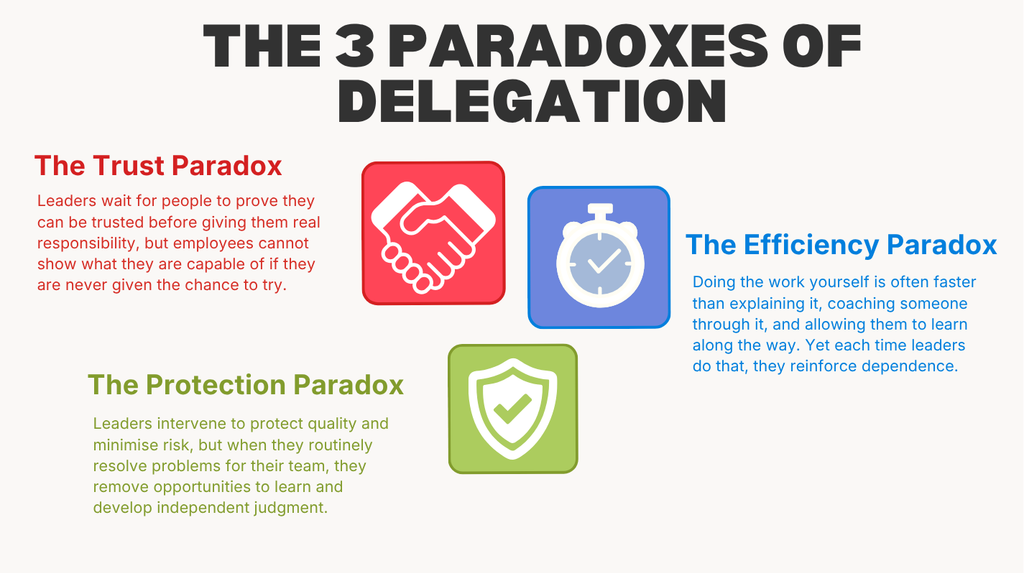
This is the cycle that is worth understanding. Leaders hold on because they do not yet trust their people to handle the responsibility. However, by holding on, they prevent those people from developing the capability that would make them trustworthy. The gap that justifies the control is partly the result of the control.
What Effective Delegation Requires
Delegation is about creating the conditions for others to take ownership, exercise sound judgment, and deliver results without requiring constant intervention. To do this well, leaders must replace personal control with a system of clear expectations, appropriate decision-making authority, and accountability.
Rather than relying on their own involvement to ensure quality, leaders must learn to establish the standards, boundaries, and feedback mechanisms that allow others to uphold those standards independently. Just as importantly, delegation is a deliberate investment in developing the confidence and decision-making capabilities of those they lead.
There are six practical steps leaders can take to begin this process:
1. Define the outcome: Assigning a task without explaining the intended outcome leaves employees guessing about priorities, quality standards, and expectations. Before delegating, clarify the objective, the desired outcome, the deadline, and the standards that must be met. The goal is to provide enough context for the person to make good decisions independently. The clearer the outcome, the more freedom employees have to determine the best way to achieve it.
2. Establish boundaries and decision-making authority: Leaders need to define which decisions employees can make independently, which require consultation, and which must be escalated for approval. These boundaries should reflect the employee’s experience, the potential consequences, and the level of risk involved.
3. Delegate progressively: Start by delegating responsibilities that are meaningful but manageable. This might mean asking them to research options, recommend a course of action, make a decision jointly with the leader, or eventually take full ownership. The aim is to strike a balance of providing enough support to manage risk, but enough autonomy to encourage learning.
4. Agree on checkpoints and timelines: Agree on when progress will be reviewed and which issues should be raised immediately. The distinction is between monitoring progress and controlling every step. Checkpoints should help leaders identify risks, provide support, and keep work on track.
5. Separate non-negotiable standards from personal preferences: The person receiving the responsibility will likely approach the work differently, but not every difference is a problem. Leaders need to distinguish between what genuinely protects the business and what simply reflects personal preference. The objective is to preserve the standards while allowing people the freedom to apply a different solution.
6. Use mistakes as opportunities for feedback and learning: If every mistake results in criticism, intervention, or the immediate withdrawal of responsibility, employees learn that taking initiative is risky. Instead, use mistakes as opportunities to understand what went wrong. Was the expected outcome unclear? Were the boundaries poorly defined? The appropriate response is to provide specific feedback, address the underlying issue, and adjust the level of support or authority where necessary.
Together, these steps allow leaders to move away from relying on their personal involvement to ensure quality and towards building the people and systems that can sustain it.
Learning to Trust is a Core Leadership Skill
The transition from control to trust is not about stepping back overnight and simply “letting go”. Effective delegation requires leaders to change how they lead. It is about gradually transferring what sits in the leader’s head into the organisation itself.
The goal is to build a team that can deliver the same quality and outcomes, even when the leader is not there. In many ways, leadership is a shift from being the person who gets the work done to being the person who enables others to get the work done. The hardest part of that transition is learning to trust your team to perform well even without you.
One reason many leaders hesitate to delegate is because they view it as a binary choice: either they remain in control, or they hand over full control to someone else. In reality, effective delegation sits on a spectrum.
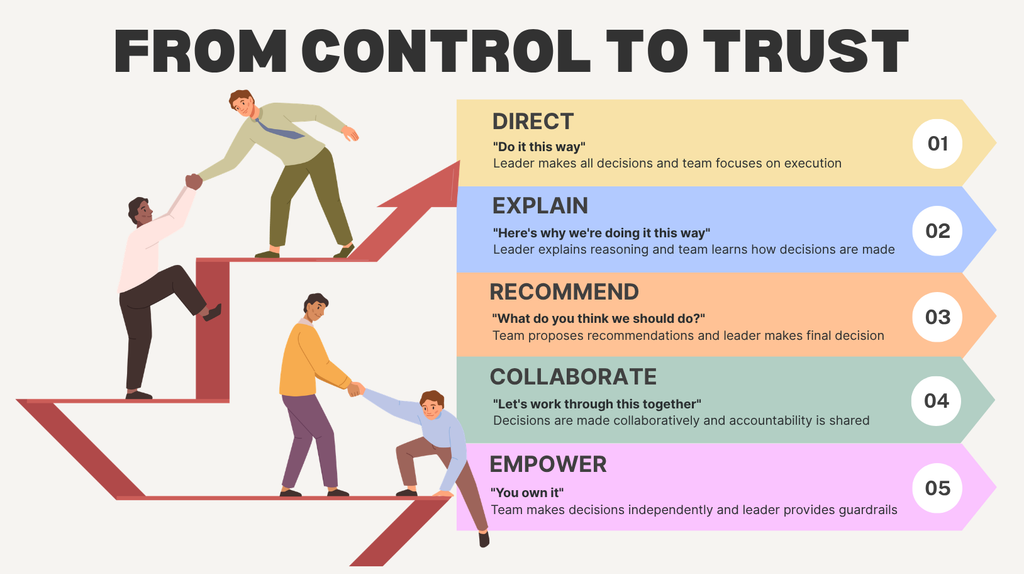
Trust is built gradually through experience, coaching, and increasing responsibility. The objective is to progressively transfer ownership as capability and confidence develop. Each stage involves a slightly different balance of control and trust.
At the beginning, leaders may need to direct, clearly defining what needs to be done and how it should be done. As employees gain familiarity, leaders can start explaining the reasoning. The next step is to ask employees to recommend a course of action, encouraging them to analyse problems while the leader retains final decision-making authority. Over time, it becomes more collaborative, with leaders and team members working together to decide on a path forward. Eventually, employees can be empowered to make decisions independently within agreed boundaries, taking full ownership for both the decision and its outcome.
Delegation Evolves as Teams Start To Grow
Stage 1: 1 to 10 people
At this stage, founder involvement in almost every aspect of the business is often necessary. The team is small, communication is direct, and having one person with full context can accelerate decision-making more than it creates bottlenecks. The priority is documenting processes, standards, and decision-making principles so that knowledge can scale.
Stage 2: 10 to 40 people
As the business grows, the founder can no longer be part of every conversation. Delegation shifts from assigning tasks to creating ownership. Managers need to be empowered to own outcomes, make routine decisions, and take accountability for results. The focus is on establishing clear responsibilities and feedback loops so leaders can stay informed without being involved in every decision.
Stage 3: 40 to 100 people
At this stage, effective delegation is no longer optional. The organisation needs managers who can hire, develop, and lead their teams independently while making decisions aligned with company goals and values. Decision rights should be clearly defined, escalation should become the exception rather than the norm, and systems should provide visibility into performance without requiring constant founder oversight.
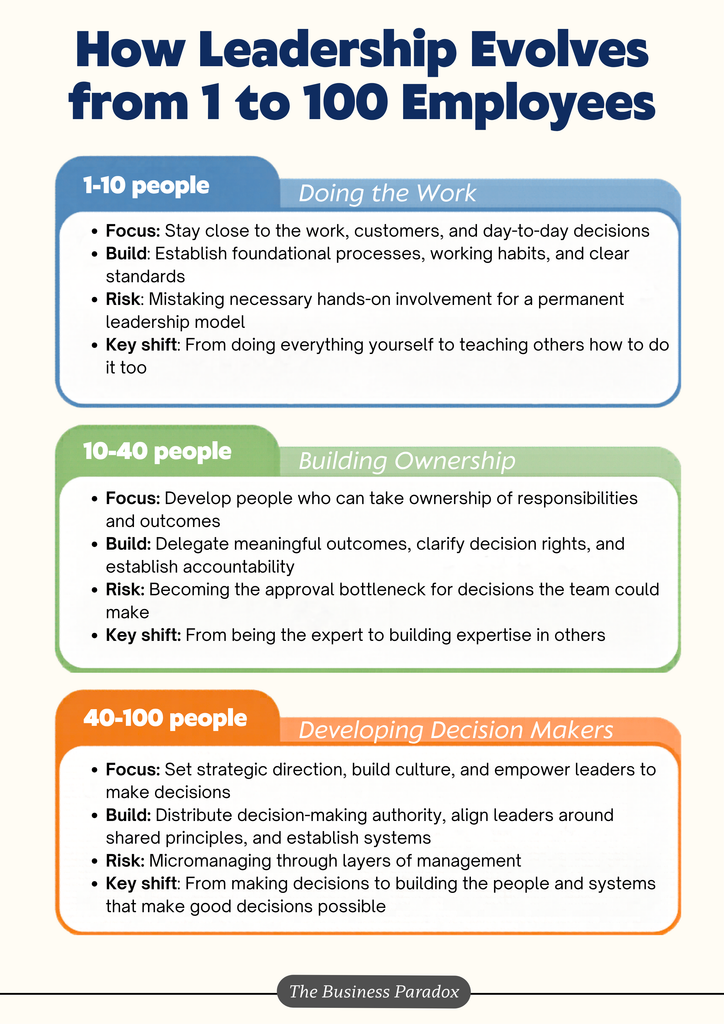
As your organisation grows, delegation evolves from sharing tasks, to building ownership, to creating leaders who can make decisions without you.
Conclusion: The Best Leaders Create More Leaders
Delegation is one of the biggest leadership challenges, particularly, of learning to let go of control. The instinct to hold on is understandable. Leaders know what can go wrong, how much mistakes can cost, and how difficult it can be to rebuild trust. What once made a leader successful, by being the person with the answers, must give way to the ability to develop others who can find the answers themselves. It means giving people the space to learn from mistakes. It means resisting the urge to step in at the first sign of difficulty. It means recognising that developing capability sometimes takes longer than doing the work yourself.
The ultimate test of delegation is not whether someone else can do the work exactly as a leader would. It is whether they can deliver the quality the company values, exercise the judgment the role requires, and uphold the principles the business stands for.
The best leaders do not build teams that simply execute their instructions. They create an environment where leadership is not concentrated at the top but cultivated throughout the organisation. The true measure of a leader is not how indispensable they become, but how many other leaders they create.
Stay ahead with exclusive insights! Sign up for our mailing list and never miss an article. Be the first to discover inspiring stories, valuable insights and expert tips – straight to your inbox!