From San Francisco to Singapore to Taipei: One Intern’s Journey Across Three Work Cultures
Lori Agbabian, a UC Berkeley undergraduate, has spent the past year doing what most students only dream about: working across continents, navigating unfamiliar cultures, and discovering who she is on the other side of the world.
There is a particular kind of confidence that only comes from doing things the hard way. For Lori, a third-year student at UC Berkeley’s Haas School of Business, that confidence has been forged across three cities, two continents, and more experiences than most people collect in a decade. Her journey, from a business internship in Singapore, back to campus in Berkeley, and now deep in Taipei’s venture capital scene, offers a rare and candid window into what it truly means to work, adapt, and grow as a young professional in Asia.
(Photo: Lori Agbabian)
Setting the Scene: Three Roles, Three Worlds
Lori’s professional story reads like an ambitious itinerary. In Singapore, she joined Advenz as an operations intern, taking on a role that was part internal consultant, part analyst. She interviewed staff across departments, mapped out core business processes, identified pain points, and delivered recommendations in a formal company presentation. She co-hosted a knowledge-sharing event, assisted with marketing, and even helped produce company videos. It was, by any measure, a substantial first foray into corporate life.
Back in Berkeley, her role at UC Berkeley Student Technology Services evolved just as quickly. She began as a Student Technology Consultant, a front-line tech support role helping fellow students troubleshoot Wi-Fi, software, and hardware issues, before being promoted mid-semester to a supervisory position. Suddenly, she was not fixing laptops; she was mentoring a team of consultants, reviewing their customer interactions, participating in hiring decisions, and managing performance. Crucially, she continues doing this work remotely from Taipei today, navigating a 15-hour time difference with characteristic pragmatism.
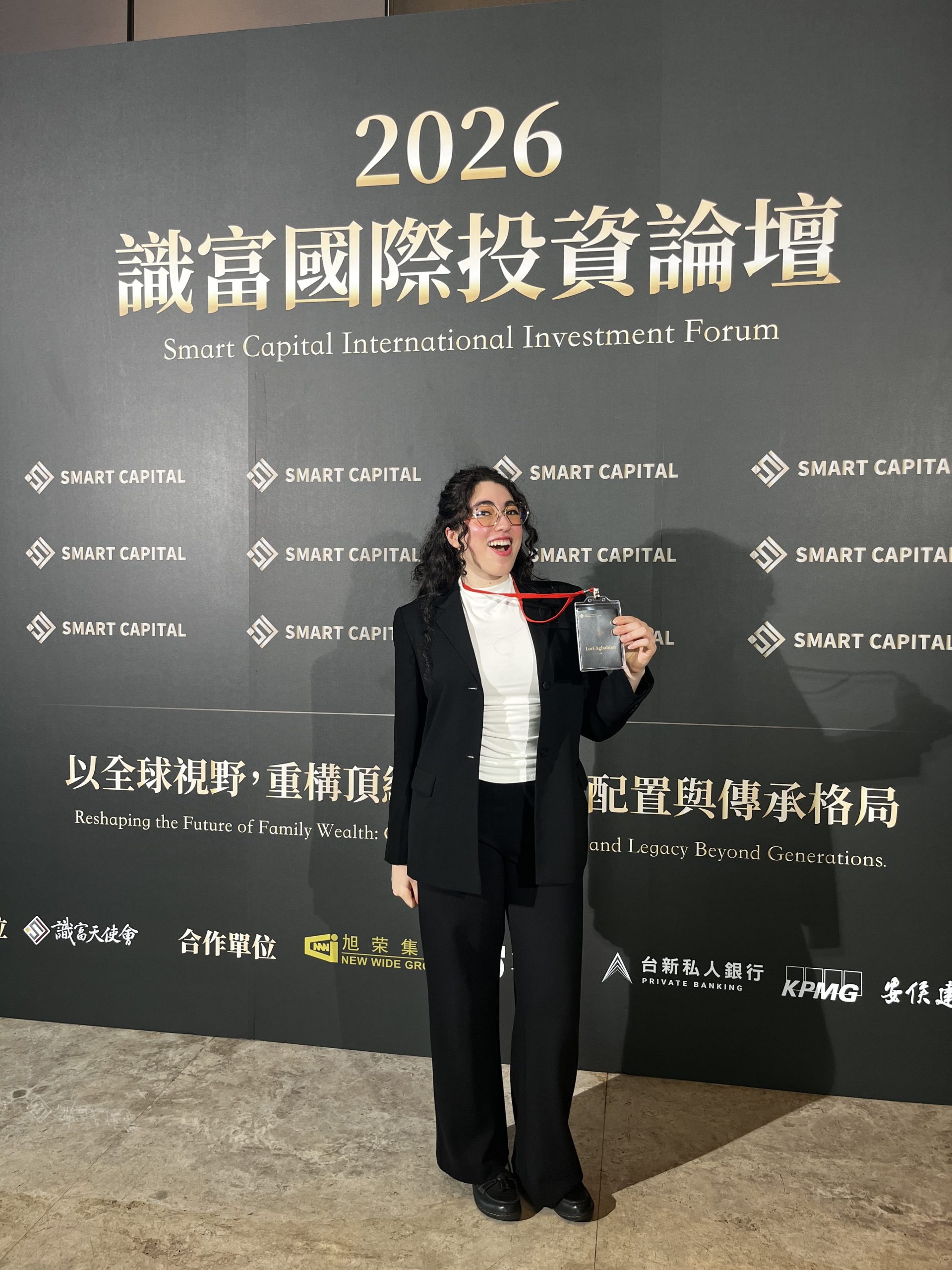
Now in Taipei, Lori is embedded at Smart Capital, Taiwan’s largest angel investor club with over 500 members. Her work there spans pre- and post-investment research, attending pitch days and demo events, and evaluating startups across sectors from maritime technology to physical AI. As a matter of fact, her first week on the job coincided with Computex Taipei, one of Asia’s most prominent AI and technology conferences, where she was thrown into the deep end and thrived, networking with founders and looking for potential new opportunities and investments.
Shattering Stereotypes, One Name Tag at a Time
Before arriving in Asia, Lori held an assumption common among many Westerners: that Asian workplaces would be stiff, hierarchical, and rigidly formal. The reality, she says, was far more nuanced.
“I expected things to be super strict. But I think people are more understanding and laid back than I thought.” She laughs recounting her wardrobe calculations, the carefully packed blazers, skirts, and flats, only to find her Taipei colleagues strolling into the office in shorts, sneakers, and dark jeans.
That said, respect is woven into the fabric of daily professional life in ways that surprised her. At a major annual forum hosted by Smart Capital, she was reminded to hand name tags to attendees with both hands, just like exchanging business cards – a small gesture but one that carries genuine cultural weight. These are not arbitrary customs, she has come to understand. They are expressions of a deeper workplace philosophy rooted in collective respect.
“I had to remind myself, oh right, two hands. It’s respectful. You want to show that you see the other person and are making thoughtful efforts to integrate into their culture.”
The Language of Business and Everything Between the Lines
If Singapore tested her professional skills, Taipei has tested something far more personal: her identity. At Smart Capital, her mentor and direct supervisor speak English more fluently than the others. Morning stand-up meetings are conducted in Mandarin, and company documents arrive in traditional Chinese characters, a script she is still learning, having grown up more familiar with simplified Mandarin.
Rather than retreat into the safety of translation apps, Lori has leaned in. She memorises her morning Mandarin to-do list before each team meeting, practising the lines so she can deliver them with confidence. When the CEO/co-founder, who occasionally attempts English with her, begins a conversation, Lori insists on responding in Mandarin. “I want to show that I am capable and willing to learn. She is the CEO and co-founder and has a lot on her plate. I want to accommodate her, not the other way around.”
It is exhausting work, she admits. Language immersion at this level is cognitively draining in ways that are hard to explain to someone who has not experienced it. But it is also, she says, one of the most important things she has ever done.

(Photo: Lori Agbabian)
Small Talk Is a Big Deal, In America
One of Lori’s sharpest observations concerns something seemingly trivial: workplace small talk. In the US, casual conversation is practically a professional skill in itself. Colleagues will ask about your weekend, your hobbies, your life, so smiling and sharing pieces of your personality is expected, to a certain degree, rather than accepted.
In Taipei, the unspoken norms are different. “It’s a little more reserved. More like ‘this is my work self’. I can be likable, but I’m not going to ask too many questions.” The culture is one of quiet diligence rather than performative friendliness.
This has created an internal tug-of-war for Lori. “I want to be more me, but I’m a little scared. I don’t know what they’ll think.” She has had to consciously recalibrate, pulling back on her instinct to fill silences, resisting the urge to ask every question she is curious about, and learning to read the room in a language that is partly cultural and only partly linguistic.
The Art of the Pitch: East vs. West
At the venture capital events she has attended, Lori has had a front-row seat to one of the more revealing cultural contrasts of her internship: the difference between how founders pitch in English versus Chinese.
“Those pitching in Chinese tend to speak very fast, very direct, a little less dynamic with body language,” she observes carefully. “Those pitching in English tend to tell more of a story, with more pauses and more personality.” She is quick to note this is observation, not criticism, and acknowledges that language fluency naturally shapes presentation style.
But the contrast she finds most instructive is not in the pitch room. It is in how business relationships are initiated. In Asia, she has observed, deals begin with people, not propositions. “In the US, it’s: hi, nice to meet you, what do you do, how can you be useful to me? Here, it’s more: let’s get to know each other first.” She watched this play out at a Smart Capital meeting with a visiting startup, where the conversation was relaxed, exploratory, and relationship-first. No deck, no pressure, just genuine curiosity about who they were and what they were working towards.
She has also noticed a deeper collectivist current in Taiwanese workplace culture. “It’s more about the unified front. Building everybody up. Not every person for themselves.” For someone raised in the hyper-individualist culture of American academia and corporate recruiting, it has been a meaningful reframe.

(Photo: Lori Agbabian)
Building a Career, One Experience at a Time
Back on campus, even while abroad, Lori is anything but idle. She is the Vice President of Operations for her sorority, managing four officers and working with an executive team to navigate finances, facilities, administration, and pre-existing organisational challenges. She is one of 8 members who sit on the Student Advisory Board for the Haas School of Business, having been selected during her Singapore internship and renewed her term this year. She is enrolled in two university courses and supervising her Berkeley tech team from a desk in Taipei.
This is more than multitasking. It is a masterclass in prioritisation.
She is also clear-eyed about what these experiences have confirmed about her professional identity. She is not, she says, a founder. “UC Berkeley really tries to foster entrepreneurship, and I know a lot of people who are building their own companies. That’s not me, at least not right now. I think I’m great at helping other people’s visions and working within systems to make them even better than before.” What she has discovered is a talent for operations, process thinking, people management, and cross-cultural communication. A signed offer to join The Technology Risk practice with one of the Big Four in San Francisco in 2027 suggests the market agrees.
The Bigger Lesson: Be Genuine, Do the Thing
Asked what she would tell the version of herself from a year ago, Lori pauses, then delivers advice that is simple but hard-earned.
“Be genuine. Don’t approach things transactionally. People can tell your intentions. They can read your body language and your tone.” Across cultures and industries, she has found this to be a universal truth.
She also offers something more personal: the permission to do things alone. On a recent free weekend, she travelled solo to Tainan, Taiwan’s oldest city, after no one else responded to her invitation. “No one wanted to come, so I went by myself. And I’m so glad I did. This is my time and if I didn’t go, the only person who would regret it would be me.”
For Lori, that is perhaps the deepest lesson of the past year. Growth, real growth, does not wait for consensus. It does not require a companion, a certainty, or a fully formed plan. It just requires showing up with both hands and seeing where it leads.
Lori is currently completing her internship with Smart Capital in Taipei, Taiwan, while continuing her studies and leadership roles at UC Berkeley. She will join The Technology Risk practice with one of the Big Four in San Francisco in summer 2027.
Stay ahead with exclusive insights! Sign up for our mailing list and never miss an article. Be the first to discover inspiring stories, valuable insights and expert tips – straight to your inbox!