When the Next Shock Arrives Before We’ve Absorbed the Last

You end a call meant to resolve one issue, only to find three more waiting, each urgent and requiring immediate judgment. A supply chain disruption. A regulatory shift. A decision that can’t wait, despite incomplete data. The problems don’t arrive in sequence, they stack up.
The cognitive load builds quickly. Under that pressure, even seasoned leaders recognise the shift: hesitation creeping into decisions, or the pull to act too quickly just to keep pace. Both responses carry risk and can deepen the instability they’re meant to resolve.
This is the reality of modern leadership. Before one issue is fully understood, the next is already in motion. Cost pressures rise as a client situation escalates, and overnight, a geopolitical event shifts the landscape again. Internal demands collide with external volatility.
The challenge is no longer just the scale of disruption, but its speed and how quickly global events compress into decisions that must be made in real time.
The issue is not simply managing crises. It is leading in a condition where disruption is continuous and the pressure to respond never fully recedes. We can no longer wait for stability to return. Rather, it is about maintaining clarity and function while instability persists.
The Permacrisis Reality
This condition is increasingly described as permacrisis: a sustained state of overlapping disruptions that no longer resolve before the next begins. Geopolitical conflict, economic shocks, climate events, and social pressures now interact rather than occur in isolation, compounding their impact.
Unlike the cyclical downturns of the past, these disruptions are not temporary deviations. They are structural, eroding resources and resilience over time while keeping organisations in a constant state of response. There is no clear reset point and no return to a previous baseline of stability. Instead, volatility becomes the operating environment. Leaders are required to make high-stakes decisions while absorbing multiple forms of pressure at once, often without the benefit of time or complete information.
As a result, the horizon shrinks. Attention is pulled toward the immediate, with one disruption demanding action before the last has been fully processed. The traditional recovery cycle disappears, replaced by a near-constant state of reaction. Over time, this sustained intensity leads to operational strain and leadership fatigue, and, more crucially, to a drift toward reactive decision-making.
It is in this environment that a less visible form of infrastructure becomes critical. Not just strategy or execution, but the leader’s ability to remain steady enough to think, decide, and act with clarity despite the noise.
Calm Isn’t a Trait. It’s a Skill.
To lead through a permacrisis, we need to abandon a persistent myth: that composure is a personality trait. In reality, it is a practiced leadership skill developed through deliberate regulation, framing, and communication. In this context, composure is the ability to remain cognitively clear and emotionally steady when external conditions are neither.
What makes this more than a personal skill is its systemic impact. A leader’s internal state does not stay contained. It shapes how information is interpreted, how decisions are made, and how teams behave under stress. In volatile environments, composure becomes an operational input.
When leaders cultivate it, they are not simply “keeping calm.” They are performing a set of critical functions:
1. Modelling Emotional Containment: A leader’s steadiness provides psychological containment for the team, absorbing urgency rather than amplifying it. This allows people to stay focused on execution instead of reacting to chaos.
2. Turning Ambiguity Into Opportunity: Calm leaders reframe ambiguity as opportunity. By challenging assumptions and seeking new perspectives, they mobilise teams to solve complex problems rather than retreat from them.
3. Creating Psychological Safety: When a leader is a fixed point, employees feel safe to take risks, admit mistakes, and offer constructive feedback. This stability fosters innovation and honest performance in unstable environments.
4. Grounding Decisions in Values: Grounding decisions in core values and long‑term vision gives the team continuity and direction. A leader’s internal clarity becomes a compass that prevents drift and keeps the organisation unified.
In a world of continuous disruption, leaders cannot control the volatility around them. However, they shape the environment their teams operate within. Composure is an active lever, one of the few forms of control that remains when much else does not.
The State We’re In Shapes the Results We Get
A leader’s ability to stay steady directly affects business performance. When leaders regulate their emotions, they think more clearly. That clarity leads to better decisions. In a crisis, this prevents the two most common business failures: total paralysis or impulsive, hasty actions.
Beyond decision-making, this internal stability is the primary factor in maintaining team cohesion. In uncertain times, people look for signals they can trust. A composed leader becomes that signal. They reduce anxiety and give the team something to anchor to. When people feel this stability, they stay focused and engaged. They are more willing to adapt and support change, not because they are told to, but because the direction feels credible.
Emotional stability also improves risk management. In volatile conditions, speed can be dangerous. Acting too quickly can waste resources or make existing problems worse. A steady leader knows when to move and when to pause. They create space for better judgment. This helps the organisation respond without overreacting.
At its core, leadership is a state before it is a role. Leaders who treat emotional regulation as part of their job are not just managing people. They are shaping the conditions in which people perform. In a world of constant disruption, that stability becomes the foundation for every other result.
The Cost of Reactivity
When leaders lose their calm, the organisation absorbs the cost.
In a permacrisis, the real risk is the chain reaction that follows when a leader becomes reactive. The most costly mistake is allowing external turbulence to shape internal response. Without an anchor, pressure at the top spreads quickly, through decisions, communication, and tone.
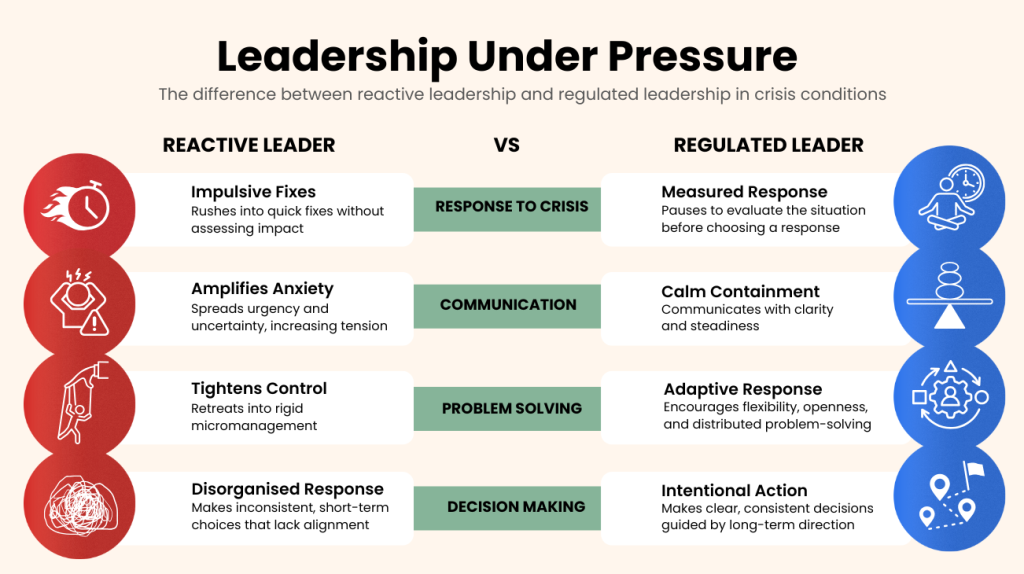
The difference between a reactive and a regulated leader is the difference between contagion and containment. When leaders mirror volatility, they transmit stress across the organisation, triggering urgency, control-seeking, and a drift toward short-term fixes.
By contrast, internal stability changes what gets transmitted. A regulated leader interrupts this cycle. They create the cognitive space for clearer thinking, more deliberate timing, and more disciplined execution. Action is no longer driven by the need to relieve pressure, but by alignment with purpose and context. As such, a leader’s steadiness is the condition that allows performance, innovation, and resilience to hold.
Staying Steady Under Pressure
We should stop treating composure as a feeling and start treating it as a deliberate executive discipline. In environments that are constantly shifting, stability comes from strengthening internal grounding. This is built through repeatable practices that shape how we think, decide, and respond under pressure.
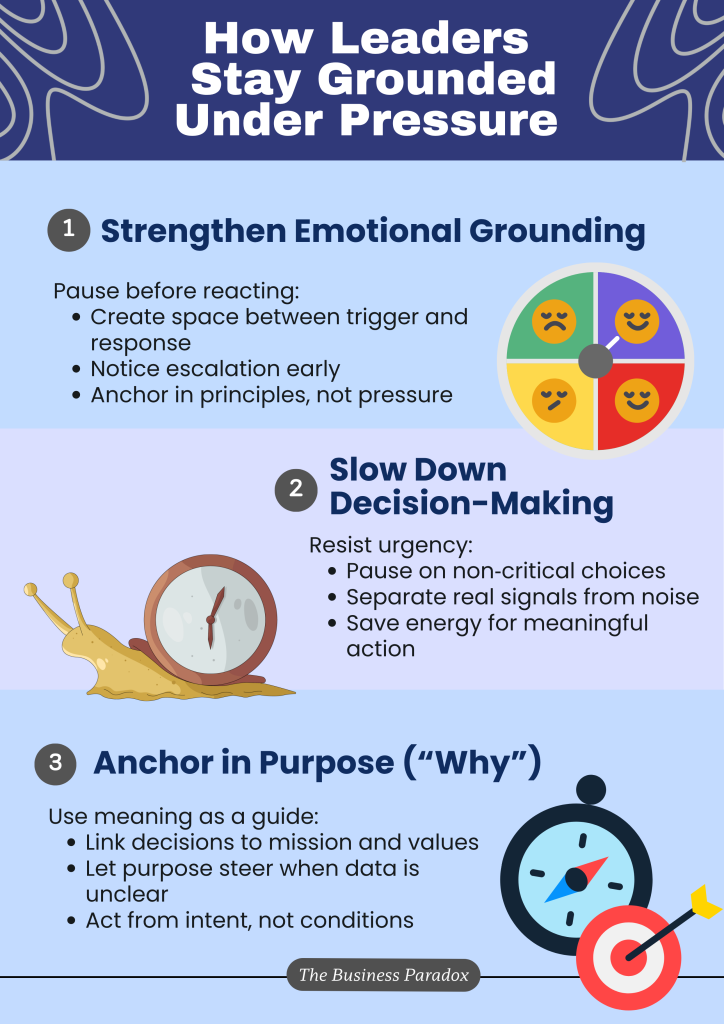
Staying steady in a permacrisis is about shaping how pressure moves through the organisation. The most important mechanism here is emotional contagion: teams absorb the emotional state of their leader. Emotional grounding allows leaders to notice pressure before it escalates into visible reactivity. Slowing down interrupts the instinct to confuse urgency with action, creating space for clearer judgment. Anchoring in purpose ensures that decisions remain coherent even when information is incomplete or constantly shifting.
Taken together, these practices are not just tools for individual regulation, they also determine the emotional tone of the organisation itself. In volatile environments, leadership stability either amplifies anxiety or stabilises it. Ultimately, calm is a form of organisational control.
Conclusion: Be the Fixed Point
The ground beneath us will keep moving, sometimes violently, sometimes imperceptibly, but always relentlessly. In a permacrisis, leadership is about becoming the stabilising force within it.
We cannot control the chaos, but we can control our position within it. And that position matters more than any strategy, framework, or system we design. Because teams don’t operate on plans alone, they operate on the signals they receive from their leader. Emotional states are contagious. When a leader is steady, clarity spreads. When a leader is reactive, uncertainty compounds.
This is why emotional regulation is a core business capability. It determines whether pressure becomes focus or fragmentation, whether teams respond with discipline or drift into reactivity. In uncertain environments, a leader’s composure becomes the operating condition that makes performance possible.
Ultimately, markets will shift, priorities will change, and crises will overlap. But the determining factor remains constant: not what is happening externally, but how leadership responds internally. The ground moves, but the leader holds.
Stay ahead with exclusive insights! Sign up for our mailing list and never miss an article. Be the first to discover inspiring stories, valuable insights and expert tips – straight to your inbox!