The Power of What’s Left Unspoken
It usually happens during team lunches, when someone finally voices what everyone has been thinking. Or in the lift after a town hall when the doors close and a colleague mutters a passing remark. Or along the corridor on a Friday afternoon, when a team member admits what didn’t sit right during the meeting. The setting is always informal. The moment is always the same: a flash of honesty that reveals more about the organisation than any engagement survey ever could.

Leaders rarely miss critical information because it doesn’t exist. They miss it because it surfaces when the perceived risk is low. After the meeting ends, in side conversations, in truths spoken only among peers. In most organisations, that honesty never travels upward. It stays grounded in how teams actually feel about a new strategy, the processes that quietly frustrate them, or what younger employees notice when they observe leadership. Senior leaders don’t hear it because candour carries a cost when you hold less power.
Traditional mentorship was meant to bridge this gap. Too often, it reinforced the hierarchy instead. For decades, programmes paired juniors with seniors for quarterly check-ins and one-way wisdom transfer. The intention was sound, but between the organisational chart and the calendar invite, the exchange became transactional rather than conversational.
Mentorship only works when it makes honesty possible. What most leadership teams lack today isn’t knowledge, it’s candour: an unfiltered read on how the culture actually feels, what the strategy is missing, and whether the people they want to keep still believe in where the organisation is headed.
Reverse mentoring isn’t just a trend or buzzword. It is a timely response to a question every modern organisation faces: not “What do we already know?” but “What are we still afraid to say?” In workplaces with up to five generations and cultural diversity, this approach turn listening into a strategic advantage.
Development Doesn’t Happen in a Training Room
Ask most organisations how they develop leaders and they’ll point to a training curriculum, workshops, or offsites. Valuable as these are, the most profound growth rarely occurs in a classroom. It happens in relationships, where listening can be practised in real time.
Formal training can deliver content but a workshop gives everyone the same slides. A mentor gives one person exactly what they need, at the moment they need it, because they know that person’s dilemmas, blind spots, and ambitions well enough to speak with precision. Research has shown that mentorship outperforms classroom training in building leader self‑efficacy: not just skills, but the confidence to lead.
The difference is the relationship. Good mentors do two things simultaneously: they help navigate career realities while cultivating emotional and social intelligence no slide deck can teach, such as empathy, resilience, and the ability to hold difficult conversations. All of these are honed through attentive listening, not passive learning.
Retention Is the Wrong Goal
For too long, mentorship has been treated as a retention tool, as a way to keep people from leaving. That question matters but it’s a lagging indicator. The best organisations ask a bolder question: How do we grow people, and what does our company become when we do?
Effective mentorship builds loyalty, capability, visibility, and steadiness under pressure. These benefits flow to the mentee, but also back to the mentor. Senior leaders who engage deeply in mentoring often report sharper strategic thinking and stronger executive presence. This is how development becomes reciprocal.
The real measure of mentorship isn’t how long someone stays. It’s how ready they are when the next challenge arrives and how much the leader across the table has grown in helping them get there. Retention is the natural outcome when you get this right, but it was never the main point.
Why the Best Leaders are Students First
There’s a hard truth at the centre of this conversation. Most leadership development still assumes the leader is the only one with something to give. The one with the experience, the wisdom, the perspectives worth passing down. But in today’s workplace that is multigenerational, multicultural, and fast‑changing, that assumption is narrow. Wisdom flows in every direction.
Reverse mentoring flips the dynamic on purpose. The junior brings what the executive can’t see from the top: how the culture truly feels on the ground, how technology and social trends are reshaping work, what emerging talent values, and whether they see a future here. In return, seniors offer context, institutional knowledge, and strategic perspective. Both sides walk away changed. That’s the point.

What makes reverse mentoring difficult is often psychological. It asks a senior leader to sit across from someone ten or twenty years younger and resist the urge to correct or instruct. And instead ask questions, stay curious, listen without defensiveness even when feedback touches their own leadership. It’s one of the hardest practices a leader can take on. But those who do it consistently aren’t just better mentors. They’re also better leaders.
When reverse mentoring works well, development runs both ways. Juniors gain confidence and visibility. Seniors gain an unfiltered read on organisational realities no town hall can provide. Hierarchy gives way to reciprocal growth.
Development isn’t something leaders hand down. It’s something they unlock by being willing to learn.
Listening Is a Leadership Skill
At some point, listening got mislabeled as personality trait instead of a skill. Some leaders were “naturally good” while others were not. That framing has let too many leaders off the hook. Listening is a skill and like any skill that matters in leadership, it can be trained, practised, and improved.
In mentoring, listening is not waiting for your turn to speak. It’s the discipline of paying attention, to what is said, to what is avoided, and to the broader context shaping every word. Culture runs deeper than behaviour. It shapes how people view authority, how they voice disagreement, whether they believe speaking up will be safe or costly. A leader who hears only the words will misread the room.
A mentee who doesn’t feel safe will offer polite performance instead of candour. They’ll say just enough to look engaged, while withholding the insight that could change something. The mentor hears the words. They miss the point. Listening creates the conditions for truth to emerge.
When leaders practise this consistently, engagement rises and accountability deepens. People stop waiting for instructions and start offering what they actually think. Because it feels safe to share it. That shift begins with a leader who learned to stop talking long enough to listen closely.
Building Cultural Competence Through Connection
Cultural competence isn’t something you learn in a seminar, it’s practised daily in our relationships. The strongest mentoring programmes intentionally design for difference, pairing veterans with early-career talent, or leaders across cultures, genders, and backgrounds. Competence grows when we step outside what feels familiar.
In these relationships, empathy becomes a lived practice. They surface biases, challenge assumptions, and build fluency in perspectives that differ from one’s own. Over time, they do more than develop individuals. They reshape power dynamics, amplify marginalised voices, and foster a co-created culture where belonging translates into impact. Mentoring across difference forces leaders to treat every conversation as a chance to learn.
Diversity brings presence. Inclusion brings participation. Belonging brings real influence on decisions and outcomes. Reverse mentoring accelerates all three by making listening across differences a structured habit.
Being in the Room Is Not the Same as Being Heard
There is a version of diversity that looks like progress but functions like performance. Many organisations have improved surface-level diversity, in headcount and public imagery, yet the deeper dynamics remain unchanged. Who speaks? Who gets truly heard? Whose perspectives shape strategy?
When people don’t feel safe to speak, it is rarely visible through the numbers. It shows up instead in the insights that never reaches leadership, the problems that went unnamed until they became crises, the talented people who quietly disengage because speaking up never felt worth the risk. The more insidious break is the one in the conversation, where hierarchy teaches people that silence is safe.
Reverse mentoring addresses this directly as a listening infrastructure. When a junior employee sits across from a senior leader with time and space to speak, the power dynamic shifts in ways no town hall can replicate. The leader hears how the culture actually feels from the inside. They see where systems are failing the people they are meant to serve. They understand what the next generation of talent is observing and what it would take to make them stay. It turns presence into participation and participation into belonging.
Turning Conversations into Systems
Mentoring often begins with good intentions. A conversation. A connection. A moment of guidance. But without structure, those moments fade. With intention, they can scale.
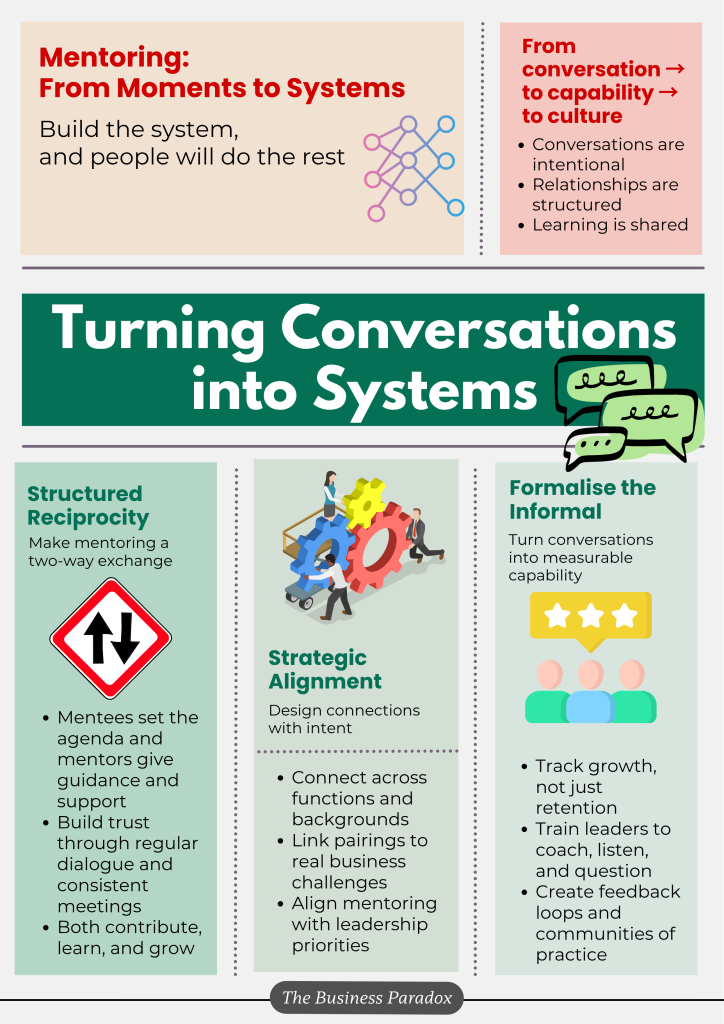
When done well, mentoring evolves from occasional conversations into a learning system that keeps the organisation inclusive and innovative. It shapes how people lead and how teams connect. Ultimately, leaders do not rise because they have all the answers. They rise because they build systems that help them listen, learn, and adapt, over and over again.
Conclusion: One Honest Conversation at a Time
Think back to that lift after the town hall, or the corridor on a Friday afternoon. Those flashes of honesty are not background noise. They are untapped organisational intelligence.
Reverse mentoring is how you turn those moments into infrastructure. It shifts hierarchy into reciprocity. It makes candour possible by design. The strongest leaders are not the ones with the most answers, but the ones with the most open ears. The ones who have trained themselves to listen deeply across generations and backgrounds.
If people wait for the lift doors to close before they speak their mind, what does that say about how safe they feel to speak up? The next time you catch a muttered truth in the corridor, don’t let it slip away. That moment is your organisation whispering what the surveys never show.
Leadership isn’t always about speaking, it’s also about listening to what’s already being said.
Stay ahead with exclusive insights! Sign up for our mailing list and never miss an article. Be the first to discover inspiring stories, valuable insights and expert tips – straight to your inbox!