What is a Corporate Secretary?

When founders incorporate a company in Singapore, appointing a corporate secretary is often treated as another item on a very long checklist. After all, most founders do not start their business because they are passionate about corporate governance. The issue is that this creates a common misconception about the role of a corporate secretary. Many business leaders see the position as little more than an administrative function responsible for filing annual returns, maintaining registers, and preparing meeting minutes. As a result, corporate secretarial services are often evaluated primarily on cost rather than the quality of support they provide.
However, the purpose of a corporate secretary is not simply administrative. It is to ensure that the company is properly governed, compliant, and able to demonstrate that its decisions have been made and documented accurately. In Singapore, a corporate secretary plays an important role. They help ensure regulatory obligations are met and maintain documentation that supports key corporate decisions. In doing so, they serve as an important link between the company’s management, directors, shareholders, and regulatory authorities.
The records maintained by a corporate secretary often sit quietly in the background until they are needed. But when a company is raising capital, undergoing due diligence, applying for tax incentives, demonstrating tax residency, or responding to regulatory enquiries, those records can suddenly become critically important. What appears to be administrative paperwork today may become evidence tomorrow. In this article, we explore the role of a corporate secretary and why businesses should view the position as far more than a filing service.
From Deadlines to Registers
The role of the corporate secretary carries legal significance.
Every Singapore private limited company is required to appoint a qualified corporate secretary within six months of incorporation, and a sole director cannot simultaneously act as the company’s secretary. The requirement exists because good governance is not something companies should think about only when a deadline approaches or a problem arises.
Under Singapore’s Companies Act, the corporate secretary is legally responsible for keeping the company compliant. This means ensuring annual returns are filed on time, maintaining statutory registers of members and directors, and documenting board and shareholder decisions accurately.
While the law requires every company to have a corporate secretary, it is important to understand that the role extends beyond filing documents. The responsibilities of a corporate secretary generally fall into the following areas:
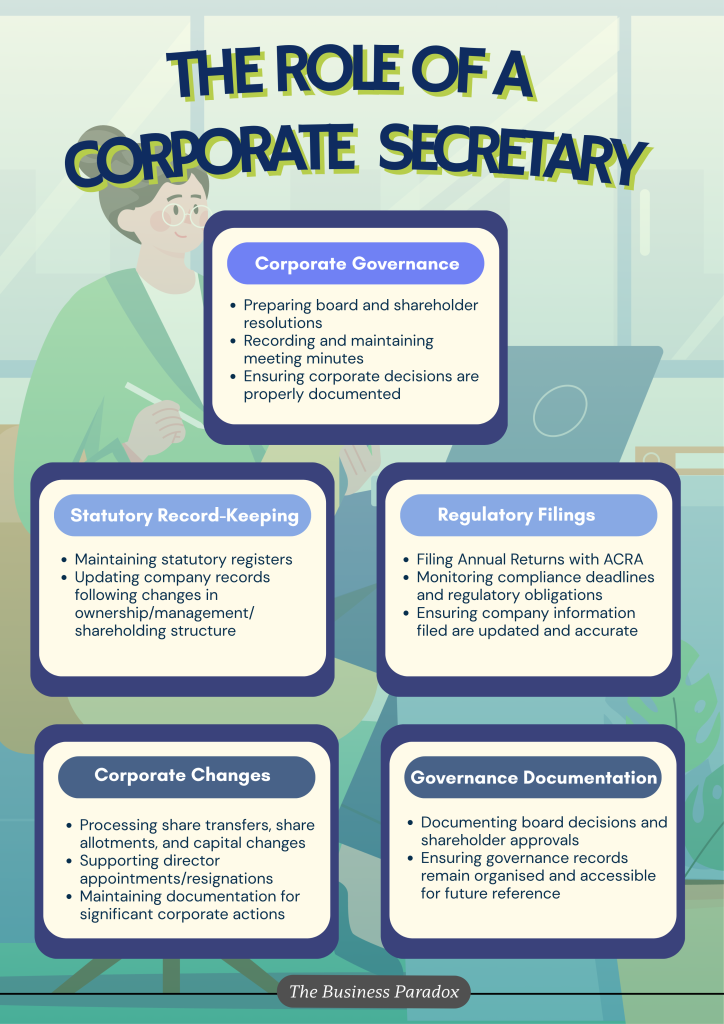
For founders, the corporate secretary ensures nothing falls through the cracks. This means that deadlines are met, decisions are properly documented, and company records stay accurate and up to date. This keeps the business in good standing with regulators.
Why Secretaries Matter for Tax Residency
As we discussed in our previous articles on Singapore tax residency and the Start-Up Tax Exemption (SUTE) scheme, regulatory and tax outcomes often depend on maintaining appropriate corporate records and supporting documentation. A well-managed corporate secretarial function helps ensure that these foundations are in place.
Consider a Singapore-incorporated fintech company with two founder-directors based in Singapore and two investor-directors located overseas. As the company expands into Indonesia, it begins receiving substantial foreign-sourced income. To access certain Singapore tax benefits, the company needs to demonstrate that its control and management are exercised in Singapore. The company applies for a Certificate of Residence (COR) from the Inland Revenue Authority of Singapore (IRAS).
This is where the limitations of a purely administrative corporate secretarial approach become apparent. The company’s strategic decisions are routinely made through virtual meetings. The board minutes prepared by a filing service simply record that meetings were held and resolutions were passed. Little attention was given to documenting the substance of the discussions or the circumstances surrounding the exercise of board authority.
Since the governance records provide limited evidence of where strategic control and management are exercised, additional clarification and supporting information may be requested. What was expected to be a straightforward process becomes more time-consuming, requiring management to provide supplementary evidence to support the company’s tax residency position.
In situations like this, the corporate secretary’s role extends beyond statutory compliance. A capable corporate secretary ensures that board minutes and governance records accurately reflect how strategic decisions are made and where control and management are exercised. When tax residency, treaty access, and cross-border tax outcomes depend on the quality of a company’s governance record, that distinction becomes significant.
A filing-focused approach often treats the transaction as routine paperwork. A governance-focused approach ensures that the company’s documentation is robust enough to support real-world outcomes, particularly when regulators or foreign counterparties require evidence. This is where corporate governance intersects with tax efficiency.
When Small Lapses Have Big Consequences
The most consequential lapses in corporate governance build quietly over time, only becoming visible when a high-stakes moment, such as a COR application or cross-border tax review, requires governance records to function as evidence. These issues tend to surface in the following ways:
1. Location‑silent minutes: Decisions are recorded as approved, but without noting where directors were physically located at the time. While seemingly minor, this gap weakens the company’s ability to substantiate where “control and management” was exercised.
2. Late officer filings: Delays in updating director or officer changes mean that statutory records may not reflect the company’s actual governance structure for a period of time. These mismatches can create avoidable uncertainty during compliance checks or tax residency assessments.
3. Disconnected governance records: When corporate secretarial work is treated solely as administrative processing, records are kept to meet minimum filing requirements. The result is a governance record that may be technically compliant with ACRA requirements, but insufficient when tested against the expectations of tax authorities or investors.
The challenge is that these details only reveal their weight when governance records are under real scrutiny. By then, it’s no longer about whether the paperwork exists, it’s whether it can stand as credible evidence. The question then becomes not whether compliance exists, but whether it can be demonstrated.
Do You Want A Filing Service or Compliance Partner?
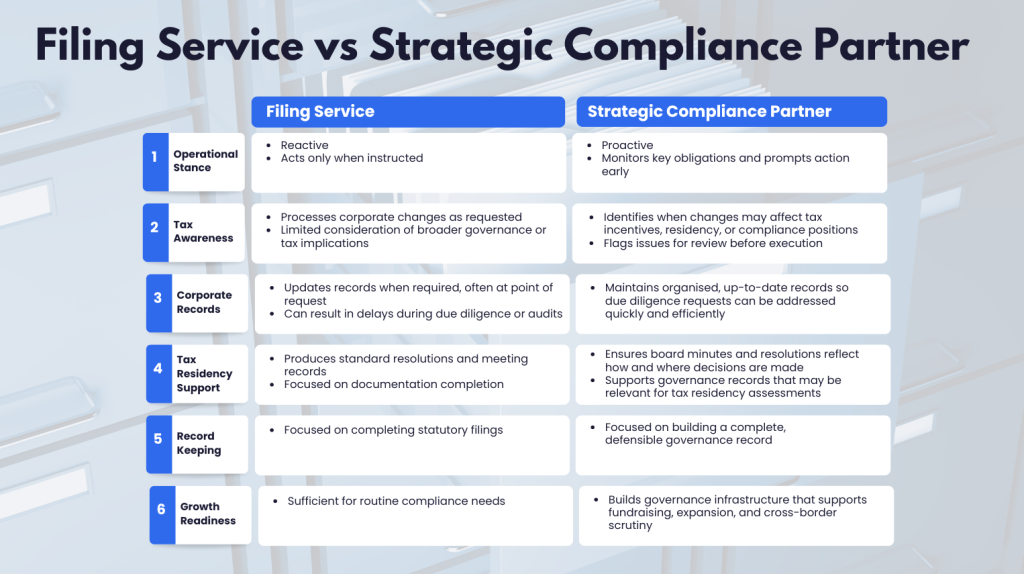
A corporate secretary can be engaged in different ways depending on how the role is understood within a business. A filing service reacts when you tell them what to submit but a compliance partner anticipates what regulators and tax authorities will expect months down the line.
In a filing service model, the function is largely transactional. It is focused on submitting required documents, updating records when prompted, and ensuring deadlines are met. This approach may satisfy basic regulatory requirements, but it often treats governance as a retrospective exercise.
In contrast, a strategic compliance partner integrates governance into the company’s decision-making. Rather than simply recording what has already happened, they help ensure that decisions are properly structured before they are executed, that corporate records reflect how the business is actually run, and that potential compliance or tax implications are surfaced early in the process.
Most early-stage companies start with a filing service, with the intention of upgrading to a more strategic arrangement as the business grows. However, that shift is usually forced by events, such as a delayed COR application or gaps in SUTE eligibility that existing records can’t support. By then, the challenge is dealing with gaps that have already formed in the company’s governance history.
The distinction may be subtle, but can be significant in terms of outcome. One approach keeps a company administratively compliant, while the other helps ensure it remains structurally prepared for scrutiny and cross-border complexity. Ultimately, the filing service helps you “get by” while the compliance partner can help you scale and grow.
Questions to Ask Before You Appoint
Choosing a corporate secretary should not be an afterthought or a search for the lowest price online. It is a decision about who will help maintain the integrity of your company’s governance record. If your governance records are messy, they can trigger regulatory audits or cost you the tax exemptions that you were counting on.
Before appointing a provider, or when reviewing your current arrangement, it is useful to ask a structured set of questions:
- Are your corporate secretaries properly qualified under ACRA requirements, and will we have a dedicated point of contact managing our account?
- How do you track compliance deadlines, and what systems are in place to keep clients informed?
- How do you support companies preparing for investor due diligence or fundraising exercises?
- How do you ensure board decisions and governance records are properly documented?
Strong providers will describe the systems and workflows they use to manage governance as an ongoing function. What you should look for is evidence of proactive screening, structured tracking of statutory deadlines through formal systems, and documentation maintained with enough substance to withstand scrutiny. This is why a strong corporate secretary does more than keep a company compliant. They help preserve the governance foundation that supports credibility, enables regulatory and tax positioning, and allows the business to scale with confidence.
Conclusion: It’s More Than Paperwork
For many, the corporate secretary begins as a legal requirement and ends up treated as an administrative function. Yes, every Singapore company must appoint one, but the law only sets the baseline standard. The real protection comes from a higher standard. What matters is not whether filings are submitted, but whether the governance record tells an accurate story of how the company is run. That record is what regulators use to assess compliance and what tax authorities examine when determining residency or eligibility for incentives.
The corporate secretary is not simply a service provider operating in the background. They are part of the company’s governance infrastructure. Founders who recognise this early will be able to avoid painful surprises during a COR application or investor due diligence. Those who treat the appointment as a checkbox discover its purpose only when the stakes are highest.
Ultimately, the governance record you establish in the first few years of your company is the foundation on which tax residency, investor confidence, and long‑term growth all rest.
Stay ahead with exclusive insights! Sign up for our mailing list and never miss an article. Be the first to discover inspiring stories, valuable insights and expert tips – straight to your inbox!