The Quiet Cost of Constant Firefighting
For many executives, leadership today feels less like steering a ship and more like treading water in a storm. In a disrupted economy, leaders are pushed into a reactive crouch. The inbox fills, the calendar overflows, and the immediate always drowns out the important.
Strategy is what gets pushed aside because it starts to feel like a luxury, something to return to once the fires are out. But the fires never stop. Every issue demands attention and the day-to-day grind becomes a relentless stream of activity that masquerades as progress. We risk slipping into a cycle of busyness, meeting results without questioning whether they are the right one.
That’s where the real risk emerges: strategic drift. The organisation keeps moving but its sense of destination quietly erodes. When the ground is shifting, the most urgent question is whether we are still heading toward the right horizon.
We began this series by making the case for a leader’s ability to remain non-reactive. Before a leader can direct a team or drive a system, they must first master the emotional state that makes clear thinking possible. In Part 2, we introduced the Four Disciplines of Execution to turn that clarity into results. This final article bridges the two and addresses the phase most leaders overlook. How you interpret what you see. How you decide what matters and what doesn’t. How you hold strategic direction in an environment that never stops challenging it. Strategy lives in how you make sense of what’s in front of you.
Stop Mistaking Motion For Direction
In periods of sustained disruption, urgency doesn’t just compete with strategy, it displaces it. Leaders find themselves in constant motion, not because they are clear on the destination, but because stopping feels riskier. We get addicted to the ‘doing,’ forgetting that speed without orientation is just a faster way to get lost.
This leads to a gradual and often unnoticed drift. Strategy isn’t explicitly abandoned but it is crowded out by a steady stream of small, necessary decisions. The organisation continues to move but with diminishing clarity about where it is actually headed.
Many leadership teams assume they will return to strategy when conditions stabilise: at the next review or the next window of breathing room. However, in a state of ongoing disruption, that window rarely appears. In the absence of a clear destination, the organisation fills the vacuum with urgency. The consequence is that strategic decisions are made by default rather than by design. Choices about where to invest resources, which clients to prioritise, and which opportunities to pursue are shaped by immediacy. What appear to be operational decisions are defining the organisation’s direction.
This is where execution can become a double-edged sword. Disciplined operating systems and frameworks are essential, but only when anchored in clear strategic intent. Without that, execution amplifies misalignment. The organisation becomes more efficient and capable of moving quickly, but it might not necessarily be in the right direction. Execution without strategy accelerates drift, but strategy ensures the destination is worth reaching.
The Loop That Was Built for Chaos
To connect execution with direction, it helps to look at a simple idea from an unlikely place: air combat. U.S. Air Force strategist John Boyd noticed something surprising. The pilots who won weren’t always flying the fastest jets or carrying the best weapons. They were the ones who could make sense of what was happening and respond more quickly than their opponent.
The OODA Loop — Observe, Orient, Decide, Act — was developed by John Boyd as a way to understand decision‑making under pressure. It has since become a universal framework for navigating complexity and disruption. At first glance, the model feels straightforward. You take in what’s happening (observe), make sense of it (orient), choose what to do (decide), and then do it (act). Then you repeat this, again and again, adjusting as things change.
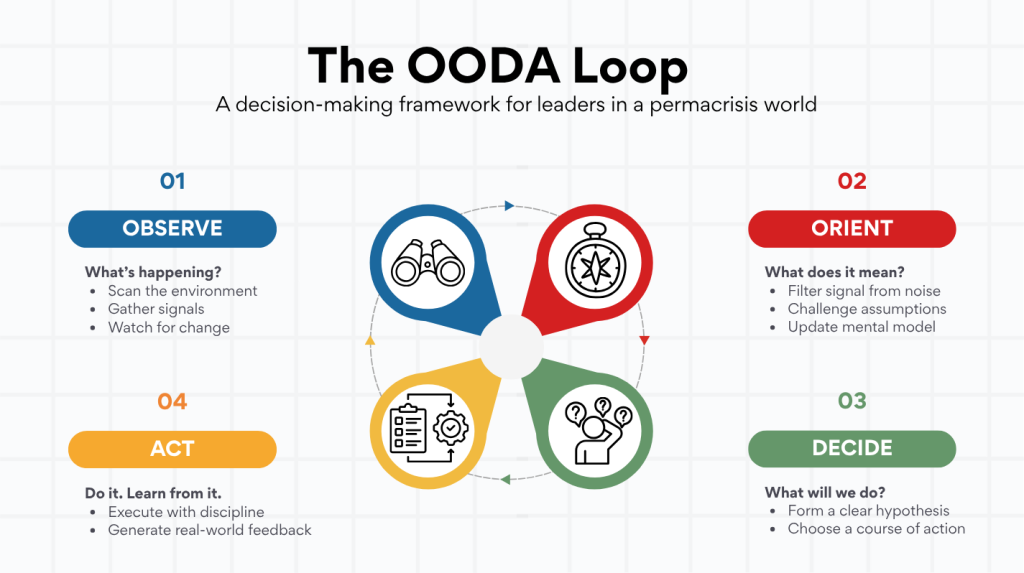
Most people focus on the last two steps: deciding and acting. That’s where things feel productive. The OODA loop breaks down when leaders rush to the end. Without observation and orientation, speed becomes reactive rather than strategic. But Boyd’s real insight was that the step that matters most is orientation. This is the phase often underestimated: the moment when information becomes insight. Orientation filters noise and shapes the point of view that drives decisions.
This is what makes the OODA Loop so relevant today. It was designed for environments defined by speed, ambiguity, and constant change, which are the conditions most organisations operate in now. The goal is not just to react, but to adapt and learn faster than the environment shifts around you.
The OODA Loop is a reminder that it starts with seeing clearly and making sense of what we see. Execution is only as effective as the perspective guiding it. When we get that part right, better decisions and better results tend to follow.
What Fear Does to Your Field of Vision
Fear doesn’t just influence decisions, it reshapes what leaders are able to see.
Under pressure, the brain shifts into survival mode. What should be a wide, 360-degree view of the environment tightens into tunnel vision. Instead of stepping back to interpret the full picture, leaders default to quick, reactive narratives, stories that feel coherent, but are built on partial information.
If we can’t make sense of what’s happening as quickly as it’s changing, we fall out of sync with the landscape. We may end up solving yesterday’s problems while new ones take shape. When leaders lose a clear view of their environment, even strong execution can take them in the wrong direction.
The Compass Inside the Storm
Every signal that leaders encounter, such as market shifts or competitor moves, arrives raw. It carries no meaning until interpreted. Orientation is where meaning is made: where noise becomes clarity, where data turns into direction, and where your perspective filter what matters most. Orientation is the lens through which leaders turn scattered inputs into a coherent direction.
Boyd emphasised that this phase shapes everything that follows. How you orient determines what you notice, the choices you make, and the actions you take. What makes orientation difficult in a permacrisis is that the world is shifting faster than our mental models. Leaders are not just processing new information, they are constantly having to update the way they interpret it. This requires letting go of outdated assumptions while forming new ones in real time.
Done well, orientation moves an organisation from reactive to proactive. It helps leaders spot patterns sooner, make sense of change as it unfolds, and act with intention. Seen this way, orientation is about staying grounded in what’s actually happening, especially as that reality evolves. It shapes what we notice, how we decide, and ultimately what we do. In a world of constant disruption, orientation requires the most attention because it is where meaning gets made, and in turbulent times, the quality of that meaning-making determines everything that follows.
4 Ways Leaders Lose the Plot Without Knowing It
In a permacrisis, the most costly mistakes are the ones that feel like good judgment at the time. Here is what they look like in practice:
1. Using yesterday’s map
The environment has changed. The mental model hasn’t. Decisions are made using assumptions that no longer match the environment. Leaders don’t realise this because outdated models are invisible from the inside.
2. Collecting more data instead of building insight
When uncertainty rises, the instinct is to gather more. More reports, more dashboards, more analysis. It feels productive, but without updating the mental models used to interpret that data, it simply reinforces existing assumptions. Orientation requires updating how you interpret data, not just accumulating it.
3. Keeping options open as a substitute for direction
In an effort to stay agile, leaders avoid commitment and keep all options open. Real agility is the ability to move fast from a position of clear conviction. Leaders who keep all options open in the name of flexibility are not staying agile, they are simply avoiding orientation.
4. Acting without closing the loop
The OODA cycle only compounds in value if action feeds back into observation. Most leaders skip this. They respond to one situation and immediately turn to the next, never processing what the response revealed. Without that feedback, they stop learning and start repeating.
What Strategic Clarity Actually Looks Like
Strategic clarity is not a plan. It is a way of seeing. In a permacrisis, it is the ability to interpret what is happening in real time and to adjust that interpretation as reality shifts.
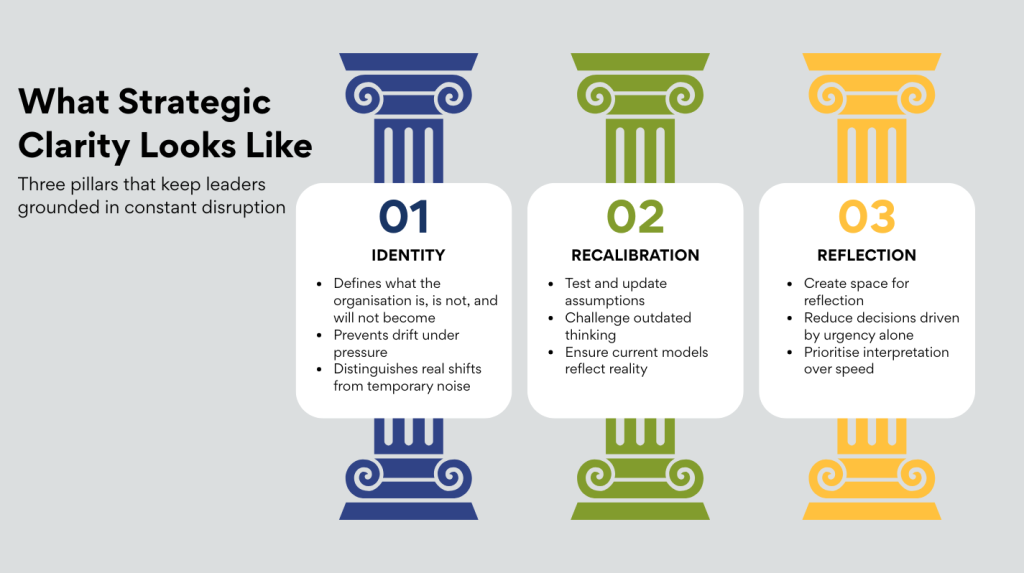
1. Know what you stand for. The organisations that stay oriented are not the ones that resist change. They are the ones that know themselves well enough to recognise which changes truly matter and which are just noise.
2. Update the lens. Clarity also depends on the quality of the mental models leaders use to make sense of the world. In a permacrisis, they need to be actively tested and updated. Does the way we understand the world still match the world we are operating in?
3. Protect time to think. Strategic clarity requires protected space for reflection and interpretation. Without it, leaders default to reacting to urgency instead of making sense of direction.
In practice, it looks like this:
- People at every level understand what they are doing and why it matters
- Day-to-day operations is clearly connected to strategic intent
- The organisation detects shifts early and responds while others are still interpreting them
Strategic clarity is not about certainty. It is the ability to keep moving in the right direction even when the path keeps changing.
When Composure, Clarity, and Execution Work as One
Across this series, three capabilities have emerged, as a single integrated system for leading through permacrisis:
- Composure is the anchor: It protects the quality of what you see.
- Clarity is the compass: It makes sense of what you see and holds direction.
- Execution is the engine: It turns that direction into results.
A regulated leader does not confuse urgency with reality. Composure, the foundation laid in Part 1, stabilises attention under pressure and prevents panic from distorting what enters the loop. That clearer observation feeds into a well-calibrated Orientation: a strategic compass that holds its bearing even as the environment keeps shifting. From that compass, the execution disciplines from Part 2 take over, turning intent into focused movement.
Each depends on the others. Composure without direction is stillness. Clarity without execution is drift. Execution without orientation is movement toward the wrong destination. When all three are working, it allows a leader to function when the ground keeps moving.
Conclusion: Stand firm. Move forward. Stay clear.
The ground beneath modern leadership is not going to stabilise. Permacrisis is not a phase to get through, it is the environment leaders have to operate in. Which means it is no longer about waiting for stability to return. It is what kind of leader you choose to become inside sustained instability.
Across this series, we’ve explored three essential dimensions of leadership in a permacrisis: Composure, Execution, and Strategic Clarity. The answer this series has built is a leader who works the full loop. One who regulates themselves before they try to interpret the world. One who develops a stable sense of direction before rushing into execution. And one who then executes with discipline and toward a direction they actually believe is right.
This is what leadership looks like in a permacrisis environment: steady enough to see what is real, clear enough to know what it means, disciplined enough to act on it consistently.
Stay ahead with exclusive insights! Sign up for our mailing list and never miss an article. Be the first to discover inspiring stories, valuable insights and expert tips – straight to your inbox!