From Anchor to Engine: Why Stability is Only the Beginning
In our previous article, we highlighted that a leader’s responsibility in a permacrisis is to remain anchored and stable. When uncertainty is constant, leadership sets the emotional tone. Without that steadiness, organisations may drift into confusion or paralysis. Calm leadership creates the conditions for clear thinking when the ground keeps shifting. But stability does not automatically create progress.
We may have learnt to steady ourselves under pressure and we respond with composure. Yet, progress is stalling and the team is busy without advancing. Composure without execution leaves organisations in survival mode, not performance mode. Targets start to slip and activity fills the days without shifting results.
This is the second failure mode of permacrisis leadership: not losing your composure, but losing your momentum. If left unchecked, it can easily become inertia. If the first step of leadership in a crisis is to hold the line, the second is to advance it. A leader who maintains composure but fails to deliver results is not going to be effective. The challenge today is bridging the gap between being a composed leader and driving high-stakes performance.
This is where execution becomes decisive.
Stability provides the foundation, but execution provides the force. It is the process of turning a clear mind into a measurable impact. Without it, even the most grounded leadership remains stalled at intent. In this article, we move beyond composure as a state of mind to execution as a discipline.
Understanding The Execution Gap
The execution gap is the space between knowing and doing: the distance between a strategy articulated in the meeting room and the reality of daily behaviour on the ground. It is the difference between intent and results. The issue is rarely a lack of clarity about what needs to happen. The issue is that it persistently doesn’t.
In today’s permacrisis environment, busyness is not the same as progress, yet the two are easier to confuse than ever. Urgent emails, recurring meetings, and routine deadlines quietly consume capacity. Established routines tether teams to familiar patterns that no longer serve the current reality. Competing initiatives scatter focus and slow momentum. Layers of decision-making often widen the gap further, distancing strategic intent from those tasked with delivering it.
The result: teams are busy and nothing seems obviously broken. But underneath, there is drift. Strategic priorities are repeatedly deferred, while the urgent overtakes the important. The real issue is failing to design a way to execute through the noise.
A Structured Path from Stability to Execution
Closing the execution gap requires a system designed for the reality leaders operate in. That’s where the Four Disciplines of Execution (4DX) come in. Developed by Chris McChesney, Jim Huling and Sean Covey, 4DX was built to solve a persistent problem: the breakdown between strategy and implementation. It provides a practical structure to focus effort, drive action, and sustain progress where it matters most.
At its core, 4DX directly confronts two forces that derail execution. The first is the Whirlwind: the endless stream of urgent demands, crises, and routine work that consumes attention and pulls teams away from what matters most. The second is the limitation of traditional management, where too many competing priorities and layers of process dilute focus.
4DX creates a structure that cuts through noise. By concentrating on what is Wildly Important, acting on the behaviours that drive results, making progress visible, and establishing a cadence of accountability, it turns execution into a deliberate, repeatable practice.
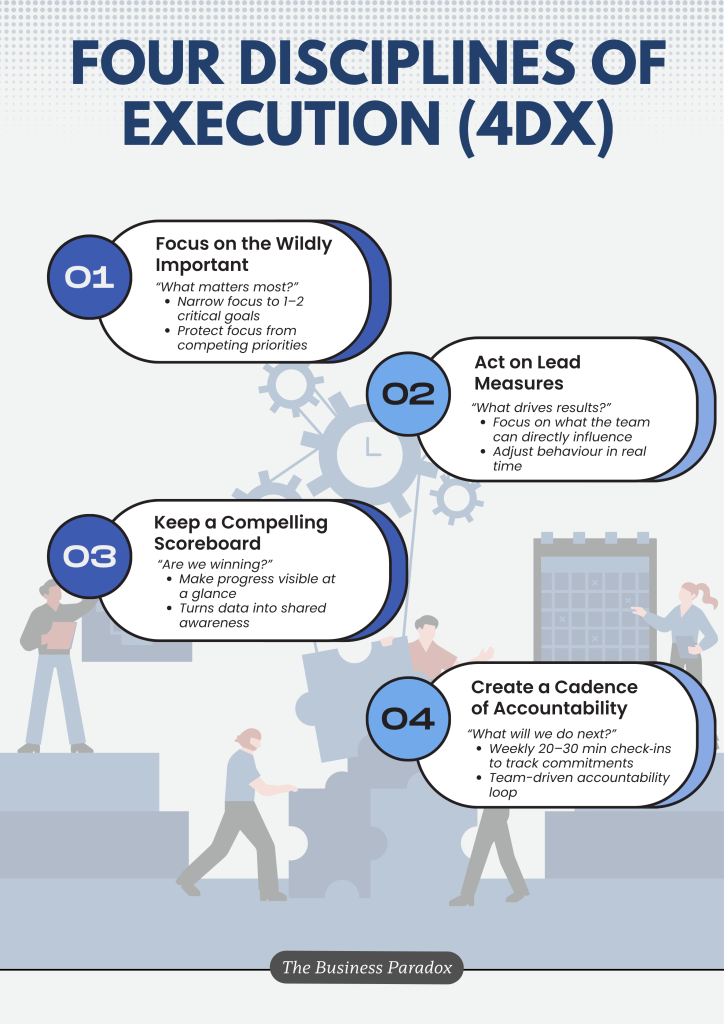
If composure is the internal anchor that keeps a leader steady, 4DX is the operational engine that creates movement. Stability gives you the clarity to act decisively, 4DX provides the framework to follow through. It is the mechanism that converts calm leadership into measurable performance.
Choose What Truly Matters
The instinct in turbulent times is to expand the list, to cover more ground, launch more initiatives, and keep every option open. In reality, it’s one of the most reliable ways to ensure that nothing meaningful gets done. When everything is a priority, nothing is.

The first discipline forces a different choice: narrow the focus to one, at most two, Wildly Important Goals (WIGs). These are the outcomes that would make the greatest strategic difference even if everything else stayed the same. This requires resisting the pull to chase multiple priorities and instead committing to what matters most. Both research and experience are clear: as the number of goals increases, the likelihood of achieving any of them drops sharply.
A WIG is precise, measurable, and time-bound. The standard is simple: move X from Y to Z by when. For example, “increase customer retention from 70% to 85% within 12 months” or “launch a new product line by Q4.” This level of clarity turns strategy into a finish line, something teams can see, measure, and rally around. This matters because it cuts through the noise and provides a clear “why”. When a goal is this specific, it becomes a shared target.
This is also where leadership discipline is tested. A reactive leader struggles to narrow focus because it feels risky. What if the situation changes, or the bet is wrong? A steady and anchored leader does the opposite. Grounded in clarity, they make the hard call on what matters most and hold that line.
Focus on What We Can Influence
The second discipline is the true lever of execution. Most organisations manage by lag measures: outcomes such as monthly revenue, quarterly profit, or annual turnover. The problem is lag measures only tell you what has already happened. By the time they signal a problem, the window to influence the result is already closing or closed.
High-performing teams shift their attention to lead measures: the specific, high-impact actions that directly drive those outcomes. If a WIG is the destination, lag measures tell you whether you arrived. Lead measures are the steering wheel and accelerator: they determine whether you get there in the first place. This discipline reframes performance from outcome-watching to behaviour-shaping. Teams focus on the actions they can take today that predict tomorrow’s success.
For example, instead of simply telling a sales team to “hit the quarterly target,” leaders outline the daily behaviours that make that outcome achievable such as number of outbound calls or speed of follow-up on leads. Or in a firm aiming to increase client retention from 70% to 80%, the lag measure is the retention rate itself and the lead measure might be weekly structured check-ins with key clients. These are actions teams can execute immediately, regardless of market conditions, competitor moves, or macroeconomic noise.
This shift is powerful because it restores agency. Teams can see exactly how their daily behaviour connects to outcomes. Execution becomes controllable and adjustable in real time. A disciplined leader has the steadiness to focus on what can actually be influenced and the patience to trust that the lag measures will follow over time.
Visibility Turns Effort Into Momentum
This is the question the third discipline of 4DX forces leaders to confront: Can every member of the team tell whether they are winning or losing on their most important goal?
4DX makes a critical distinction between a leader’s scoreboard and a player’s scoreboard. The leader’s scoreboard is designed for analysis but the player’s scoreboard is built for engagement. Too often, data is trapped in dashboards or spreadsheets that only a few people see and understand. To close the execution gap, teams need something more immediate that makes progress unmistakable in the moment.
A player’s scoreboard is built around the lead measures that signal future success. It is about the inputs that drive outcomes such as outbound calls made, code reviews completed, response times achieved, or client check-ins delivered. This clarity fundamentally changes execution as teams begin to adjust in real time. It turns progress into something visible, immediate, and shared.

When everyone can see the score, the work itself becomes more intentional. In practice, this might look like a sales team tracking weekly outreach and proposals on a shared board, or a service team displaying response times and resolution rates in real time. What matters is transparency. The scoreboard becomes a focal point that aligns attention and effort. The goal stops being abstract and becomes something the team actively pursues together.
In a permacrisis environment, this becomes even more relevant. When the external world is unstable, a visible scoreboard anchors the team by providing tangible proof of progress. That sense of progress is a stabilising force that sustains momentum when external conditions are unpredictable.
Regular Check‑Ins Drive Progress
The fourth discipline of execution is about creating a structured cycle of review that ensures progress doesn’t fade beneath the weight of daily distractions. It establishes a regular rhythm, typically a short weekly session of approx. 20 minutes, where teams step back to focus exclusively on their WIGs and lead measures. The first three disciplines provide clarity through focus, measures, and visibility. However, without a mechanism to revisit them consistently, they risk dissolving into the background noise of routine work. This recurring cycle is what locks execution in place.
These sessions are intentionally tight and structured. The team reviews the scoreboard, reflects on what is working, surfaces obstacles, and makes clear commitments for the coming week. Accountability is forward-looking and tied to actions each person can directly control. It keeps the WIGs present and active in decision-making rather than buried beneath operational noise.
Importantly, it changes the nature of accountability itself. Instead of a top-down mechanism of review, it becomes a peer-driven commitment system. Team members declare their own weekly actions based on their expertise and ownership of the work. A commitment spoken aloud to colleagues carries a different weight than a task assigned through hierarchy. This shift moves accountability from compliance to ownership.
The session doesn’t need to be perfect, it simply needs to happen. Over time, regular check‑ins surface problems earlier, enable faster adjustments, and make execution more consistent. What begins as a meeting becomes a discipline: the steady rhythm of accountability that transforms execution from a one‑off event into an enduring habit.
Stability as the Platform for Execution
The 4DX framework creates a protected lane for execution within the Whirlwind of daily demands, carving out disciplined space for WIGs so they are not displaced. Stability and execution discipline reinforce each other: stability grounds leaders and prevents reactive decision-making, while 4DX converts that steadiness into measurable momentum. The result is leadership that is not only composed in chaos, but effective within it, consistently advancing what matters most, even in turbulent conditions.
Conclusion: Driving Performance When the Ground is Shifting
Volatility doesn’t excuse a lack of progress, it demands a more rigorous system for achieving it. In an environment of constant change, execution separates leaders who are simply coping from those who are making progress.
Start small: this week, define your team’s single Wildly Important Goal. Name it precisely, then ask, what specific behaviours when repeated consistently would most directly drive that outcome? That is the starting point.
When inner steadiness is combined with 4DX, leadership shifts from reactive management to purposeful execution. The challenge is building structures that keep teams focused and advancing through it. Having clear results prove that disruption doesn’t dictate performance. While volatility may be constant, your team’s performance is steady.
Execution drives motion, stability provides coherence. The next challenge is alignment of intent. In the last part of this series, we’ll move beyond composure and execution to explore strategic clarity. We’ll uncover how it enables leaders to distinguish what matters from what merely demands attention, and set direction that holds under pressure.
Stay ahead with exclusive insights! Sign up for our mailing list and never miss an article. Be the first to discover inspiring stories, valuable insights and expert tips – straight to your inbox!