The Pressure Behind the Numbers
Running a business is relentless. Targets must be hit, investors updated, boards reassured, and teams kept motivated. KPIs become the scoreboard, and every missed number feels existential.
Pressure rarely announces itself as unethical. It looks practical: accelerate revenue, soften losses, polish forecasts. But over time, accuracy yields to appearance. Numbers are shaped to fit the story rather than the facts. Truth bends, then breaks.
That’s where accounting becomes vulnerable. Management, armed with deeper knowledge of the numbers than any outsider, holds informational power. That imbalance invites shortcuts. It begins as “creative accounting” or “interpretation”, always justified as being within the rules.
But when performance targets override professional judgment, objectivity erodes. When auditors fear losing clients, independence weakens. When accountants are asked to align numbers with narrative, conflicts of interest emerge.
History offers a clear warning. Enron did not collapse from a single reckless act, rather, it imploded under a culture where financial appearance consistently trumped financial reality. Ethical erosion is rarely sudden, it slowly creeps in, under pressure, under incentives, under silence.
When trust collapses, the fallout is human before it is financial. Investors retreat, capital evaporates, credibility disintegrates. Yet, behind those numbers are livelihoods, careers, and communities. Ethical accounting is not just about compliance, it is about safeguarding the trust that allows people to believe in the story a company tells.
Trust is The Only Currency That Matters
Valuation models speak the language of revenue growth, margins, and discounted cash flows. But beneath every spreadsheet lies a quieter question: Can these numbers be trusted?
Every financial model is only as reliable as its inputs. If revenue is overstated, expenses deferred, or risks understated, the precision of the model becomes irrelevant. Sophistication cannot compensate for distortion. When credibility weakens, the math itself loses meaning.
Trust is the invisible infrastructure of accounting. Financial statements only matter if they’re trusted. Investors commit capital, creditors extend financing, and employees stake their careers on it. Without trust, financial reporting collapses into noise.
This is why ethical accounting is economically strategic, not merely regulatory. Strong internal controls, independent oversight, and transparent disclosures reduce informational asymmetry and compress uncertainty. Uncertainty carries a hidden tax. It widens risk premiums, prolongs negotiations, raises borrowing costs, and stalls momentum.
Trust is the hidden engine of business. It safeguards reputation, keeps valuations stable, accelerates transactions, and unlocks capital. It’s invisible in accounting, yet decisive in valuation. Growth doesn’t generate trust, trust is what makes growth possible.
The Ethical Bedrock of Accounting
Ethical standards in accounting exist because history demanded them. They were built in response to crises where trust collapsed and markets failed. At its heart, ethical accounting is built on clear, practical commitments.
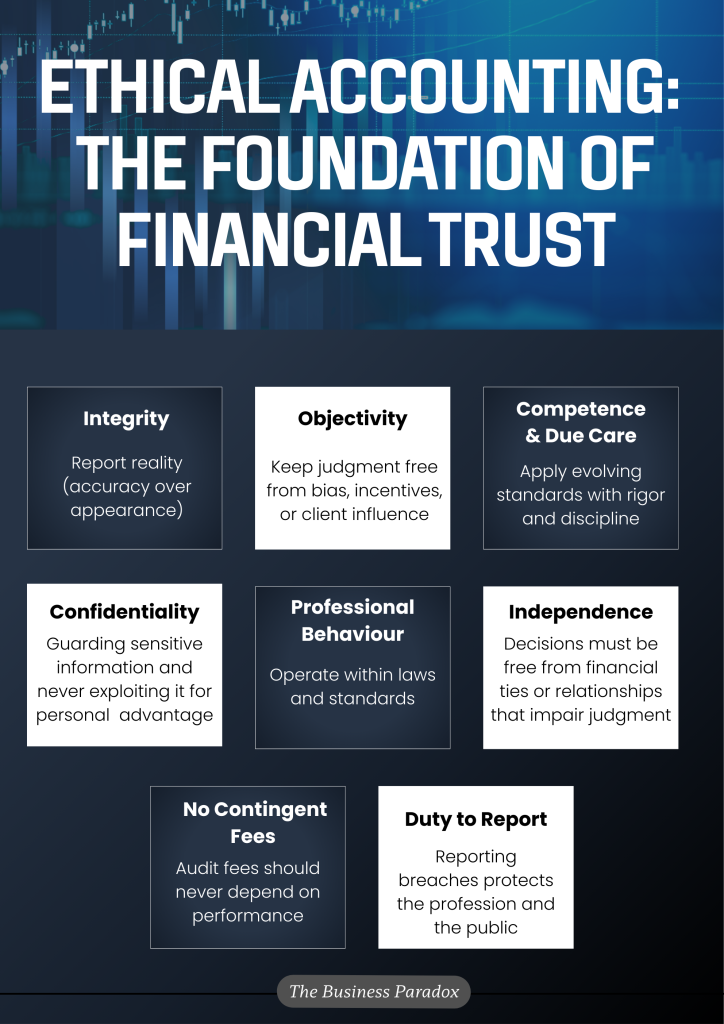
These principles are the profession’s guardrails. They protect investors, creditors, employees, and the public from the consequences of distorted reporting.
When they are respected, financial statements carry weight, decisions are informed, and markets remain stable. When abandoned, they invite fraud, destroy reputations, and fracture confidence. Ethics is the cornerstone of trust, and trust is the foundation of capital markets.
When Confidence Collapses
The early 2000s delivered painful reminders of what happens when ethics fail. Enron collapsed after systemic fraud involving Special Purpose Entities (SPEs) and mark-to-market accounting hid billions in debt. WorldCom’s downfall followed the discovery of nearly $11 billion in accounting entries where ordinary operating expenses were illegally capitalised to make the company appear profitable. Meanwhile, Tyco International illustrated how a lack of ethical oversight allowed for massive unauthorised executive compensation and the circumvention of internal controls.
These scandals shook public confidence, cost investors billions, and exposed how conflicts of interest, weak oversight, and compromised integrity could destabilise entire markets.
In response, the Sarbanes-Oxley Act of 2002 (SOX) transformed ethical standards into federal law. Key mandates included Section 302, requiring CEOs and CFOs to personally certify financial statements, and Section 404, requiring rigorous internal control audits. This shift moved accounting ethics from a voluntary professional code to a mandatory, enforceable architecture designed to protect the public interest.
Legislation is only part of the answer. The deeper work has been cultural: raising standards of competence, reinforcing independence, embedding confidentiality, and reminding accountants that they also have a duty to shareholders, creditors, employees, and the public interest. These crises forced the profession to confront its vulnerabilities and re‑commit to ethics as structural safeguards.
The Culture That Determines the Call
Leadership quietly sets the tone for every number on the books. Accountants provide the data, but the CEO and executives decide whether those numbers tell the full truth or a polished story. When short-term optics take priority over transparency, leaders push teams toward self-interest, leaving investors, employees, and other stakeholders in the dark.
Ethical breakdowns rarely start with fraud, they start with pressure. The demand to “hit the numbers” turns accounting into a battlefield: be honest, or make the figures look good. In cultures where targets matter more than integrity, small compromises quickly become routine.
Strong governance and internal controls act as a shield. Weak oversight, as scandals like Enron and WorldCom showed, creates gaps that even honest accountants struggle to resist. Without robust supervision, powerful executives can bend or override professional standards.
The best leaders empower their finance teams to speak up. They give CFOs and controllers permission to say “No.”
If leaders fail to protect independence or allow retaliation against auditors, ethics remain aspirational. But when leaders champion integrity and demand accountability, transparency becomes non‑negotiable. In accounting, culture is lived practice and it decides whether trust survives or collapses.
Beyond the Balance Sheet
Founders may focus on growth inside the walls of their business, but the numbers their accounting teams produce ripple far beyond. Those statements become signals for investors, employees, governments, and entire markets. Ethical accounting is what makes those signals trustworthy. It’s the difference between confidence and collapse.
At its core, the credibility of accounting is the scaffolding of capital markets. Leaders who champion integrity are protecting the system itself. In an era of skepticism, the most powerful signal a company can send is a financial statement that can be trusted without question. That is the real contribution to the public good: truth in numbers, transparency in practice, and trust that endures.
Who Are We Under Pressure?
We are emerging from an era that glorifies growth at all costs, a time when speed is mistaken for strength and scale for sustainability. But growth without an ethical foundation is not progress, it’s acceleration toward a dead end.
The real question for leaders today is not whether ethics slow growth, but whether growth without integrity can survive the scrutiny of a sophisticated market. When the foundation is strong, scale doesn’t dilute trust, it amplifies it. Transparency becomes a competitive advantage, not a compliance exercise.
Ethical accounting is not a technical hurdle. It is a leadership choice. Every incentive structure a founder designs sends a signal: either reward the truth or demand results at any cost. That choice shapes culture, and culture shapes outcomes.
The companies that consistently choose integrity may not be the loudest, but they are the most enduring. They understand that valuation is more than a function of growth, it is a reflection of trust.
Conclusion: Trust Is Earned Slowly and Lost Quickly

In the rush to scale, leaders often forget that trust needs to be earned. It grows through transparency, objectivity, and the courage to report inconvenient truths. Just like a wall built brick by brick, trust grows through transparency, objectivity, and the courage to report inconvenient truths. Each honest decision is a brick laid with care. But if the foundation is weak, or shortcuts are taken, the entire structure can crumble in an instant.
The real question for today’s leaders is simple: Can growth without ethics survive? Accuracy is more than compliance, it is the protection of a company’s soul and the foundation of its long‑term value. Integrity transforms scale into a multiplier of success rather than a magnifier of risk.
Markets don’t just reward numbers, they reward belief. Belief is earned, consistently, through honesty in every ledger, every report, every decision. Growth can be chased, but trust must be built patiently without any shortcuts. Companies that understand this truth are able to endure because they recognise that the most valuable asset they hold is credibility.
Stay ahead with exclusive insights! Sign up for our mailing list and never miss an article. Be the first to discover inspiring stories, valuable insights and expert tips – straight to your inbox!