The New Competitive Advantage: Global Competence

Employees today increasingly recognise that global competence i.e., the ability to operate, collaborate, and lead across cultures, markets, and business ecosystems, is becoming a defining currency of modern career success. It is built through real overseas exposure and strengthened by global networks and a mindset that looks beyond a single market.
This matters everywhere, but it matters even more in a small city‑state like Singapore, where the domestic market is inherently limited. While organisations champion the need for global‑ready talent, many struggle to provide meaningful pathways for employees to gain that exposure. The result is a widening gap between what companies say they need and what they actively develop.
In a previous article, we highlighted the experiences of two students from the University of California, Berkeley, who built cross‑border experience during their internship in Singapore. Their experiences revealed how transformative overseas exposure can be for young talent and how today’s talent actively seek to bridge the gap between local expertise and global leadership.
That same hunger for global experience has moved beyond students and interns as full‑time employees are increasingly recognising that global competence matters. The ability to navigate cultural nuance, decode unfamiliar markets, and operate confidently across borders now separates those who accelerate from those who stagnate.
Instead of waiting for corporate pathways to open, employees are taking their careers into their own hands. We’re witnessing a shift toward career self‑management, where individuals are:
1. Active Agents: Employees are proactively seeking overseas experiences, from structured international programmes to self‑funded “digital nomad” stints, to build cultural intelligence and future‑proof their careers.
2. Impatient for Growth: When skills expire quickly, rigid career paths become a constraint. High‑potential employees are no longer willing to wait years for development, they want accelerated learning, responsibility, and exposure to complex markets now.
3. Shaped by a Borderless World: With tertiary institutions promoting overseas exchanges, cross‑border internships, and long‑term immersion programmes, Singaporean employees have been primed early to think beyond borders and see international immersion as a natural extension of their professional identity.
Beyond the Little Red Dot
For many individuals, the pursuit of global competence starts in Singapore, where the pace and quality of learning are unusually high. Founders can validate products quickly, stress-test operations, and gain early traction with remarkable efficiency. Few markets combine this level of efficiency with such clarity of feedback, making it an exceptional environment for accelerated learning.
Yet, this early advantage also makes the next step unavoidable. Singapore excels as a launchpad for testing and sharpening a business, but it cannot offer the scale required for sustained growth. An efficient market saturates quickly. A sophisticated customer base is still a small one. The local ecosystem cannot provide the scale, diversity, or complexity required for long‑term global growth.
Once a company proves its business model locally, growth demands what the domestic market cannot provide: larger customer pools, greater diversity, and exposure to less predictable operating environments. At that point, expanding beyond Singapore shifts from ambition to necessity.
Scaling, in revenue, customers, or organisational capability, comes from operating in markets shaped by size, variation, and complexity. To build global competence, founders must extend their reach beyond Singapore and apply their capabilities in markets that stretch them further.
Yet recognising the need to internationalise is not the same as being ready to do so. For many leaders, overseas expansion feels like stepping into uncertainty with new regulations, unfamiliar consumers, and the risk that their teams lack the local experience and networks to execute confidently.
The Real Challenge of Expanding Abroad
While many companies know they need to expand overseas, growth often stalls in the transition from intent to execution. Many Singapore companies commit to regional growth, yet expansion plans stall because they don’t know how to do it. Local teams, while highly capable, often have limited exposure to foreign markets and little familiarity with the regulatory environments, business norms, and day‑to‑day operating realities of neighbouring countries.
This capability gap shows up quickly. Early missteps such as misreading cultural cues, underestimating compliance requirements, or entering without strong local networks, create hesitation. Each setback reinforces the perception that expanding abroad is risky, expensive, and best delayed.
Scaling abroad requires more than market reports and strategy decks. It requires people who understand how business actually works on the ground. The Overseas Markets Immersion Programme (OMIP), launched by Workforce Singapore (WSG), in partnership with Singapore Business Federation (SBF), was designed to meet this need, addressing the shortage of employees with operating experience in overseas markets.
Many companies in Singapore have the ambition to scale beyond our borders. Far fewer have teams equipped to navigate the regulatory rules, cultural expectations, and operational realities of a new country. This gap between ambition and capability is fundamentally a talent challenge. By developing cross‑cultural competence, local networks, and market fluency within their teams, companies can better manage overseas complexity and scale with confidence across borders.
Singapore’s Nudge Toward Global Talent Building
When organisations tap into the outward-looking aspirations of globally minded employees, individual ambition becomes a catalyst for regional growth. International assignments allow Singaporean employees to develop market insight, cultural sensitivity, and the confidence to collaborate and lead across borders. All of which are critical for international expansion.
Singapore has embraced this logic, actively promoting overseas career development as part of its economic strategy. Beyond just funding, OMIP is a forward‑looking response to a workforce that increasingly defines success through global exposure. It helps companies to start guiding, supporting, and benefiting from those global journeys.
By offering structured frameworks and financial support, OMIP empowers companies, especially SMEs and high‑growth startups, to send employees abroad for real‑world market immersion and on‑the‑job training.
In doing so, OMIP aligns three powerful forces:
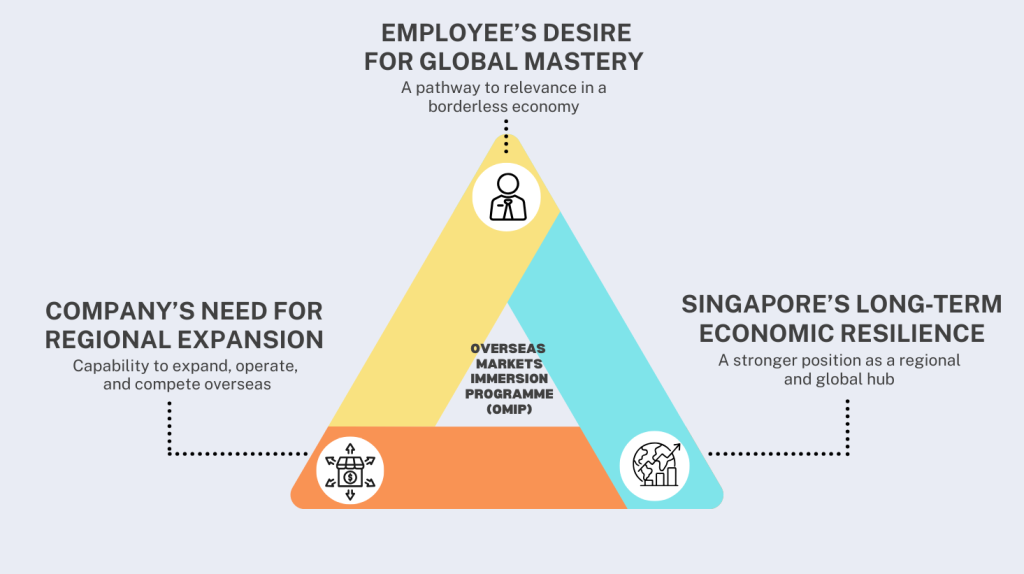
Instead of treating global expansion as a high‑stakes bet, OMIP turns it into a guided progression. By co‑funding salaries and overseas costs, it gives companies the breathing room to develop market‑ready leaders without absorbing the full financial or talent burden. It allows organisations to cultivate the very capabilities they need such as cultural intelligence and regional insight, while reducing the fear of overextending.
How Overseas Immersion Elevates Talent and Business
OMIP creates meaningful value for both employees and companies by developing the kind of in‑market expertise that theory alone can’t produce.
For employees, it opens a real pathway to global experience. Local talent, including those without prior overseas exposure, have the chance to work directly in foreign markets, understand how business is actually conducted on the ground, and build networks. They return with sharper judgment, cultural fluency, and the resilience needed to operate confidently across borders. OMIP gives individuals the lived experience that accelerates leadership growth and strengthens long‑term career relevance in a global economy.
For companies, OMIP is a mechanism to support both international expansion and talent development. Firms can receive up to 70% salary support (capped at $5,000 per month) and 70% overseas allowance support (capped at $3,000 per month) for up to nine months. With SBF as a strategic partner, companies also gain guidance in shaping training plans and exploring internationalisation opportunities.
By embedding real overseas experience within their teams, companies strengthen their ability to adapt and compete in complex global markets. Mobility strengthens talent attraction and retention, while enabling employees to transfer systems, standards, and institutional knowledge. In turn, companies become better equipped to scale efficiently and capture growth opportunities beyond Singapore.
Competing in a Borderless Economy
In a borderless and increasingly interconnected economy, competitiveness no longer hinges on strategy alone. It depends on people who can operate with confidence across markets, cultures, and contexts. OMIP responds directly to this reality by enabling Singaporean companies and talent to compete on an international stage.
By embedding employees in foreign markets, OMIP gives them the cultural fluency and market insight that only lived experience can produce. Participants absorb the unwritten norms that shape trust, negotiation, and partnership. They see how decisions are made, how relationships are built, and how work truly gets done on the ground. When they return, they bring back more than technical skills. They return with trusted networks and global operating standards that strengthen Singapore’s talent base and reinforce its role as a launchpad for sustained international growth.
Conclusion: The Path Forward for Singaporean Firms
Overseas exposure is becoming a prerequisite for both individual relevance and organisational resilience. As markets converge and competition intensifies, global competence has shifted to a core capability. As 2026 unfolds, employees are actively seeking roles that offer meaningful international exposure because they understand that careers built on a single‑market perspective are increasingly fragile.
At the same time, organisations are competing for talent who can bridge cultures, interpret geopolitical shifts, and operate with confidence in unfamiliar environments. Demand is rising on both sides, and the stakes are higher than ever.
The OMIP sits precisely at this intersection. It provides what no classroom or case study can deliver: lived experience in real markets, shaped by real customers, real constraints, and real cultural nuance. The outcome is a workforce that is globally fluent and a Singapore business community better equipped to compete and lead on the world stage.
Stay ahead with exclusive insights! Sign up for our mailing list and never miss an article. Be the first to discover inspiring stories, valuable insights and expert tips – straight to your inbox!