The Emptiness After the Big Win
As the year comes to an end, this is the time when we reflect and take stock of everything we’ve accomplished. Yet, for many of us, we’ve certainly done a lot of work, but the outcome feels insignificant. It stirs a quiet unease: the sense that, despite the projects delivered, the milestones ticked off, we have this feeling that we still haven’t done enough. This is the arrival fallacy at work, the belief that once we reach a certain goal, we’ll finally feel complete. We chase goals believing they hold the feeling we’re missing, only to discover the feeling never stays.
We continually chase more success, more recognition, more wealth, believing that the next achievement will silence the restless voice inside. But as the calendar turns and we look back on twelve months of striving, the gap between what we’ve achieved and how fulfilled we feel becomes glaring. The meaning we thought would arrive with each accomplishment never shows up. Even in December, our minds are racing ahead to next year’s goals, already plotting the next rung on the ladder.
We’re often caught in this achievement loop: we set a goal, pursue it, and eventually reach it, only to find the satisfaction fades quickly. This leads to an emotional plateau, after which we recalibrate and reset for the next pursuit, creating a continuous cycle where ambition drives action, but fulfillment frequently lags behind.
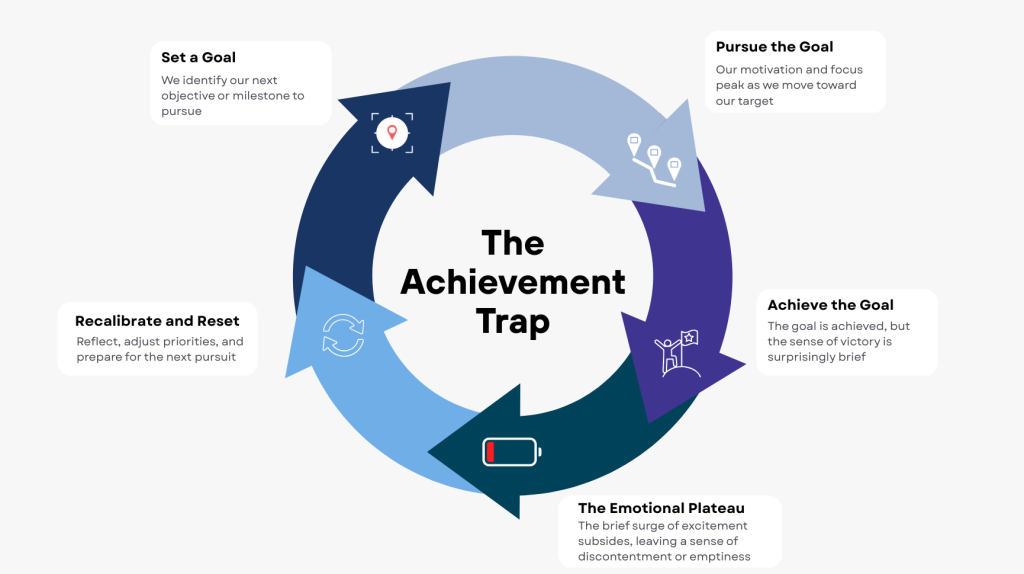
This week’s article explores why achievement often feels hollow, why the pursuit of “more” rarely delivers the satisfaction we expect, and how the culture of constant striving shapes the way we reflect on our careers at the end of the year.
Why the Chase Feels Better Than the Win
Even when we reach major milestones, many of us are left with a quiet question: “Is this it?” The sense of disappointment that can follow a major milestone is a classic example of the arrival fallacy and it has a clear neurobiological basis rooted in the brain’s dopamine reward system. Our brains are not designed for sustained satisfaction, they are designed to anticipate what’s next. The thrill of anticipation inevitably feels more energising than the moment of arrival.
Dopamine, a neurotransmitter linked to motivation and learning, is most active during anticipation and progress toward a goal rather than at the moment of completion. As we move toward an objective, dopamine sharpens focus and sustains drive, but once the outcome is achieved, the brain’s motivational response naturally diminishes. As a result, accomplishments lose their emotional impact far faster than we expect.
When an outcome exceeds our expectations, dopamine signals a positive “surprise,” reinforcing the behaviour. However, when the outcome matches what we predicted, there is little to no additional dopamine release above baseline, because the brain has already anticipated it. Neuroscientists refer to this as the Reward Prediction Error, which reflects the gap between expectation and reality and explains why novelty and striving often feel more motivating than achieving familiar or expected goals.
The brain also adapts rapidly to success and redirects our attention toward the next target. In practical terms, we are wired for the chase. Even our highest achievements rarely feel like enough, because once the fleeting satisfaction fades, the mind immediately shifts to the next goal, leaving us with the persistent question: “Am I there yet, or is there always more?”
Status Anxiety at Work
Beyond neurobiology, our drive for achievement is heavily influenced by deep-seated psychological and cultural narratives about success. From a young age, we internalise the notion that status is measured by wealth, prestige, and visible achievements. As our careers begin, this lesson deepens: progress is expected to be upward and publicly acknowledged. Over time, titles, compensation, recognition, and influence become proxies for our self-worth, quietly fueling a persistent form of status anxiety: the fear of falling behind or being overlooked.
For many professionals, particularly those in mid-career leadership roles, ambition subtly shifts from growth to proof: proof that they are still capable and still valuable. These narratives rarely originate from a single source. They are reinforced through organisational norms, performance metrics, peer comparison, and broader cultural messages that equate success with constant advancement. Over time, the internal question changes from “What do I want?” to “How do I measure up?”

Social Comparison Theory helps explain why this status anxiety is so pervasive. Humans have an innate tendency to evaluate themselves relative to others, which often means looking upward toward peers or colleagues higher in rank. These upward comparisons create a subtle pressure: no matter what we achieve, there is always someone ahead of us. Over time, this fosters a chronic sense of inadequacy and reinforces our belief that we are never doing enough. Our internal measure of success becomes externally defined, and the more we compare ourselves to those ahead, the further the finish line recedes.
Compounding this is a societal narrative that equates busyness with worth and achievement with identity. The need for validation and belonging, which are deeply human impulses, has been effectively monetised by modern professional culture. Leaders feel compelled to take on the next project and chase the next win, not just to signal value to others, but to reassure themselves. In this environment, stopping does not feel like rest, instead, it feels like a huge risk. What emerges is a cycle where the act of working becomes a performance in itself, fueled by the fear of falling short rather than meaningful achievement.
What This Constant Climb Takes From Us
The relentless pursuit of achievement and the continuous upward climb imposes a profound and often hidden toll. The continuous pressure to strategise and perform creates a state of cognitive overload, diminishing our capacity for deep, creative thinking. Emotionally, it fosters chronic disconnection and anxiety: we become alienated from our own intrinsic needs, prioritising external validation over internal well-being, and it breeds a persistent sense that nothing is ever enough.

For leaders, the consequences extend beyond themselves: teams internalise the pace and pressure of leaders. Leaders perpetually chasing the next milestone rarely have the presence or energy to mentor, empathise, or build genuine connection with their teams. Their constant striving translates directly into a stressful, mirrored urgency, inadvertently cultivating a performance-driven culture that prioritises output.
The irony is that this exhaustive striving rarely delivers the fulfillment we expect. Achievement alone cannot fill the meaning gap. Breaking the cycle requires a deliberate shift in perspective by recognising that true value lies not in the next milestone or ‘win’. Rather, we should cultivate the capacity to pause, to embrace restorative rest, to nurture authentic connection, and to find significance in contribution rather than constant consumption. In doing so, ambition transforms from a source of anxiety into a vehicle for purpose, creativity, and sustainable leadership.
Reimagining Success for the Next Season
Breaking free from the cycle of relentless comparison and achievement begins with shifting focus from external validation to internal alignment. Instead of automatically chasing the next promotion, project, or metric, we can pause to ask: “Which goals and pursuits truly matter to me?” Cultivating this inward focus requires intentional reflection and self-awareness to help us distinguish meaningful ambition from culturally prescribed pressure.
A sustainable relationship with achievement hinges on two actions: 1)reclaiming our metrics and 2)revaluing our well-being. It requires consciously choosing which goals truly matter and letting go of the pressure to pursue every metric that appears impressive on paper. It involves intentionally prioritising rest, reflection, connection, and practices that replenish energy and focus. By pairing a personally defined measure of success with an active commitment to well-being, our professional journey and the pursuit of achievement can be a tool for purposeful growth and long-term satisfaction.
When we realign our efforts around personal values, we reduce the grip of upward social comparisons and status anxiety, replacing it with a sense of direction and agency. This inward focus encourages prioritising depth over breadth: building competence in a skill, fostering authentic connection with colleagues, or carving out time for reflection. When our efforts serve something beyond ourselves, we channel ambition into outcomes that are both motivating and genuinely rewarding. Ultimately, the goal is not to stop wanting more, but to recalibrate what ‘more’ actually means: chasing meaningful work over high-profile status, being present over constant production, and personal growth over professional elevation.
Conclusion: Building a Healthier Relationship With Achievement
In the end, the tension between our drive to achieve and the fleeting satisfaction of success is an inherent part of being human. No matter how much we accomplish, our minds will always nudge us toward the next goal. Recognising this pattern is the first step toward a more intentional and fulfilling professional life.
As the year draws to a close, we have a unique opportunity to pause and reflect: to truly acknowledge what we have achieved, to celebrate every small win, and to appreciate the growth and effort that each accomplishment represents. This reflection allows us to reset our perspective, distinguishing between milestones that genuinely matter and the endless chase dictated by comparison or status anxiety.
Looking ahead to the next year, we can pursue our goals with the same drive, but with conscious attention to celebrating each achievement along the way. Rather than rushing from one milestone to the next, we can pause to draw insight and satisfaction from each success before turning toward what comes next. As we continue our ascent, we must cultivate the discipline to stop at each ledge, fully appreciate the view, and deliberately catch our breath before attempting the next climb. By reflecting, acknowledging progress, and embracing these pauses, we can ensure that our ambition enriches our lives rather than depletes them.
Stay ahead with exclusive insights! Sign up for our mailing list and never miss an article. Be the first to discover inspiring stories, valuable insights and expert tips – straight to your inbox!