The Leader’s Role in Everyday Learning
The future of work is evolving faster than most organisations can redesign their training strategies. Technology is accelerating, careers are lasting longer, roles are constantly being reshaped, and work itself is becoming more flexible and fragmented. In a landscape that never stops shifting, the ability to learn is what enables people and organisations to keep moving forward.

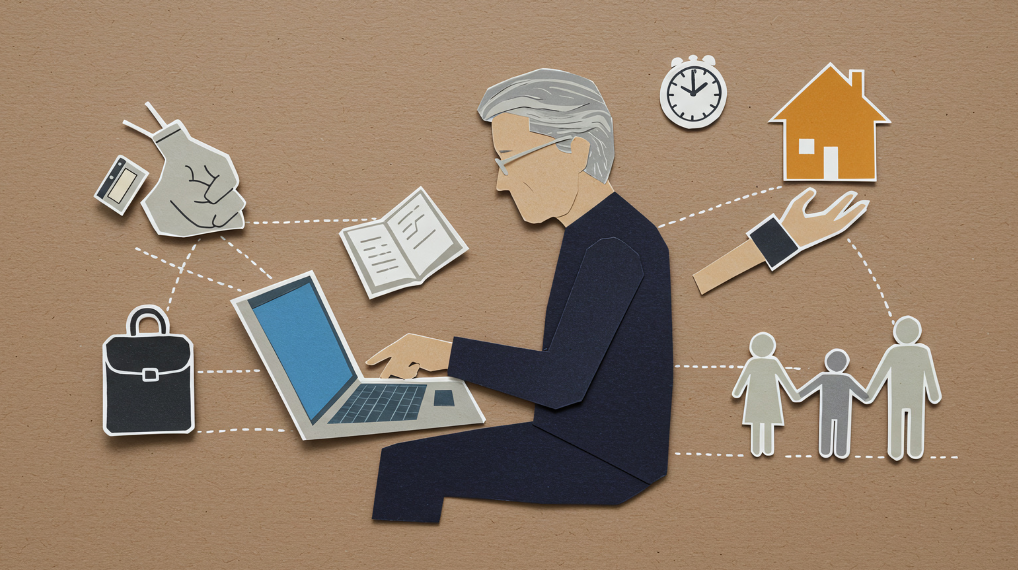
The traditional career ladder has given way to a far more fluid and unpredictable landscape. Careers no longer move neatly upward, rung by rung. Instead, they look more like a maze full of twists, dead ends, unexpected openings, and opportunities that appear only when you turn a corner. You navigate the maze by exploring, backtracking, trying new routes, and making sense of each turn as you go. This is the reality people are faced with today, and it’s why learning has become the essential skill.
Yet many learning models were designed for a time when careers were stable, teams sat together, and roles were clearly defined. Today, remote work has reduced the informal learning that comes from observation and proximity. The rise of gig and informal work has left many people without structured development pathways. As a result, individuals increasingly understand that they must take ownership of their own growth, because no employer can future‑proof their skills for them.
Employees rarely leave their jobs because they want a new title or a marginal pay increase. They leave when they feel they’ve stopped growing. When learning stalls, engagement drops. In a world where a significant share of the workforce will need to shift roles or reinvent their capabilities in the coming decade, people increasingly see stagnation as a threat to their future.
Most people want to keep developing. They want to stay relevant, employable, and confident that their skills will carry them into the future. In a shifting workforce, learning is what keeps people employable and hopeful. Learning does more than build new skills, it gives people a sense of momentum when the future feels uncertain. Supporting that growth doesn’t always require sending them for another course, workshop, or certification. In fact, some of the most meaningful learning happens informally, through solving real problems, collaborating with others, reflecting on experiences, and engaging in everyday conversations.
This is where leadership matters most. An organisation’s competitive advantage depends less on what people know today and more on how quickly they can learn what they’ll need tomorrow. The leaders who thrive are those who create the conditions for learning to happen every day. They foster curiosity, encourage knowledge-sharing, and turn day‑to‑day work into a continuous development opportunity. In a rapidly changing world, enabling people to learn is one of the most effective ways leaders can retain great talent, build organisational resilience, and prepare their teams for whatever comes next.
Why Training Can’t Keep Up with the Pace of Work
Traditional learning models are failing because they were built for a world that no longer exists. They were designed for stable roles, predictable career paths, and employees who learned primarily within a single organisation. Their rigid design doesn’t match the fluid, fast‑changing reality of today’s workforce. While organisational learning has historically focused on building capability for the company, individuals now shoulder much more responsibility to adapt, reskill, and navigate disruption themselves. This is especially true for gig and informal workers, who now make up a significant portion of the global workforce, yet they sit outside traditional training and development systems.
When performance systems reward only speed and output, employees stop taking risks and stick to what they already know. When incentives and reward systems prioritise short-term output, learning is quietly discouraged. In the process, they overlook the social and motivational forces that actually drive lifelong learning. Learning is shaped by the relationships people rely on, the networks they participate in, and the support they receive across work, family, and community. As careers extend, social motives increasingly influence why adults choose to learn. People gravitate toward development that connects them to others and enables them to contribute meaningfully. Traditional systems also miss the value of informal learning: the everyday conversations, reflections, and shared experiences that build confidence and broaden perspective.
It’s important to remember that your team members aren’t passive participants in training, they are adults managing complex careers and real‑world pressures. To lead effectively in 2026, it requires a fundamental mindset shift: learning must be treated as core work. Learning thrives when people work together, reflect on their experiences, and receive feedback, so leaders should design roles that make these interactions part of everyday work. Organisations should also invest in stronger social networks and communities of practice that help people stay motivated and connected. At a broader level, company policies must recognise the pressures employees face outside of work and ensure employees have the time, energy, and mental space required to learn.
4 Key Shifts That Are Reshaping How People Learn at Work
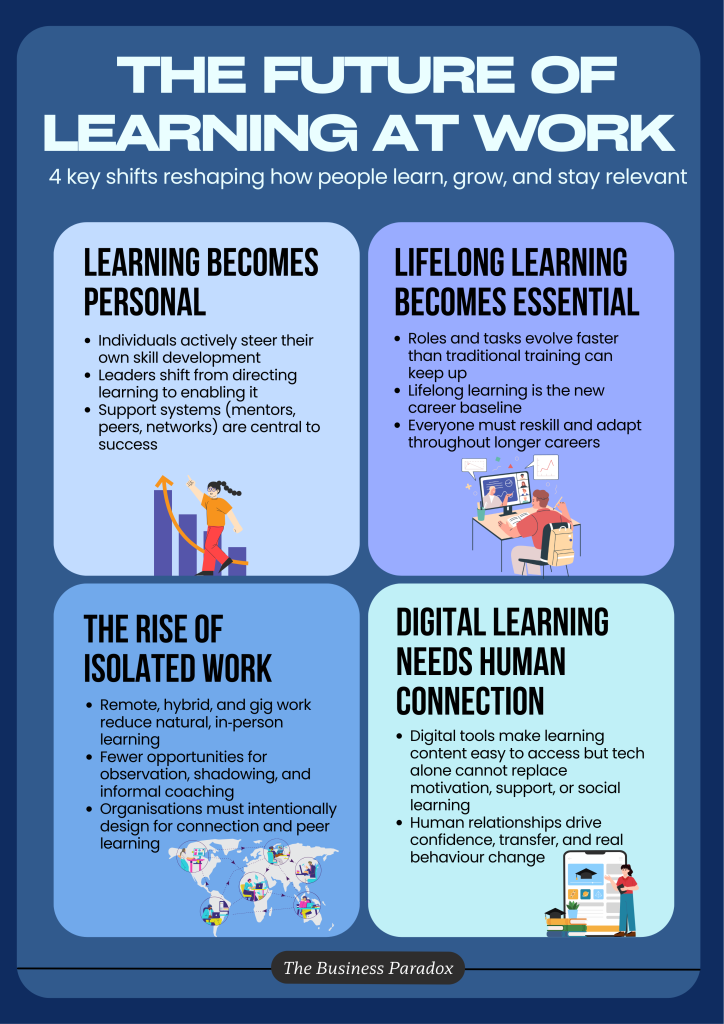
The rules of workplace learning are being rewritten by profound changes in how work is organised, experienced, and sustained. For many workers, this translates into a future where continuous, lifelong learning is essential to remain employable. At the same time, learning is shifting away from organisation-centric models designed to serve company needs, toward more person-centred approaches that recognise individuals must increasingly navigate their own development across roles and life stages.
This shift is intensified by the rise of remote, hybrid, gig, and informal work, which has left many workers to rely on self-directed learning and fragmented networks. While digital platforms and online learning have expanded our access to knowledge, it has also made clear that learning only becomes capability when people have others to learn with and learn from. Learning unfolds through relationships and everyday interactions, not just formal instruction. Organisations must build learning ecosystems that strengthen connection, enable adaptability, and help people keep evolving rather than fall behind.
Why the Best Leaders Prioritise Learning, Not Training
For leaders, investing in learning is no longer about delivering content. It’s about shaping the conditions where learning can happen every day. Training is a one‑off event. It is structured, time‑bound, and often disconnected from real work. Learning, by contrast, is continuous. It grows through experience, reflection, and social connection.
People need a work environment that encourages curiosity, experimentation, and shared problem‑solving. This starts with making learning visible and safe: inviting questions, normalising trial and error, and treating uncertainty as something to explore together. Leaders create space for informal learning when they design work that supports collaboration and knowledge‑sharing, and when they recognise learning that happens through experience. In doing so, they shift from providing answers to cultivating environments where learning thrives.
When leaders invest in learning this way, the impact goes far beyond skill acquisition. Learning becomes a driver of career mobility, helping people move across roles, adapt to change, and navigate transitions with confidence. Over time, it builds self‑efficacy and trust in one’s ability to learn again when the next challenge arrives. This sense of momentum matters. It keeps people engaged, hopeful, and willing to contribute.
Conclusion: What Are You Helping Your People Learn Next?
At the end of the day, the future of learning at work won’t be built on courses or certifications. It will be built on people, their curiosity, their relationships, and the experiences that shape them. The most valuable thing we can do for our teams is to encourage them to learn, not just attend training. Formal courses still matter, but real growth comes from experience, reflection, and doing the work.
Learning happens in the flow of everyday tasks: in conversations that spark ideas, challenges that stretch us, and moments of reflection that help us make sense of change. It grows through problem‑solving with others, observing how colleagues work, testing new approaches, and learning from setbacks. Human connection gives learning its energy and momentum.
People are also taking greater ownership of their own development. They know their careers won’t follow a straight path, and they want to stay adaptable and confident. The role of leaders is not to control that learning, but to enable it. When we create space for exploration, experimentation, and peer learning, we build workplaces where people can grow through change.
Stay ahead with exclusive insights! Sign up for our mailing list and never miss an article. Be the first to discover inspiring stories, valuable insights and expert tips – straight to your inbox!