Why Post-Break Motivation is a Leadership Challenge

Having to return to work after a long Christmas and New Year break is emotionally complex. Time away disrupts the usual cadence of work and we need space to ease back into professional demands. For many, the transition back to work feels like a shock to the system, blending tiredness, reflection, and a quiet unease about the year ahead.
After the new year, many return with renewed personal intentions and rebalanced priorities, but the pressure to ‘start strong’ hits the moment they are back online. While calendars quickly fill up and inboxes are flooded, the emotional transition back into work often lags behind the operational one.
For leaders, January can feel like a moment that demands a fresh start. Leaders are expected to bring energy and direction, and it often becomes a race to regain momentum. But while leaders may be focused on making plans, teams are still recalibrating, both emotionally and mentally.
Employees are carrying questions they may never say out loud: What kind of year is this going to be? Is it worth staying for another one? Will leadership listen, support and show up differently this year or will it be more of the same? These questions shape motivation, trust and commitment long before any targets are set.
The way leaders show up in these early weeks matters more than we realise. Before the first KPI is reinforced, employees are reading the room to see if 2026 will empower them or exhaust them. The emotional tone leaders set in January often becomes the baseline their teams operate from and it can heavily influence whether people choose to stay or go.
The First Decision Leaders Make: Setting the Emotional Tone
The most important choice a leader makes at the start of the year isn’t strategic or operational, it’s emotional. Leaders shape this tone more than anyone else, because their emotional intelligence and leadership style ripple through every interaction and decision. Rather than pushing forward immediately, these leaders recalibrate the team’s energy. Emotionally intelligent leaders recognise that January represents a psychological shift in how people return to work, reconnect with one another, and reassess what matters to them.
All of this matters profoundly as teams return to their routines. Teams don’t instantly return at full speed after time away, and leaders who understand this avoid mistaking urgency for effectiveness. Instead, they see the early weeks as a vital opportunity to rebuild trust and restore clarity. These leaders are intentional about the pace they set, easing teams back in rather than rushing ahead. By tuning into the team’s emotional frequency, they create space for people to reconnect openly and authentically.
How leaders show up in this moment quietly influences motivation, connection and confidence for months to come. As employees come back online, they are deciding whether they feel supported or simply managed. Leaders who influence with intention help shape a story of belonging, and that story is what carries performance forward when the new-year optimism wears thin.
Why Buy-In Comes Before Execution
At the start of a new year, many leaders unintentionally weaken buy‑in by rushing straight into targets and tasks. They lead with the what instead of the why, introducing new metrics or a heavier workload without grounding them in meaning. When work feels like an added burden, people shift into a transactional mindset. Likewise, leaders who rely on urgency as a motivational tool may simulate momentum but this also heightens anxiety. Building buy-in requires a different approach: one that ties goals to shared purpose, reinforces why each role matters, and leads with awareness of what people need in the moment.
Buy-in is what separates teams that merely comply from teams that truly contribute. Leadership is not about getting people to follow your instructions, it’s about inspiring them to care about the outcome and see the team’s goals as their own. Influence works the same way: it’s not about pushing certain behaviour, it’s about shaping beliefs. Before people act, they need a shared understanding of why their work matters. When teams trust in their collective ability, collaboration flows naturally and people step in to support one another.
Teams follow the cues their leaders give long before any instructions are spoken. Every interaction models the unwritten rules that signal it’s safe to ask questions and challenge ideas. These patterns build a social safety net: one where shared norms sustain momentum even when individual energy dips. Buy‑in is something leaders cultivate and it grows when people feel seen and supported. January is where that groundwork begins, through intentional actions, visible care and the emotional tone leaders set from the outset.
This is why buy-in must come before execution. When people don’t believe in the purpose or the way of working, they’ll simply do what’s required. When belief and motivation are shared, teams work together and the results becomes a shared win.
The 4 Leadership Anchors That Shape The Year Ahead
The start of the year rests on four leadership anchors that together LIFT teams and embody the principles of transformational leadership: Loyalty, Inspiration, Facilitation, and Trajectory. At its core, transformational leadership is defined by its ability to inspire and motivate teams.
L – Loyalty & Belonging: Leaders build loyalty by creating a genuine sense of belonging. Through trust, empathy and psychological safety, they make people feel valued and supported.
I – Inspiration & Motivation: Leaders ignite motivation by connecting individual purpose to collective goals. This fuels intrinsic motivation, encouraging team members to go above and beyond because the work feels meaningful.
F – Facilitation & Influence: People follow what leaders demonstrate, not what they demand. Leaders shape team norms by modelling the behaviours and collaboration they want to see.
T – Trajectory & Direction: Leaders establish the path ahead by setting clear goals and communicating them consistently, so people know what they’re working toward and why it matters.
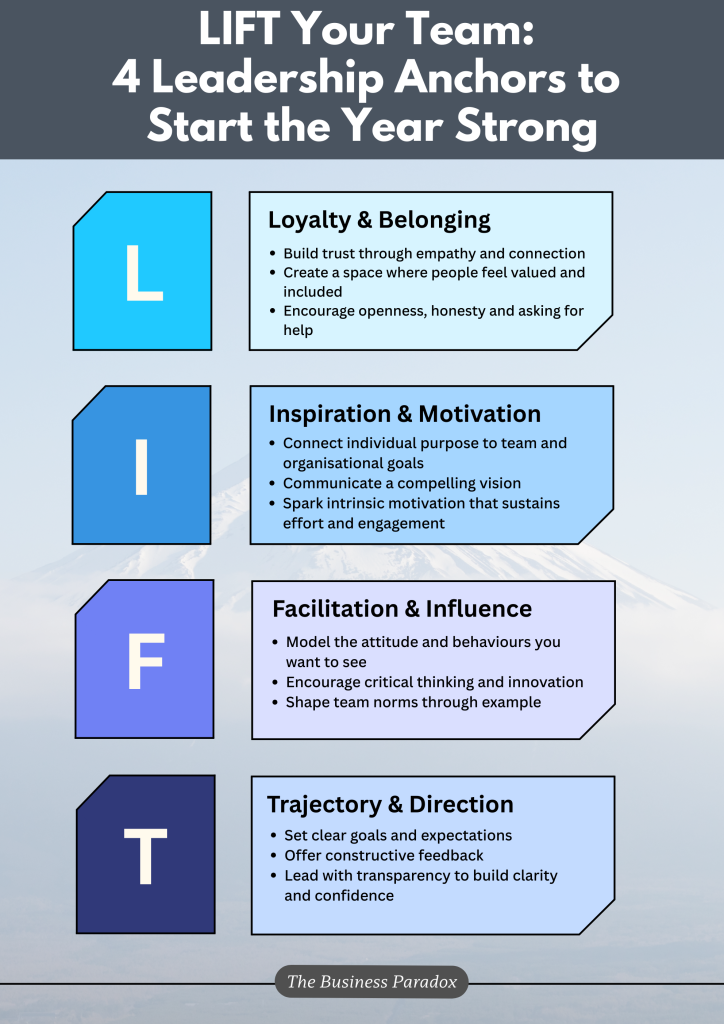
Together, these four anchors capture the essence of transformational leadership: a style that strengthens commitment, boosts satisfaction, and builds a dynamic environment where people are empowered to grow.
LIFT is designed for the moments when leaders want to elevate their teams, reconnect them to a shared purpose and guide them through periods of change. It will be most effective in contexts that demand trust and clarity, such as new beginnings, periods of uncertainty, fast growth or engagement challenges.
What Leaders Should Prioritise in The First Weeks of the Year
As work ramps up again, leaders should prioritise belonging, connection and motivation before performance metrics, because how people relate to one another determines how work actually gets done. Most organisational goals are interdependent, relying on cooperation, trust and the willingness to share effort and knowledge.
When leaders intentionally build strong relationships, foster cohesion and reinforce a shared identity, they create an environment where prosocial motivation thrives. In these environments, people are driven not only by personal success, but by a genuine commitment to one another and to the collective outcome. This shared mindset encourages openness and collaboration, reducing defensive behaviours that undermine performance.
In contrast, work cultures that emphasise individual rewards and short-term metrics often trigger self-protection. People focus narrowly on their own tasks, withhold effort or information, and disengage from the wider team. Leaders who model trust, care, and reciprocity shift this dynamic, creating a social climate where cooperation feels safe and worthwhile. In doing so, performance becomes a natural by-product of people working together. Motivation and belonging matter first because they determine whether people truly care about the work and whether they will support one another through the inevitable challenges ahead.
Conclusion: Creating Momentum That Lasts All Year
The start of the year is a chance for leaders to reconnect with the people behind the work. When leaders take the time to understand their team’s feelings, mindset and aspirations, they set an emotional tone that shapes the months ahead.
By cultivating belonging, sparking motivation, modelling the behaviours they want to see and offering clear direction, they create an environment where people feel valued, supported and confident to give their best. At the end of the day, teams do their best work when they feel seen, inspired and guided.
Put simply: lift up your people, and they’ll lift the work.
Stay ahead with exclusive insights! Sign up for our mailing list and never miss an article. Be the first to discover inspiring stories, valuable insights and expert tips – straight to your inbox!