Chasing The Entrepreneurial Dream
As you scroll through your LinkedIn feed, you see another person breaking from the corporate script to build something of their own. Meanwhile, you’re stuck in endless meetings and a job that has become achingly dull, dealing with the profound frustration of working for a boss who fails to acknowledge your impact. The instinct is to escape and the answer may seem obvious: time to strike out on your own. The entrepreneurial dream feels like such an enticing option when you picture the freedom, the autonomy, the thrill of calling the shots.
By the time you hit mid‑career, the urge to carve out a legacy and claim ownership often intensifies. Yet, we need to unpack this illusion that entrepreneurship automatically delivers liberation and control. The idea of a ‘dream job’ can be misleading because every job has its rewards and challenges. There will always be tough moments and launching your own business is guaranteed to require more effort and more sleepless nights than you are currently experiencing as an employee.
Instead of leaping headfirst into resignation and reinvention, we’ll examine the practical demands of entrepreneurship, unpack our cultural obsession with founders, and help you reflect whether staying put, switching tracks, or starting anew is the move that truly fits your goals.
The Complexity of Career Decisions
Career decision-making rarely feels straightforward or logical, it is often an emotionally charged process that sits at the intersection of personal identity and professional analysis. Uncertainty is unavoidable. Professionals must weigh alternatives, interpret imperfect information, and make choices without full clarity about future roles, industries, or life circumstances. Some navigate this through structured frameworks and systematic evaluation, while others lean on intuition or instinct. Most of us do both.
Along the way, support systems such as mentors, peers, coaches, and increasingly AI-based tools, play a crucial role in helping individuals make sense of this complexity, especially in volatile labour markets. The importance of key decision factors shifts over time: income, advancement prospects, autonomy, work–life balance, and alignment with personal interests rise or fall depending on life stage and priorities. Additional variables such as risk tolerance, family expectations, and the need for lifelong learning further complicate the landscape.
Career decisions are not singular events, but recurring choices shaped by evolving values, changing circumstances, and new opportunities. Acknowledging the normalcy of indecision can help professionals make choices that are more grounded and intentional.
Should You Stay, Switch, or Start?
Mid-career professionals often arrive at a crossroads where the momentum that once fuelled their growth begins to slow. The plateau arrives gradually: first as slower progression, then as reduced strategic visibility, and eventually as a sense of stagnation. Being overlooked for promotions or even facing job loss can trigger disillusionment and uncertainty. As such, mid‑career is a pivotal phase that demands recalibration.
At this inflection point, three pathways usually emerge:
1. Stay: By deepening expertise and embracing the stability of a familiar environment
2. Switch: By exploring new companies or industries that offers renewed challenge
3. Start: By venturing into entrepreneurship with all its risks, freedoms, and demands
These decisions are often shaped by structural factors such as flatter organisations, limited advancement pathways, rapid technological change that exposes skill gaps, and shrinking middle-management tiers. At the same time, they are also driven by personal factors: shifting values, a desire for purpose, and reassessments of work–life balance. We begin to question what motivates us, what energises us, and what kind of impact we want to create in the second half of our careers.
In a world where careers are no longer linear, this mid-career pause is a chance to align our work with who we are becoming. It is a chance to realign and actively shape the future path rather than passively continuing along the old one. What matters is using this moment to look honestly at what you want next: stability, reinvention, or the freedom (and pressure) of entrepreneurship.
Why Do We Idolise Entrepreneurs?
Part of the allure comes from a growing frustration with traditional employment. Founders are celebrated as people who have successfully “opted out” of corporate constraints. They embody the values our culture now prizes most: autonomy, control, personal freedom, and the ability to shape one’s own narrative.
Social media amplifies this ideal by turning entrepreneurship into a public spectacle, portraying founders as visionaries and framing risk-taking as a marker of courage. Entrepreneurship feels so attainable because we mostly see the victories. The failures stay hidden in the background, so our minds start to believe the path is clearer than it really is. This is a classic case of survivorship bias. What’s spotlighted are the polished successes: the fast-scaling startups, the effortless-looking personal brands, the profitable exits. What remains invisible are the far more common truths: years of uncertainty, multiple abandoned ideas, intense financial pressure, and emotional exhaustion.
This selective visibility distorts our understanding of what entrepreneurship really entails, creating the impression that it is the clearest path to self-actualisation even when the odds of success are low. In the end, what we pursue is often not the discipline of entrepreneurship, but the allure of what it represents. We’re chasing the story we’ve attached to entrepreneurship: a symbol of freedom, meaning, and sense of agency.
The Truth About Building Your Own Path
Trading your employee status for the title of “founder” doesn’t grant you immediate freedom, it just exchanges one set of masters for many harsher ones. Instead of answering to a single boss, you now report to the entire ecosystem: your customers, your investors, your suppliers, and the unforgiving fluctuations of the market.
This new reality demands sacrifices on three key fronts:
1. Operational Burden:
Entrepreneurship means taking full ownership of the unglamorous foundations of a business. You alone must navigate complex regulatory hurdles, from tedious tax compliance to the bureaucratic maze of formalising a company. When something goes wrong, the financial liability rests entirely on you. Beyond running the business, you must constantly and proactively secure the necessary capital to simply keep the doors open.
2. Strategic and Market Risk:
In the early stages, you must operate simultaneously as strategist and executor, often filling roles that span across functions. You have to understand the market as it shifts beneath your feet, respond to volatility, and compete with global players who hold far more resources and influence. Every new venture faces systemic barriers and an unavoidable “trust deficit” as an unknown brand. The pressure to stay relevant, differentiated, and credible never lets up.
3. Personal Cost:
The promise of autonomy quickly gives way to the reality that you must become the expert in everything. You have to develop a wide span of competencies, from leadership and emotional intelligence to operational and strategic acumen, while simultaneously filling every gap in your organisation. Every critical decision, every resource allocation, every value creation choice lands squarely on your shoulders. It is high-stakes, unending, and demands a level of resilience and readiness few anticipate.
When Work Defines Too Much of Us
We live in a culture that often conflates net worth with self-worth, routinely blurring the line between what we do and who we are. It subtly teaches us that our careers should be the primary source of meaning in our lives. It’s no surprise, then, that many mid-career professionals anchor their identity almost entirely to their roles, titles, or achievements. But the danger of this over-identification is that it makes our sense of self fragile and conditional, becoming contingent on forces we cannot fully control.
This over-identification creates a dangerous emotional spillover. A sharp critique from a manager, a promotion that goes to someone else, a redundancy exercise, these moments don’t just feel like a professional setback, it feels like a personal failure. Instead of seeing them as part of a broader career journey, we internalise them as a verdict on our value. When our identity is welded to a job title or a company, even minor turbulences can feel existential, because there is no buffer between the role we play and the person we are.
By allowing work to dominate our identity, we crowd out the stabilising anchors that give life continuity: relationships, health, creative pursuits, service to others, and our sense of community. These are the domains that sustain us when work becomes unpredictable, yet they are often the first sacrifices made in the pursuit of career success. A career is one dimension of personal expression but it is not the sole stage on which our identity is performed. When work is simply part of your life, not the whole of it, you gain the flexibility to stay, switch, or start something new without feeling like you are dismantling your entire self in the process.
For many mid-career professionals, the lure of entrepreneurship intensifies at the exact moment corporate life begins to feel constrained. This happens when growth plateaus, politics overshadow purpose, or the work no longer aligns with personal values. Career choices at mid‑life should not be rooted in dissatisfaction, but in the pursuit of purpose. It calls for a clear assessment of your resilience, strategic thinking, risk appetite, and long-term vision.
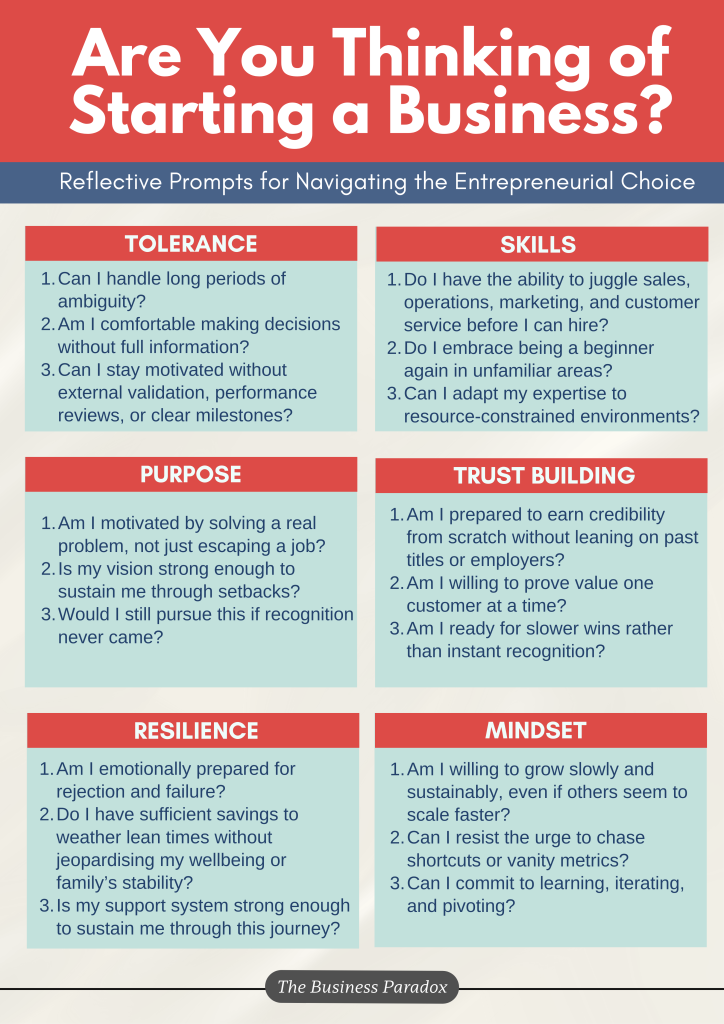
Building a business from scratch demands capabilities that often sit outside traditional corporate comfort zones. You must cultivate a brand without inherited credibility, win customers against incumbents with deeper pockets, manage scarce resources, and navigate the slow realities of sustainable growth. Whether it’s carving out a niche, iterating your product under pressure, or expanding regionally before dreaming globally, these become non-negotiable survival skills. Entrepreneurship is a testing ground for patience, adaptability, and personal conviction.
Conclusion: Success on Your Own Terms
At the end of the day, the choice between remaining an employee or becoming an entrepreneur is an intensely personal one. Not everyone needs to be a founder. It’s not about chasing trends, comparison, or proving your ambition to anyone else. It’s about asking, with honesty and clarity: What do I want my life to look like? The right choice depends on your values, your risk appetite, and the kind of impact you want to create.
For some, that means the autonomy and challenge of creating something new. For others, it’s the stability and meaningful impact found within an organisation. Entrepreneurship isn’t automatically better than employment, and stability isn’t a lesser ambition than autonomy. What matters is alignment to your goals, your energy, your life. The right path is the one that fits your life, not someone else’s narrative.
Stay ahead with exclusive insights! Sign up for our mailing list and never miss an article. Be the first to discover inspiring stories, valuable insights and expert tips – straight to your inbox!