Is 2 Years is the New 10?
Have you looked closely at the average tenure on your team and noticed how often it clusters around the same period?
Across industries, a growing number of Millennial and Gen Z employees are leaving roles far earlier than previous generations did. This isn’t generalisable to every team or every industry, but the pattern is consistent enough that leaders should pay attention. It typically shows up most clearly in the 12- to 24-month window, right after the initial learning curve flattens.
When your strongest performers consistently walk out the door after 18 months, it’s often because they’ve hit a growth ceiling you didn’t realise was there. In a market where opportunity is abundant and mobility is frictionless, people will move when a better path appears. If a competing organisation offers a more expansive future, whether through impact, development, or rewards, employees reassess where they can grow most.
For Millennials and Gen Z, a job is no longer a lifelong commitment. Careers are now constructed across multiple companies, with people accumulating skills, experiences, and credibility along the way. They are not leaving at random, they are asking a simple question: Where is this taking me? They will stay where growth is visible and their contribution compounds over time. When that sense of momentum disappears, so does their attachment. Leaders often interpret this as disloyalty, but it’s better understood as a logical response to a market that rewards growth, not tenure.
For early- and mid-career professionals, staying is an intentional choice, and it has to be continually earned. When that choice shifts toward leaving, it’s usually less a reflection of the individual and more a reflection of the environment they are navigating.
From Holding On to Being Chosen
Many leaders focus on retention tactics such as bonuses, counteroffers, engagement surveys, and perks designed to keep people from leaving. While these can be useful, they often treat retention as a problem to manage rather than a question to understand. In doing so, leaders risk missing the more important issue altogether: what makes this a place worth staying?
When retention strategies revolve around blocking exits, they treat the symptoms rather than the underlying conditions. It might delay turnover, but it won’t deepen engagement or commitment.
The more powerful question shifts the focus from control to choice. What about this environment makes people want to keep showing up? What signals to them that their effort, growth, and potential are valued here? When leaders build workplaces that answer those questions, retention becomes a natural outcome.
In the end, people don’t stay because they’re convinced to. They stay because the experience aligns with who they are and who they aspire to be.
Why Employees Leave Sooner Than You Think
Herzberg’s Two-Factor Theory captures a fundamental truth about work: people don’t stay because work is tolerable, they stay because it feels worthwhile. The Maintenance vs. Meaning distinction offers a simple way to understand why people stay or leave.
Maintenance factors are the foundational elements that prevent dissatisfaction. They cover the essentials employees expect as a baseline for employment: fair compensation, reasonable hours, a safe and comfortable working environment, supportive leadership, and respect for life outside of work. When these basics are missing or inadequate, employees experience frustration, stress, and a sense that their future is constrained.
In such environments, turnover tends to be rapid, often with little hesitation since the cost of leaving feels lower than the cost of staying. Maintenance factors create stability, but they do not inspire commitment.
Meaning, on the other hand, explains why employees actively choose to stay. It’s what transforms work from a set of obligations into a source of personal and professional fulfillment. Meaning comes from the factors that motivate people beyond the basics: opportunities for visible career progression, continuous learning, recognition for contributions, the ability to take on meaningful responsibility, and the feeling that one’s work genuinely matters. They stay because leaving would mean giving up growth, purpose, and relationships that matter.
Put simply: Maintenance stops people from quitting today, Meaning stops them from quitting tomorrow. Leaders that focus only on Maintenance may prevent immediate turnover, but without Meaning, they risk losing their most capable and ambitious employees.
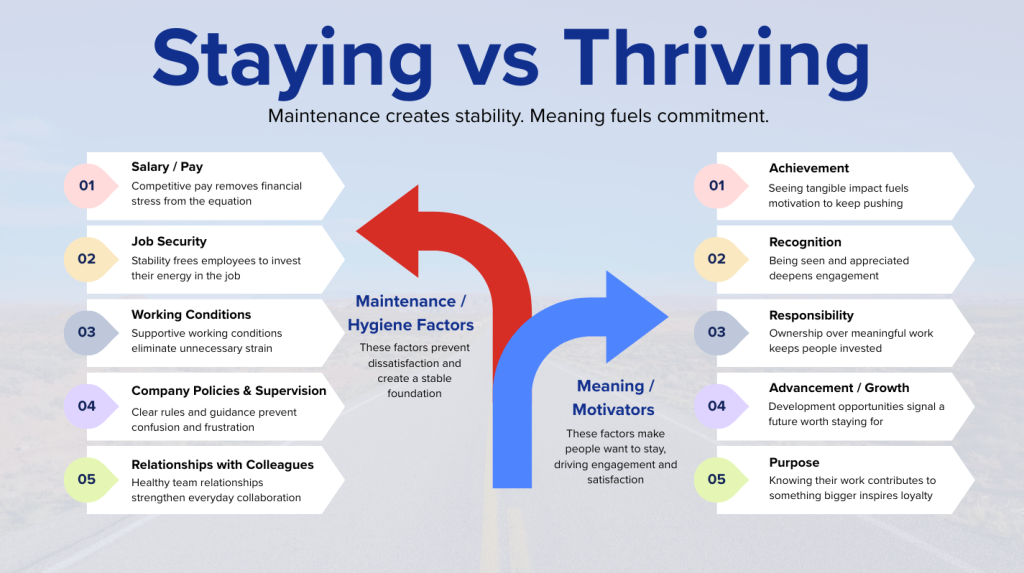
Retention is less about preventing departure and more about creating an experience people actively want to stay part of. While competitive pay, reasonable hours, and supportive leadership set the foundation, it is Meaning that cultivates long-term commitment. A workplace that masters both inspires people to thrive and they will continue to advocate for the organisation long after they’ve left.
Why People Stay: The Embeddedness Advantage
This commitment doesn’t happen by accident. It’s reinforced through the relationships people build, the alignment they feel, and the value they would give up by leaving.
Job Embeddedness Theory explains why people stay. It’s not just pay or perks, but a web of small, powerful forces that anchor them in place. To keep top talent engaged, leaders need to focus on three strategic dimensions:
1) Links: The relationships and commitments people build with colleagues, mentors, and key projects. Every high-value connection increases the social cost of leaving. Strong links make people feel part of something bigger than themselves.
2) Fit: The alignment between a person’s values, strengths, and aspirations, and the role, culture, and trajectory they experience. When employees see a match, external opportunities start to feel like a step backward rather than forward.
3) Sacrifice: The status, benefits, momentum, and identity they would give up by walking away. The experience they have with you (e.g., growth, recognition, and influence) must outweigh any extra money they might get elsewhere.
When these forces are strong, employees feel rooted. They identify with their team, draw confidence from shared goals, and rely on their workgroup for support and opportunity. They invest more, contribute visibly, and strengthen the social fabric around them.
As ties deepen, the desire to differentiate or distance themselves fades. Leaving becomes costly, not just financially, but socially and emotionally. The job “sticks” because the relationships, alignment, and accumulated value are hard to replace.
Conversely, weak embeddedness creates drift. Without strong links, clear fit, or meaningful sacrifices, people disengage. Opportunities outside start to look more attractive. In short, embeddedness transforms a job from a stopover into a place worth staying.
The Best Leaders Re‑Recruit Their People
To keep a high performer from looking at the door, you need to re-recruit them every twelve months. That means treating each year as a fresh opportunity to earn their commitment. The leaders who retain top talent don’t rely on assumed loyalty, they actively cultivate it. They design workplaces where growth is visible, autonomy is real, and support is consistent.
Competitive pay can attract talent, but it rarely keeps them. Retention is not transactional, it’s relational. Re-recruiting requires a holistic approach: nurturing growth, recognising contributions, and supporting who employees are becoming. When people feel they are evolving and growing with you, they don’t need to leave to find opportunity elsewhere.
A truly great workplace earns loyalty long after someone moves on. Employees who feel developed, respected, and supported leave as advocates, referring top candidates, partnering as clients, or even returning with greater capability. That’s the long-term return on investing in people, not just positions.
This is your annual reminder to re-recruit your people. Some will stay five years, some two. What matters is that while they are in your team, they are fully engaged and fully contributing. The true measure of retention is the depth of engagement and the level of investment people bring to their work while they’re with you.
The companies that do this well build cultures where people choose to stay, grow, and advocate, because they want to. That is how leadership turns talent into a sustainable advantage.
Conclusion: Short Careers, Big Impact
Maybe it’s time to retire the idea that a “long-term employee” is inherently more valuable than a “short-term star” and ask yourself: would you rather have two years of peak performance or ten years of stagnant loyalty?
As a founder or leader, the goal shouldn’t be to keep people forever. Your job is to build a platform that helps them become the strongest version of themselves while they are with you. When you invest in embeddedness (i.e., the relationships, the belonging, the social web) and pair it with real motivators like autonomy and ownership, you stop managing tenure and start building momentum.
At the end of the day, don’t take an exit personally. If a top performer leaves after two years, it’s also a sign that your company was the launchpad they needed. Celebrate the impact they made, the growth they achieved, and the reputation they carry into the world. Be the leader who builds an environment so high‑impact that your alumni become your advocates and send talent back to you to start the cycle again.
Stay ahead with exclusive insights! Sign up for our mailing list and never miss an article. Be the first to discover inspiring stories, valuable insights and expert tips – straight to your inbox!