Why Rest Never Feels as Restful as We Expect
If rest were simply the absence of work, most of us would feel better than we actually do.
You might return from a two-week holiday spent “switching off” and doing very little, only to feel mentally foggy, restless, and already craving the next escape. Yet, after a demanding session of a challenging hobby such as mastering a complex musical piece or training for a marathon, you often feel an unexpected sense of calm, focus, and clarity.
We live by a rigid binary: grinding through work, then collapsing into leisure to “refill our tank.” We’ve been taught to think about our energy like a battery: work drains us, leisure recharges us. When we feel depleted, the solution seems obvious: more time off, more holidays, more disconnection. Yet, this model is flawed. It turns leisure into a remedy for exhaustion rather than a source of renewal, something we cling to in order to survive the week rather than a rhythm that sustains us.
Within the achievement trap, this logic becomes even more insidious. Rest starts to feel like something we must earn. Leisure becomes a reward for exhaustion, reinforcing the belief that burnout is the price of success.
The real question isn’t how to work less or escape more, but how to design time (across both work and leisure) in ways that genuinely restore us. This requires moving beyond the false binary that pits work against rest, and toward a more integrated understanding of how humans renew energy.
We don’t necessarily need more time off. Maybe we need a better way to spend the time we already have.
Why We Treat Work and Leisure as Opposites
Our struggle to recharge isn’t simply about having heavy workloads or too little time off. It stems from a long‑held narrative that treats work and rest as opposites. We see them as mutually exclusive, as if life naturally separates effort from recovery.
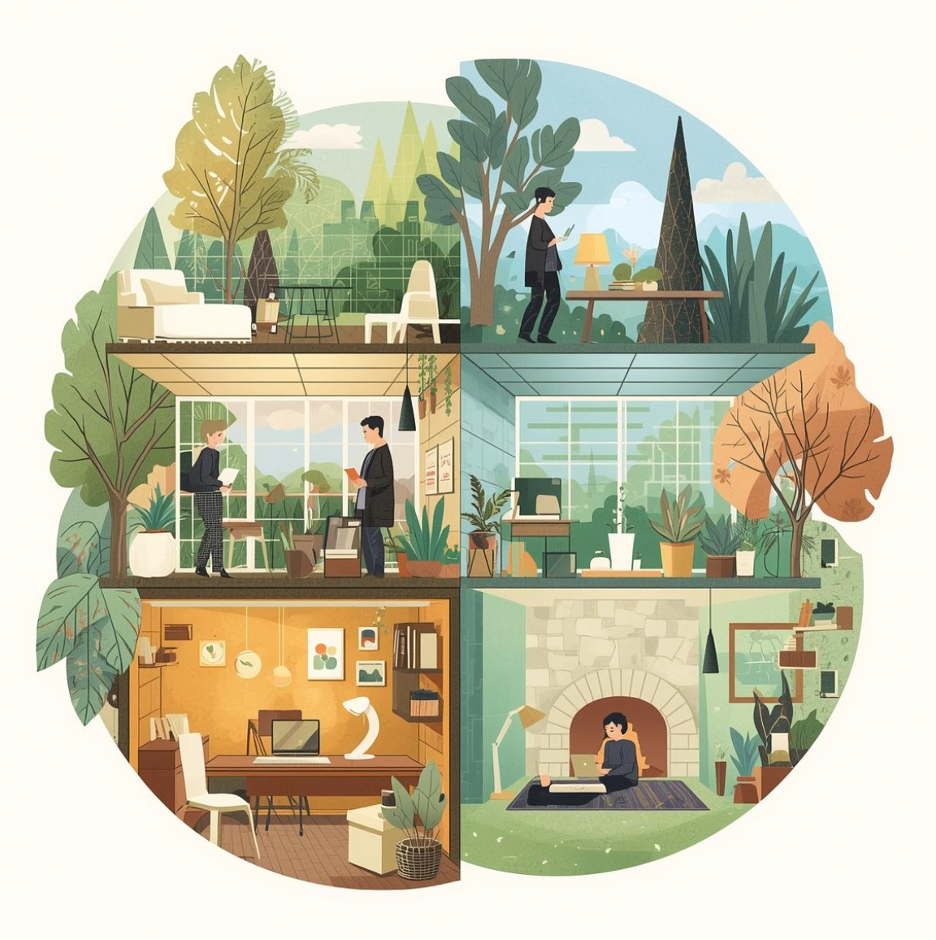
This belief that work and leisure are opposites has deep historical roots. For centuries, work has been framed as necessary for survival. Paid labour provided the means to meet basic needs for food and shelter, making it obligatory. In contrast, leisure was seen as optional, a time for creativity or social connection, separate from the “real” work of sustaining life.
Economic and philosophical ideas reinforced this divide. Neoclassical economics defines leisure simply as time not spent earning money. Marx described work as the “realm of necessity” and leisure as the “realm of freedom.” We learn to see work as a grind endured for a paycheck, and leisure as the reward that comes afterward. Society has long valorised work as morally good and essential, while idleness is stigmatised.
Industrialisation further widened the gap. By moving labour out of the household and imposing the factory clock, it replaced natural, flexible rhythms with strict schedules. Work became mandatory, and rest a scarce resource. In today’s modern work environment, our “always‑on” culture stretches this further. Technology blurs the boundaries but reinforces the split: work drains our energy and recovery can only happen outside of it. Even “work‑life balance” discussions often reinforce the binary, implying leisure steals from career progress and work steals from personal freedom.
Many of us treat downtime as something to “catch up” on after a gruelling day of work. In reality, rest isn’t about escape, it’s about weaving recovery into the rhythm of life, so energy and well‑being can flow continuously.
The Needs That Quietly Shape Both Work and Leisure
We return from our holidays tired because we confuse escape with restoration. We treat rest as somewhere we travel to, rather than a state we learn to enter. Research shows that restoration depends on meeting specific mental and emotional conditions, not on physical inactivity or distance from work. This explains the “beach paradox” where you can be lying under a palm tree doing nothing, but if your mind is rehearsing Monday’s presentation, your nervous system is still at work.
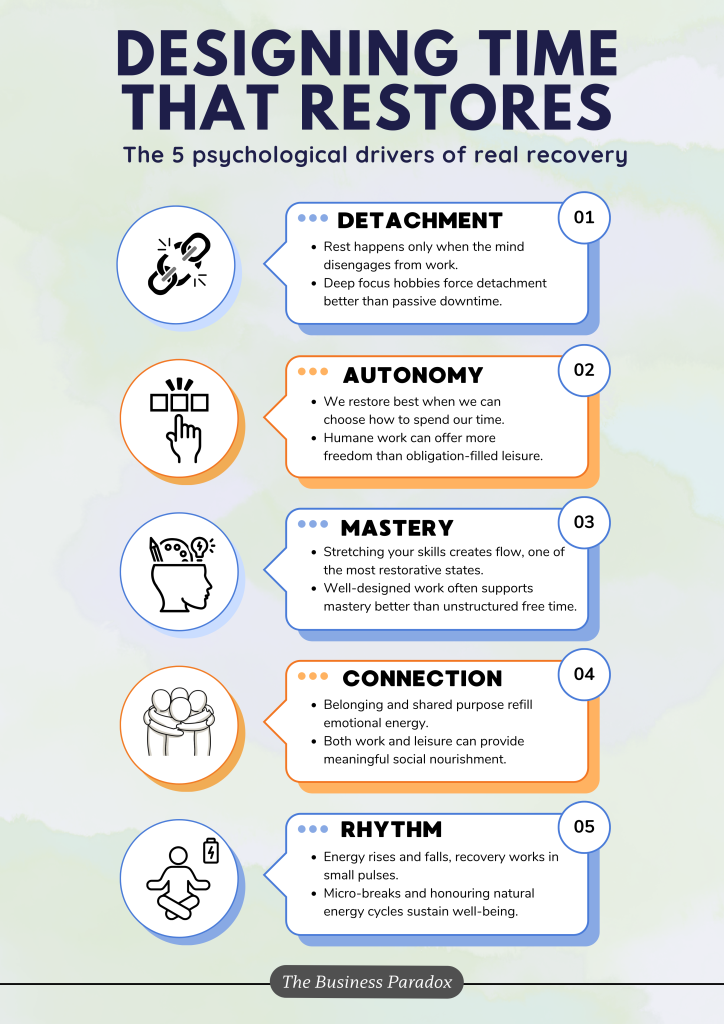
Time feels well spent not because of where we are, but because of what that time gives back to us. It must provide 5 core ingredients:
1. Mental Detachment: We rest when our minds truly switch off from work, not when our bodies simply stop moving. It is the ability to mentally disengage from the performance pressures and to stop preparing for what comes next. This is why a challenging hobby, like rock climbing or playing the piano, can be restorative. The high level of focus required forces detachment from work stress, whereas lounging leaves the mind free to wander back to the office.
2. Autonomy & Choice: We recover best when we feel in control of how we spend our time. When rest becomes something we have to do, it stops restoring us. When work is structured well and supports development, it can provide more agency than a weekend stuffed with plans you didn’t choose.
3. Mastery & Flow: Mastery is an underrated form of restoration. Humans recharge not only by resting, but by progressing. When we enter flow i.e., when we are fully engaged in a challenging task, our energy and focus increase. Structured work often provides better conditions for mastery than leisure with no direction.
4. Meaning & Connection: Feeling valued and connected refuels us, whether at work or at play. For example, a shared win at work or a meaningful conversation with a friend can refill our emotional reserves. We recharge best when we’re connected to people, not when we’re cut off from them.
5. Rhythm: Recovery depends on honouring our natural energy cycles and creating small pockets of renewal during the day, not from one big annual break. It emerges through oscillation: the ongoing movement between effort and recovery.
If you’re on holiday but you find yourself following rigid plans or thinking about work, you’re not resting. You’re just off the clock and still draining yourself. Conversely, a well-designed job that allows for focus, mastery, connection, and clear boundaries, can genuinely renew us. When we shift our attention from where we are to which needs are being met, we stop chasing leisure as a solution.
Why More Time Off Isn’t Fixing Our Burnout
Simply adding more time off rarely resolves burnout because recovery depends far more on how time is experienced than on how much of it we have. Our time off frequently fails to restore us because we trade one form of cognitive load for another: the residue of work for the stimulation overload of modern leisure.
Instead of actually switching off, our “free” time is quickly filled with social obligations, digital comparison, constant novelty, and the pressure to make every moment count. Even rest becomes something to optimise, schedule, and perform, until it’s just another task on the to-do list. This is the achievement trap in its most ironic form: we try to earn rest, then feel uneasy or guilty when we do nothing.
More time away from work will not help if that time lacks purpose, agency, or meaning. Recovery depends on specific psychological conditions that leisure alone doesn’t always provide. In fact, well‑designed work can offer these elements more consistently than unstructured time off. Work also gives us stabilising anchors we often overlook: structure, shared goals, social connection, and the satisfaction of progress. When time off removes these without replacing them, it can leave us feeling lost and aimless. Burnout, then, is not simply a shortage of leisure. It is a failure to design our time in ways that renew our energy.
What Changes When We Stop Managing Time and Start Managing Energy
To break out of this draining work‑vs‑leisure mindset, we need to move from managing time to intentionally managing our energy. It starts with a shift in perspective: work and leisure aren’t rivals. They are complementary forces in our restoration.
Managing our energy starts with asking better questions: What parts of my day do I control? What activities pull me in? What actually restores me? These questions help us design our days with intention. We begin to choose activities that offer purpose and a sense of fulfilment, whether they sit inside our job or outside it.
To stay energised, we need clear boundaries. We need a buffer around our time so work doesn’t bleed into rest. That means believing we can protect our hours, even when demands feel constant. At its core, energy design comes down to two steps:
1. Integrate recovery into work. We don’t have to wait for the weekends or holidays to recharge. We can build recovery into the day. Everyone has natural highs and lows in their day, i.e., times when they feel sharp and focused, and times when their brain feels more easily distracted. Instead of pushing against those rhythms, we can work with them:
- During high-energy windows, focus on deep work. This is the best time for problem-solving, creative thinking, and tasks that demand sustained attention and original thought.
- In mid-energy windows, shift to maintenance work. Handle routine tasks, admin, emails, and meetings that require responsiveness but not deep concentration.
- During low-energy windows, use this time for breaks, movement, simple tasks, or reflection.
2. Redefine leisure. Skip the mindless distractions that drain you. Choose things that spark your interest, use your skills, or connect you with others. Let the good energy from meaningful work carry into the rest of your life. When you stop comparing your downtime to others and start asking what feels “enough” for you, rest becomes restorative instead of performative.
Conclusion: A Better Way Forward
The false dichotomy between work and leisure has underpinned the achievement trap for far too long. It has taught us that the only way to recover from a life of constant doing is to escape into nothingness. Feeling restored isn’t about avoiding effort, it’s about doing things that offer choice, challenge, and a mental exit from the office.
This is why the language of “balance” often fails us. Balance assumes two opposing forces locked in tension. What humans actually need is rhythm: a sustained oscillation between intensity and recovery that exists both on and off the clock. Human energy is cyclical, hence, we need periods of deep engagement followed by intentional release.
At the individual level, the goal is not to escape work, but to build self-efficacy. To stop treating ourselves like batteries that run down and recharge, and start seeing ourselves as humans who thrive on meaningful effort and restorative rest. When we stop chasing leisure as a cure for exhaustion, we can begin the far more rewarding work of designing time that actually restores us.
Stay ahead with exclusive insights! Sign up for our mailing list and never miss an article. Be the first to discover inspiring stories, valuable insights and expert tips – straight to your inbox!