The Trap of Digital-Only Thinking
For years, many leaders believed that “going digital” meant replacing everything physical and moving as much of the business online as possible.

The idea seemed simple: swap the retail space with a website or app, the frontline staff with chatbots, and manual processes with automation. Digital transformation became a race toward speed, efficiency, and scale.
But somewhere along the way, many companies fell into the digital-only trap.
In the pursuit of convenience and automation, some businesses stripped away the things that made customers trust them in the first place: tactile experiences, human interaction, personalised support, and being able to experience something firsthand. Technology was added, yet the experience itself often felt more fragmented and less human.
At the same time, other companies resisted digital change altogether. They relied too heavily on traditional models, ignored changing customer expectations, and struggled to keep pace in an increasingly digital world.
The most successful companies today are not choosing one over the other. Rather, they have stopped treating “digital” and “physical” as competing forces. They are focusing on how the two can work together to create smoother experiences and more adaptable businesses. That is because people do not live in purely digital or physical worlds. They move fluidly between both every day and they expect businesses to do the same.
The future is not digital-only. It belongs to companies that can seamlessly weave digital and physical experiences together in ways that feel connected and intuitive.
Digital Replacement is Easy, but Digital Integration is Hard
The failure of most digital transformation efforts is not a lack of technology. Most companies already have cloud systems, Artificial Intelligence (AI) tools, and digital channels. Technology itself is rarely the limiting factor.
The real problem is the absence of integration.
Too often, companies add new platforms and features without connecting them. They launch apps that don’t improve customer journeys. They automate workflows that lock in broken processes. They invest in platforms without considering how employees actually work or how customers move between online and offline environments.
As a result, digital transformation becomes an endless cycle of implementation. A new platform is introduced. Teams are told to adopt AI‑powered analytics. A customer app is redesigned. The rollout takes months and training sessions are scheduled.
Yet, the same frustrations persist:
- Employees wrestle with poor user experiences and disconnected systems.
- Automation digitises inefficiencies instead of fixing them.
- Customers face fragmented experiences and their expectations go unmet.
This is where the distinction between replacement and integration matters.
- Digital replacement asks: How do we move this online?
- Digital integration asks: How do we use digital capabilities to make the overall experience more seamless and useful?
This mirrors the debate we explored in our previous article on the role of the office. The same logic applies here. The choice is not digital or physical. The essence of integration is designing digital and physical to amplify each other, rather than forcing a choice between them.
Digital transformation fails when technology is added without intention. The problem isn’t the tools themselves, it’s the way they are introduced and used. The technology is new, but the problems remain the same.
Lessons From IKEA
IKEA offers a powerful example of what digital integration looks like. IKEA did not succeed by abandoning physical retail, rather it succeeded by extending it. They redesigned their strategy to treat digital and physical as one. IKEA built a continuous “seamless journey” where a customer might discover a product on a phone, visualise it in their actual room using Augmented Reality (AR), and then head to a physical store to test it out and make the final purchase.
The company recognised that physical stores still had value. Customers wanted to see furniture in real spaces, they wanted to test comfort and understand dimensions. Physical environments created confidence and emotional connection in ways digital platforms alone could not.
At the same time, innovations like IKEA Kreativ allow customers to see how furniture would look in their own homes before buying. Instead of guessing whether a sofa would fit or whether a dining table matched the room, customers could visualise products in their own spaces. It solved a real customer problem that physical stores alone could not address.
IKEA proved that digital doesn’t replace the physical. By making online discovery seamless, they actually drove more customers into their stores. Online tools made shopping easier, but stores remained the place for design and service. The two channels actively reinforce each other rather than compete. The result was a business where technology supported efficiency, and people delivered creativity and trust.
IKEA’s digital strategy worked because it was intentional. They digitised to make it easier for people to design and furnish their homes. For any leader, the goal is the same: use digital to remove friction and physical to build connection. IKEA demonstrates that digital transformation is not about shifting away from physical retail, but designing both layers to work as one connected ecosystem.
What Successful Integration Looks Like
Success comes from designing connected experiences where digital tools support how people work, interact, and move between physical and digital environments. It’s not about adding more digital channels, but removing friction so customers feel continuity.
When systems aren’t connected, frustration appears: customers repeating information and restarting processes while employees switch between disconnected tools. Successful organisations close those gaps by linking data, teams, and touchpoints so information flows smoothly. More importantly, they use technology to enhance human interactions, giving people the context to serve with empathy and trust. Integration also builds agility as connected systems let organisations adapt faster, respond to change, and make better decisions in real time.
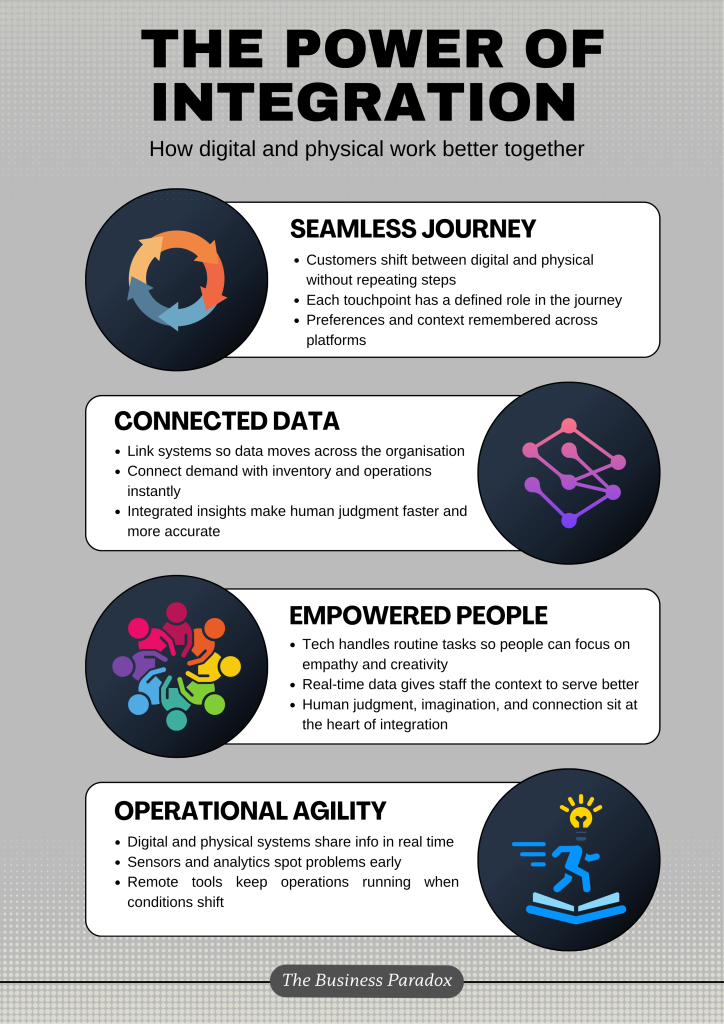
The goal is not to replace the physical experience. The goal is to improve it.
How This Works in Different Sectors
The same pattern is emerging across almost every industry:
In healthcare, technology isn’t replacing doctors. Telehealth handles routine check-ins, freeing up in-person time for complex exams. Digital records ensure every specialist has the same information, while remote monitoring lets clinicians catch problems earlier, strengthening the bond between patient and provider.
In education, digital tools haven’t ended the need for physical classrooms. Instead, they provide flexibility. Students access materials and collaborate online, allowing their time on campus to be spent on what matters most: mentorship, deep discussion, and community.
In banking, mobile apps have taken the “chore” out of transactions. This shift allows human advisors to step away from paperwork and focus on what they do best which is helping clients navigate complex financial decisions.
Across different sectors, the lesson is the same: digital tools are most powerful when they reduce friction and amplify human value. Technology is not a replacement for people or physical experiences. Integration is not about being “more digital” but how technology is used to improve experiences, strengthen relationships and create agility.
How to Blend The Digital and Physical
The organisations that integrate technology well consider how people actually live and make decisions. They blend digital convenience with physical depth, so the experience feels like one connected system rather than two separate worlds.
1. Design around real journeys: Instead of rolling out one-size-fits-all systems, design tools around specific customer and operational journeys. This means understanding how people actually move between the digital and physical, so that integration is shaped by real needs, environments, and behaviours.
2. Keep systems simple to use: The best digital tools reduce effort rather than add complexity. Instead of overwhelming users with features, focus on removing friction and making everyday tasks easier.
3. Strengthen human interactions with technology: The best digital systems equip employees to perform better with real-time insights and full customer histories. This allows them to spend less time searching for information and more time solving problems and building relationships.
4. Embed digital into culture: Adjust roles, workflows, and decision-making to match the speed and flexibility that digital enables. When digital tools are woven into how teams think and operate, integration becomes natural.
Launching an app is not transformation. Using AI is not transformation. Automating a workflow is not transformation. At the heart of successful integration is a simple mindset shift: digital and physical has to be designed together. This is how technology becomes part of how the organisation operates and delivers value.
Conclusion: Designing Digital With Purpose
Companies succeed at digital transformation when they deliberately design the relationship between both physical and digital. They use digital tools to make physical experiences more valuable and difficult for competitors to replicate. IKEA didn’t ask how to digitise the store. It asked how digital tools could elevate the physical journey, by enhancing personalisation, convenience, and competitive edge.
This principle applies across every sector, whether it’s a hospital integrating patient records, a university blending classrooms with online learning platforms, a bank combining mobile convenience with human advice. All these examples prove that integration is not about replacing what exists, but about elevating it.
Digital transformation is not about purchasing new technology for the sake of appearing modern and innovative. It is about using technology to amplify what makes the business valuable in the first place.
Stay ahead with exclusive insights! Sign up for our mailing list and never miss an article. Be the first to discover inspiring stories, valuable insights and expert tips – straight to your inbox!