Why Staying Relevant Feels Harder Than Ever

We keep hearing that we need to upskill. Learn this tool. Take that course. Master this platform. But somewhere along the way, upskilling stopped feeling like progress and started feeling like pressure. Like a race with no finish line, fighting against an opponent that never slows down. The honest question no one is asking loudly enough is this: if we’re all doing the “right” things and still feel like we’re falling behind, are we solving the right problem?
The shelf life of professional skills is shrinking faster than most organisations can respond. Artificial intelligence and other emerging technologies are transforming how work gets done, at a pace that outstrips individual adaptation and institutional planning alike. Job roles are shifting. Competency benchmarks keep moving. And the pressure to keep up has become a permanent condition of modern work.
Staying relevant isn’t simply a matter of learning faster. The real challenge is understanding what actually needs to change and why the standard playbook is no longer enough.
Beyond the Old Playbook
For years, the response to technological disruption seemed straightforward: learn to code, master analytics, collect credentials. That model assumed a stable enough target: acquire a skill, apply it, stay relevant. Today, the target moves faster than most people can manage. By the time a tool is mastered, it has often been automated or superseded, and the market has already moved on to demand something else.
This is the upskilling trap: a cycle of continuous investment with diminishing returns on relevance. Workers do everything they’re told and still feel exposed. Leaders invest in training programmes and still face capability gaps. The problem isn’t effort. It’s that most upskilling is still optimised for technical fluency in a landscape that increasingly rewards something harder to teach.
Automation has crossed a threshold where it is no longer confined to physical labour but is moving into routine cognitive work. Tasks that once defined professional careers such as data analysis and operational reporting, are increasingly delegated to algorithms and systems. This represents a fundamental shift in what human work actually is: from doing, the execution of repeatable functions, to deciding, the exercise of judgment that machines cannot replicate. As automation absorbs the functional how, human value migrates toward the strategic and ethical why.
That sounds like opportunity. But it also creates a disorienting gap and it doesn’t close itself.
The Hidden Inequality in Upskilling
The conversation about upskilling assumes a level playing field. But it doesn’t exist.
Access to continuous learning favours those who already have stable employment, strong digital foundations, and the time to invest beyond their existing workload. Training programmes, by design or default, tend to advance those who are already ahead, reinforcing a cycle where the prepared keep accelerating and those without a strong starting point fall further behind.
The barriers compound. People managing multiple jobs or caregiving responsibilities simply don’t have the bandwidth for continuous learning that comes naturally to those in secure roles. Older workers are routinely overlooked in upskilling initiatives. Women continue to encounter structural barriers in industries shaped by norms that predate the digital era. Hiring practices that define “tech-savvy” too narrowly screen out capable people before they gain the experience that would make them competitive.
This matters beyond fairness. Organisations drawing digital capability from an increasingly narrow pool are making themselves fragile. Societies that treat upskilling as a privilege for the already-prepared aren’t solving the problem of relevance, they’re concentrating it. And leaders who don’t see this dynamic playing out on their own teams are already behind.
Assessing Your Strategic Position
Most professionals assume they are further along than they are. The framework below maps relevance across the two dimensions that will define professional durability in an automated world: technical fluency and ethical judgment, and shows where most people, and most upskilling programmes, currently sit.
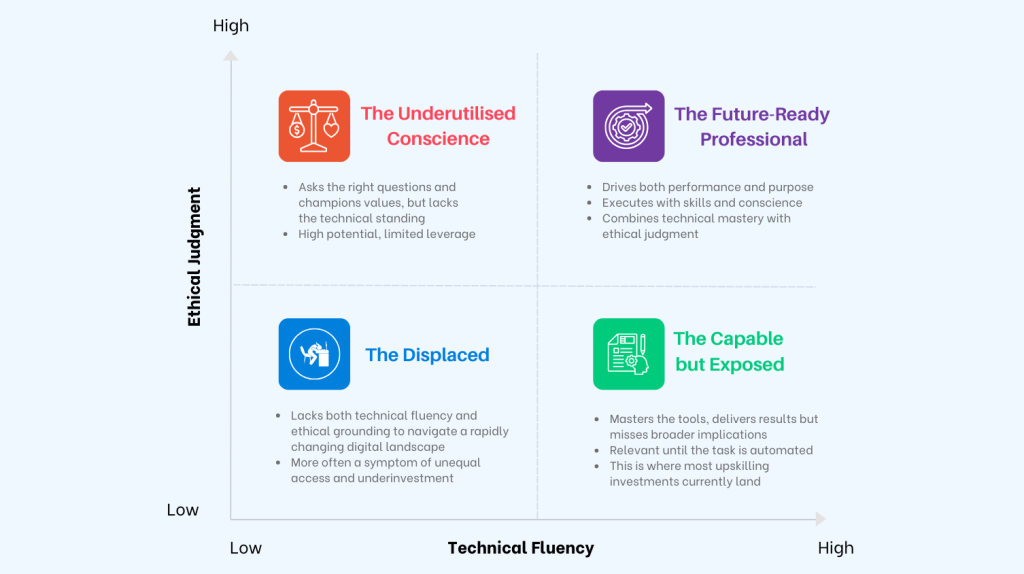
The goal is the top right because it is the one where both dimensions compound each other. Technical fluency without ethical judgment produces capability without conscience. Ethical judgment without technical fluency produces conviction without influence. Only when both are present together does a professional become genuinely difficult to replace.
The quadrant you occupy today is not fixed. But getting to the right place requires knowing where you actually are.
The Skills That Actually Extend Your Shelf Life
So what does future-proofing look like? It is not the accumulation of credentials, and not simply keeping pace with the latest interface. The shift required is more about how you learn, question, and lead.
1. Develop the Capacity to Unlearn. The professionals who will remain relevant are not those who accumulate the most tools, but those who can let go of outdated assumptions. Cognitive agility (i.e., the ability to reframe, adapt, and operate comfortably in ambiguity) is now a core professional competency. This means being willing to change your mind and adapt when new information arises.
2. Build Digital Reflection Skills. Digital fluency (i.e., knowing how to use tools) is the baseline. What extends your shelf life is the layer above it: understanding what a system assumes, who it was built for, and what it gets wrong. The professionals who matter most will be those who engage with the tools honestly and critically, asking not just how does this work but what does this cost.
3. Treat Ethical Judgment as a Skill. Machines can do more than ever, but they cannot choose what is right. AI systems reflect the inputs, assumptions, and priorities of the humans who build them, amplifying both our best intentions and our worst biases. The ethical weight of every decision about which technologies to deploy, on whom, and to what end, rests entirely with humans. For individuals, this means developing the habit of asking should we, not just can we. For leaders, it means building cultures where that question is treated as rigour, not friction.
4. For Leaders: Examine the Environment, Not Just the Individual. Upskilling initiatives that focus entirely on the individual while leaving organisational structures untouched are treating the symptom. Employees stuck navigating outdated approval chains and legacy workflows are quietly losing market relevance regardless of what training they complete. Where someone works doesn’t just shape what they do, it determines how long what they know stays valuable. The leaders who will build the most lasting organisations are those who commit to continuous renewal.
Conclusion: The Mindset Shift That Ties It Together
The pressure to constantly upskill has become the defining demand of modern work. Yet even when we collect new credentials and master new tools, something deeper remains at stake: our ability to preserve what makes us irreplaceably human.
Extending your digital shelf life is not about hoarding skills or outpacing machines. It is about depth. The depth of understanding that lets you engage with new systems critically, the depth of judgment that lets you make calls machines cannot, and the depth of responsibility that ensures the future being built by these tools is one worth inhabiting.
That demands a shift in mindset: from how fast can we do this to should we do this at all. From treating technology as a neutral tool to recognising it as a mirror of our choices, our biases, and our values.
In the age of intelligent systems, the most durable professionals won’t be those who kept up the fastest. They’ll be those who never stopped asking the right questions.
Stay ahead with exclusive insights! Sign up for our mailing list and never miss an article. Be the first to discover inspiring stories, valuable insights and expert tips – straight to your inbox!