The Business Pre‑Nup vs. The Business Divorce
In our previous article, we discussed the importance of a shareholders’ agreement as the “business pre-nup” i.e., setting ground rules for managing a business together as co-owners. But what happens when someone decides to leave the partnership? Every business partnership has two chapters: coming together and parting ways. The Sale & Purchase Agreement (SPA) governs the second.
If the shareholders’ agreement is the “pre-nup”, then the SPA is the divorce agreement drafted before the wedding. One party exits and the SPA decides who keeps what, how the price is paid, and who bears responsibility if any surprises come up later.
For example, Party A and Party B have been business partners for years. Now, Party A is ready to move on to pursue a new venture. Party B wants to continue running the business and is willing to buy over Party A’s shares. In theory, it should be simple: one partner leaves, the other stays. However, without clear terms guiding the exit, what starts as goodwill can easily unravel into disagreement and aligned partners can drift into contradictory expectations.
Party B believes certain assets are included while Party A assumes some liabilities will stay with the company. As Party A and Party B learn, what starts as a friendly business sale can become complicated when hidden details emerge. Initial discussions about selling the business are warm and optimistic, but deeper questions soon emerge: What assets are included? What liabilities follow? What happens to staff or ongoing contracts? Suddenly, what seemed like a smooth deal can turn into an expensive fallout. Without a SPA, the separation becomes emotional and costly.
This is why a SPA exists: to make the business breakup fair and fully understood before anyone walks away.
Sale and Purchase Agreement: What They Cover and Why You Need One
A SPA is more than a piece of paperwork, it is the legal backbone of any business sale or acquisition. At its core, it provides a structured, enforceable framework that protects both buyer and seller. It eliminates ambiguity by spelling out what is being transferred, e.g., shares, assets, intellectual property, contracts, or even staff obligations. It establishes each party’s rights and obligations with clarity, preventing misunderstandings about assets, liabilities, staff, contracts, or financial expectations.
A SPA defines exactly what is being bought and sold, identifies the parties involved, and sets out the agreed price, payment terms, and any adjustments. It explains how and when payments will be made, whether installments or earn‑outs apply, and how adjustments might occur if the company’s financial position changes before completion. This level of precision ensures that both sides know what to expect, thereby reducing the risk of disputes over valuation or timing.
It protects both sides through representations, warranties, indemnities, and default provisions, giving recourse if a party breaches the agreement or if hidden issues arise. For example, the seller may warrant that the company has no undisclosed debts or pending lawsuits. This allocation of risk is critical: it ensures that hidden problems don’t derail the deal or unfairly burden one party.
The SPA embeds dispute-resolution mechanisms (mediation, arbitration, or litigation) so conflicts can be managed efficiently without affecting relationships and business continuity. It also extends into the post‑completion phase, defining responsibilities that continue after the deal closes. This could involve transitional support from the seller or non‑compete clauses to protect the buyer’s investment. These provisions provide continuity and reassurance, helping the business move smoothly into its new ownership.
In sum, a well-drafted SPA is the safety net for business transactions. It provides the structure, legal certainty, and fairness necessary to complete a smooth and secure business exit or acquisition. It transforms what could be a risky and emotional process into a clear, enforceable, and professionally managed transaction.
What Buyers and Sellers Risk Without a SPA
Without a SPA, both buyers and sellers are left exposed to serious financial, operational, and legal risks.
For buyers, the absence of clear documentation means they could unknowingly inherit hidden debts or liabilities, face disputes over which assets are included, or encounter confusion around employee transfers, customer relationships, and ongoing contracts. These uncertainties can disrupt operations, damage goodwill, and create legal complications, turning what seemed like a profitable acquisition into a costly burden.
Meanwhile, sellers remain vulnerable to claims long after the sale if warranties or liabilities are not clearly limited. They also risk non-payment or default without defined payment schedules or enforcement mechanisms. Without structured dispute resolution, conflicts can escalate into lengthy and expensive litigation, and sellers may face claims for defects, misrepresentations, or breaches months or even years after completion.
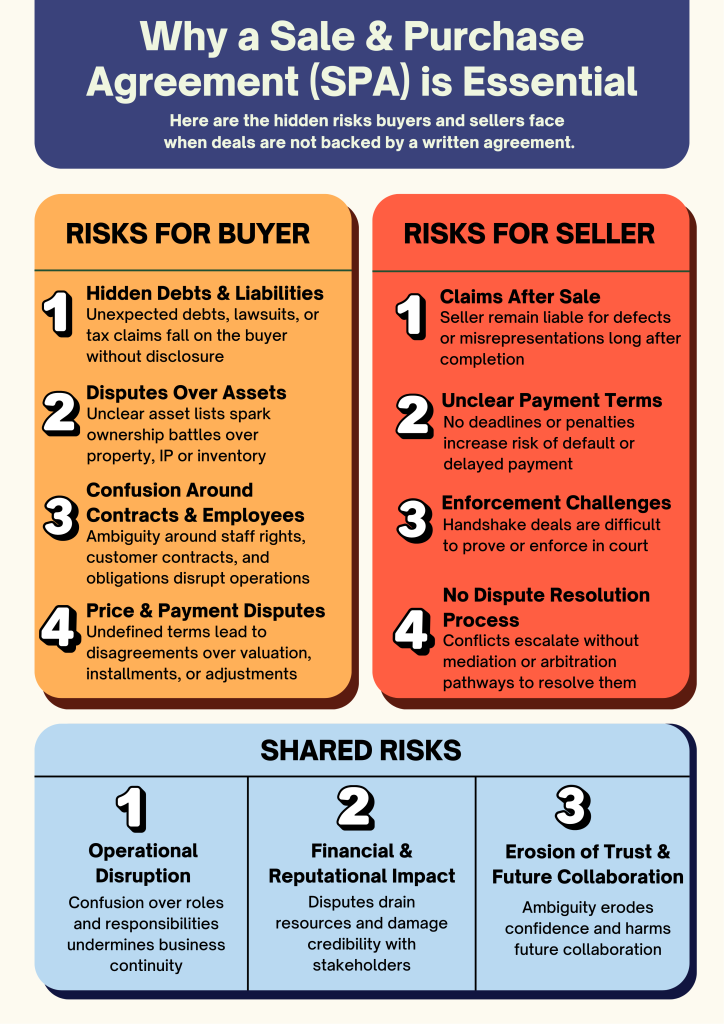
In short, the absence of a SPA creates ambiguity at every stage of the transaction, opening the door to financial loss, legal exposure, and costly disputes for both parties.
Conclusion: The Business Divorce Settlement You Can’t Afford To Skip
No one enters a partnership expecting it to end, just as no one gets married anticipating a divorce. Yet in business, circumstances inevitably change: priorities shift, new liabilities arise, or one partner may decide to move on. Having a SPA doesn’t signal distrust, rather, it demonstrates foresight, professionalism, and careful planning. In many ways, a SPA functions like a pre-negotiated business divorce. By clearly defining what happens if a partner exits, it protects both sides, establishes responsibilities, and minimises the risk of disputes. It’s about safeguarding the business and preserving the relationship, allowing partners to move forward confidently.
Putting every detail in writing provides certainty, ensuring that the transaction proceeds as smoothly and orderly as possible, much like a well-planned exit in any partnership. Ultimately, a well-drafted SPA transforms a verbal understanding into a transparent agreement, protecting both financial and operational interests. In the world of business, clarity and certainty are priceless. A SPA is the safeguard you cannot afford to skip, because you never know what the future may bring.
Stay ahead with exclusive insights! Sign up for our mailing list and never miss an article. Be the first to discover inspiring stories, valuable insights and expert tips – straight to your inbox!